United States of America
OzymandiasThe United States of America is the expedition’s operative national identity and the source of its military priorities. The crew may travel among distant worlds under the broad language of exploration, but the mission is funded and judged through American strategic interests: archaeology is tolerated within an undertaking designed chiefly to secure weapons and materials before a rival power can do so.
National Identity and the Expedition
The expedition’s charter assigns it to investigate worlds near the Galactic Rim that an earlier survey had passed over while looking only for life. Its two branches have sharply different purposes. Dr. Leopold’s archaeologists are to study extinct civilizations; Colonel Mattern’s military personnel search for fissionable substances, alien weapons, and materials such as lithium or tritium that could serve fusion technology. The archaeological group is acknowledged as having little direct empirical value to national security, but it is included because American public opinion has come to frown on purely military expeditions.
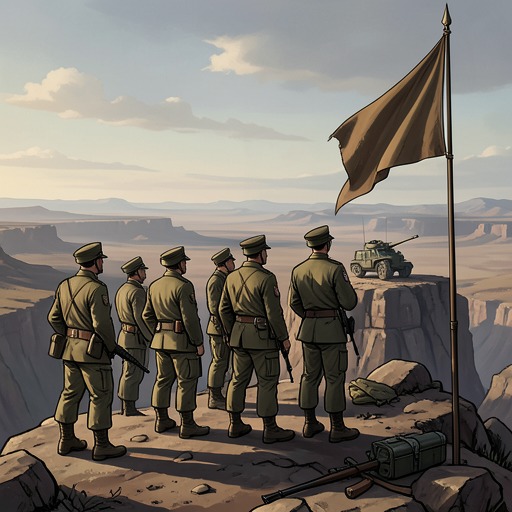
That compromise does not make the mission politically neutral. The narrator stresses that the crew is not, in practice, representing a unified Earth: it is American, while the Other Hemisphere remains a possible competitor in space. With tensions rising again on a divided planet, the possibility that the rival might return to space turns the search for ancient technology into an armaments race. The expedition’s scientific and military halves therefore share a ship and a charter, but not an equal claim on its purpose.
Funding, Authority, and Competing Claims
The General Staff of the Armed Forces of the United States of America provides 70 percent of the expedition’s budget and expects practical results in the form of weapons and strategic resources. That investment explains Mattern’s impatience when the first world appears lifeless and barren: he sees no reason to spend time on archaeological work if the planet offers nothing useful to his employers. Yet military funding does not give him an unrestricted voice. The military’s Public Liaison branch has secured rights for Leopold’s group, allowing the archaeologists to invoke a limiting clause and insist on time for research.
The arrangement establishes both the protection and the fragility of civilian inquiry. The archaeologists can claim a temporary space within a mission dominated by military expenditure, but their authority depends on expedition rules rather than control of the budget or the ultimate purpose. When Ozymandias is identified as a source of military information, Mattern invokes security, declares the expedition ended, and orders the crew back to Earth with the robot. The funding structure thus becomes a structure of possession: the institution that pays for the mission can ultimately recast its archaeological discovery as a national strategic asset.
Ozymandias and the Military Reframing of Knowledge
The discovery initially seems to justify the archaeologists’ presence. After excavation yields no artifacts beyond worn building foundations, Ozymandias proves to be an exceptionally durable guide to the vanished civilization. Leopold recognizes him as an archaeological treasure, and the robot’s ability to learn English opens access to an immense store of historical information. For the researchers, the machine can preserve knowledge that the ruined cities and the surrounding landscape no longer provide.
Mattern gives the same discovery a different meaning. He claims that Ozymandias contains detailed knowledge of ancient Thaiquen weapons, including the superweapon that explains the planet’s lifeless condition. In his account, the robot’s historical memory is also a military archive, and its information might make America impregnable. The claim changes the contest from a dispute over research time into a struggle over custody: Leopold calls Ozymandias an archaeological preserve, while Mattern declares him a security resource belonging to the military. The story leaves the robot’s knowledge at the point where historical understanding and strategic exploitation become inseparable.
Political Significance
The United States of America is not merely the expedition’s point of departure; its divided institutions and rivalry with the Other Hemisphere determine the value assigned to the discovery. The archaeologists’ work is admitted as a concession to public conscience, while military use supplies the mission’s underlying measure of success. Once ancient knowledge can be translated into weaponry, the balance shifts decisively toward the military branch, and the archaeologists cannot prevent the removal of their find.
This national frame sharpens the irony of the expedition. The crew reaches a world whose civilization has vanished, and the most important surviving record may reveal how that world was destroyed. Yet the first institutional response to the record is not simply to preserve or understand it: Mattern argues for its strategic value and takes control of it. The American mission therefore encounters the ruins both as evidence of a past civilization and as a potential resource in Earth’s continuing conflict.