Earth
OzymandiasEarth is the distant home of the expedition to Planet Four, but it is not a unified world: renewed tension between America and the Other Hemisphere makes interstellar exploration an extension of terrestrial rivalry. The barren planet’s remains—and the ancient knowledge preserved by Ozymandias—bring that rivalry into direct conflict with archaeology, exposing how Earth’s divisions determine what its explorers seek and who may claim what they find.
A Divided World Behind the Expedition
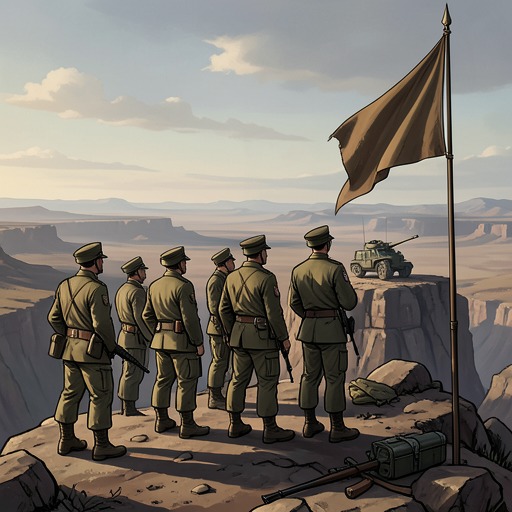
The expedition’s outward destination is an alien world, yet its political frame is specifically terrestrial. The narrator observes that the crew comes from America, not from Earth in any unified political sense; global unity remains a fantasy even in the far-future age of space travel. That distinction undercuts the customary idea of exploration as a shared human undertaking: the ship carries national interests into space.
The division is active rather than merely historical. Tension is mounting again, and the Other Hemisphere, after a century of quiescence, might resume its own space program. The possibility that the rival power could reach valuable discoveries first makes the expedition a race for advantage. The Other Hemisphere is not present on Planet Four, but its anticipated actions help govern the crew’s priorities there.
The Military Purpose of Exploration
The military half of the expedition has institutional authority because the General Staff of the Armed Forces of the United States of America supplied most of its budget. Its expectations are practical and strategic: new weapons and sources of materials, rather than the recovery of knowledge for its own sake. The five archaeologists were included in part to answer public resistance to expeditions devoted solely to military purposes, but the arrangement leaves them politically marginal.
The conflict is therefore built into the expedition’s structure. Colonel Mattern regards his military personnel as the consequential members and the archaeologists as ballast; the narrator acknowledges that, under the mission’s actual priorities, this judgment has force. The crew’s work on a world with no obvious resources or surviving artifacts initially seems to frustrate the military mandate. Yet that assessment changes when Ozymandias proves to hold an immense record of Thaiquen civilization.
The narrator frames this arrangement as an arms race rather than neutral exploration. The search for military advantage has followed the explorers beyond Earth, and the apparent distance from terrestrial politics does not free the expedition from them. Instead, the expedition’s institutional sponsor defines what counts as a result and who has the power to act on it.
Planet Four and Earth’s Competing Claims
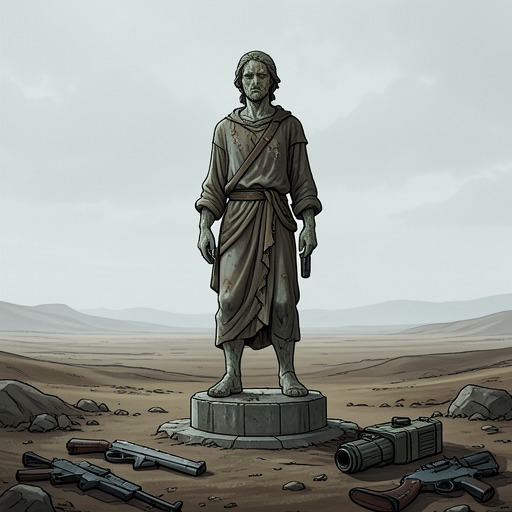
At first, the nearly lifeless surface seems to offer little to either side of the expedition’s internal dispute. The crew finds only weathered building foundations, with no artifacts or human remains; time and environmental erosion have erased almost everything. Those observations support the archaeologists’ limited conclusion that a civilization once existed, but cannot by themselves recover its laws, technology, or history.
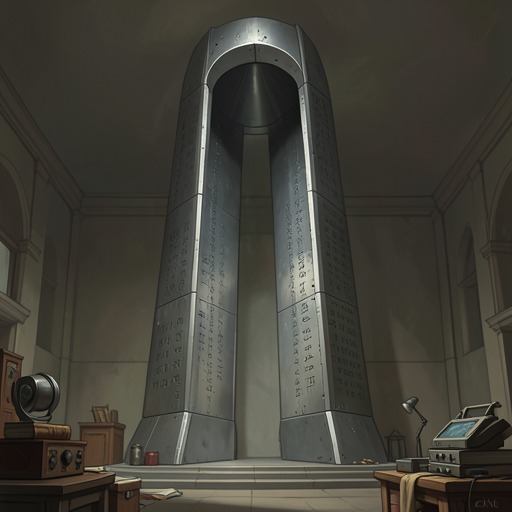
Ozymandias overturns that scarcity. The robot, constructed by the Thaiquens as a guide to their cities, can converse in English after absorbing the explorers’ words and can recount a civilization that endured for three hundred thousand years. Its information includes the scale of Durab, the history of the Eleventh Dynasty, and the contents of a library whose fourteen million volumes have vanished from the site but remain in the robot’s memory. For the archaeologists, this is a cultural archive of effectively inexhaustible scope; for the military, it is also a possible source of weapons knowledge.
That difference in valuation becomes a struggle over control. Dr. Leopold asks that the robot be kept within the archaeological group’s preserve, fearing that military experiments could damage its memory. Mattern instead declares the expedition ended, has Ozymandias secured aboard the ship, and orders an immediate return to Earth. He argues that the robot knows details of Thaiquen weapons, including a superweapon that could explain the planet’s absence of life. The barren world is thus read not only as an archaeological site but as evidence of the catastrophic consequences of military technology; Mattern’s explanation is consequential, though it is presented as his inference from the devastation and the information he says the robot contains.
Earth as the Destination and the Stakes
The order to return Ozymandias to Earth gives the home world a double meaning. It is the expedition’s point of origin and the political system that has financed the search, but it is also where the recovered knowledge may be put to strategic use. Mattern claims the robot for the military because its information could make America impregnable against the Other Hemisphere. His decision makes plain that the expedition’s institutional priorities outweigh the archaeologists’ claim to safeguard the archive.
Earth’s divisions therefore shape the meaning of the discovery even though the planet itself is never the expedition’s setting. The explorers’ first encounter with a dead civilization might have become an inquiry into a vanished culture; under the pressure of terrestrial rivalry, its surviving memory is recast as a military asset. The contrast is stark: the Thaiquens’ cities and population have disappeared, while their indestructible guide preserves both their history and the knowledge that may tempt another divided world to repeat their weapons race.