Atevi
PeacemakerAtevi are the people at the center of the mainland’s political and cultural order, a society organized through overlapping clans, guilds, and associations rather than a single undifferentiated population. Their history with humans moves from wary first contact to war and negotiated coexistence, while the novel’s smaller encounters show how loyalty, fairness, and friendship can cross the boundary between the two peoples without making their differences disappear.
Identity and social order
Atevi affiliations shape both local life and national politics. Clans and regional associations can defend their own interests, while guilds provide another powerful basis for belonging. The guilds’ presence in Shejidan, separate from the clan structure, strengthened the authority of the aiji: lords seeking the work of scholars, merchants, treasurers, physicians, or assassins had to deal with people whose primary man’chi was to their guild and the aiji. The resulting order does not erase local loyalties. It places them in continuing negotiation with a broader political system.
The Assassins’ Guild’s stated neutrality is especially important because its authority depends on its role as an enforcer of law and keeper of peace. During the political crisis surrounding Murini, the Missing, senior Guild members operating outside the Council’s reach, distrusted the appearance of dependence on Cenedi because he belonged to the Eastern Guild. They also objected to unFiled attacks on civilians, violations of Guild rules, and the Council’s refusal to bring charges in cases including Haikuti’s. Their account shows that institutional legitimacy rests not simply on force, but on whether the Guild observes its own standards across political disputes.
The crisis also exposed earlier choices that the Missing reconsidered. They had supported Shishogi’s demands and rejected computers as a gift from humans; later, they judged that decision a serious mistake. They reconstructed how appointments to particular offices had helped set up the coup that installed Murini, and knew that Haikuti had been involved in the attack on the aiji at Taiben. Their knowledge was consequential but initially not absolute: the Guild’s files concealed Haikuti’s records, and the information they had gathered did not yet amount to proof. Atevi political knowledge here is painstakingly assembled through records, sources, and verification, even when the consequences of delay are dangerous.
Contact with humans
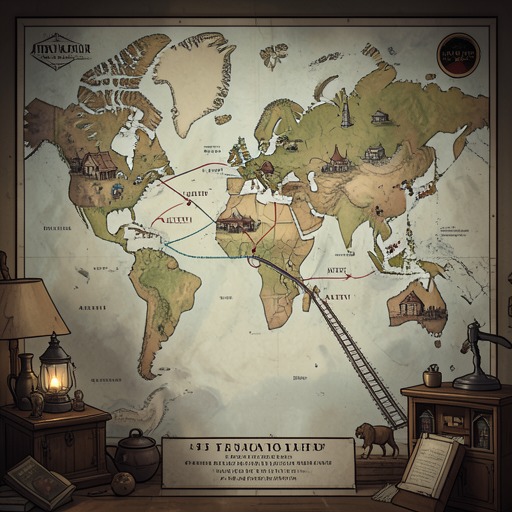
The novel’s retrospective account of the Foreign Star gives first contact a scale and texture different from the later political crises. In Lord Paseni’s history, humans descended to Earth over three years, sometimes in large groups, arriving beneath petal sails. Some landed on Mospheira, among the Edi and Gan peoples; others came down near Dur on the mainland, while some were lost at sea. Their small size, fragile bones, unfamiliar arrival, and limited possessions made them objects of curiosity, and their courage earned admiration. They dismantled their landing containers for materials and used the sails as shelter. Atevi also learned that humans could eat only plain, simple foods, since other food sometimes killed them.
The account describes contact as a process of mutual accommodation rather than instant understanding. Atevi learned a few human words, fed the newcomers, helped them make better shelter, and assisted them in finding scattered associates. At the same time, each people was shocked or distressed by the other’s manners. The narrative does not make either side’s customs a neutral measure of the other: the first encounters reveal reciprocal judgment, practical dependence, and the gradual work of learning how to communicate.
Loyalty and cross-cultural friendship
Cajeiri’s reunion with Gene, Irene, and Artur gives personal form to that history of contact. As a child, Cajeiri had first met them in the ship’s corridors, when the human children were among the first children he had ever seen. A year later, he deliberately restaged that meeting: he touched his chest, introduced himself again, and named his friends in turn. The exchange made their bond a public fact, witnessed by Madam Saidin, Master Kusha, his valets, and other adults. Cajeiri affirmed both that they were friends and that he could give them birthday gifts according to Atevi custom.
His gestures also addressed the material inequality the children had experienced. On the ship, Reunioners could not work, and their allotted food depended on calculations of age, sex, and height; if they were hungry, they could not obtain more. Cajeiri had brought his companions sweets, sausages, and bread from his mother’s kitchen. In welcoming them into his home, he insisted that this was not the ship: there were no such numbers, and they needed clothes. His generosity is shown not as an abstract virtue but as a response to what he remembered about their constrained circumstances.
That childhood bond later becomes a public political question. An older Atevi lord asks whether humans can truly feel man’chi. Bren answers patiently that humans do feel loyalty and explains that Cajeiri’s companions had met him during the dangerous displacement from their home to the station. Cajeiri had been their comfort in a harsh, unfamiliar existence; his generosity, curiosity, and kindness had attached them strongly to him, and a year apart had not diminished that attachment. Though the three human children were older than Cajeiri, they followed his lead. The exchange does not settle every difference in how the two peoples understand loyalty. It does show Atevi listeners considering human attachment seriously, and Bren placing the children’s relationship within a wider community of Atevi and human caretakers concerned for their character.
Conflict, union, and political change
Atevi political order is also presented as something built through conflict and realignment. The old division between north and south, and between local security and assignment across clan lines, remains visible in Bren’s conversation with Lord Topari of the Cismontane Association. Bren recognizes the legitimacy of districts protecting their own interests and notes that the aiji’s maternal clan had only recently made peace with the Atageini after two hundred years of warfare. He presents the Assassins’ Guild’s return to its former leadership as grounds for renewed confidence after Murini had displaced it, while acknowledging that dissent from the aiji’s administration would not be silenced. The political union is therefore neither uniform nor complete: trust must be rebuilt, and local reservations remain part of public life.
The history of the War of the Landing makes the costs of failing to manage competing loyalties still clearer. Geigi’s account says that Atevi had been pushed beyond their limit before they finally resisted the threat posed by human managers and a large load of weapons. The response moved through existing institutions: clans, guilds, and associations reacted, coastal associations joined in, and the aiji in Shejidan asserted leadership. That leadership brought the remaining western clans into the aishidi’tat and eventually incorporated the Marid as well.
The aiji’s strategy was to contain the conflict by pushing humans off the continent and onto Mospheira, where most humans already lived. The Edi and Gan, who had first encountered the newcomers, were not part of the aishidi’tat and did not share Ragi customs; they continued attacking humans on their own, with disastrous results. The aiji offered the tribal peoples refuge in two small areas of the west coast, where they could continue their fishing livelihoods. With the island serving as a safer retreat for human non-combatants, the mainland conflict could be narrowed to more aggressive forces and contained in isolated pockets. The war ended with mainland humans cut off from supplies and from a route back to the station. They were offered a choice between extermination and a way out: they could own Mospheira, but only after surrendering their weapons to be sunk at sea.
Taken together, these accounts resist a portrait of Atevi as either a single political will or a people defined only by conflict with humans. Their institutions can aggregate different interests into a broader union, but local affiliations and mistrust remain active forces. Likewise, cross-cultural friendship is possible without making the peoples interchangeable: Cajeiri’s bond with the Reunioner children grows from a particular shared history, while Atevi political life continues to reckon with the consequences of human arrival, war, and coexistence.