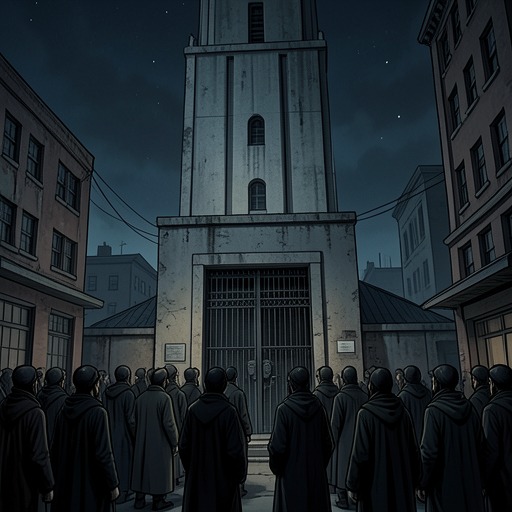
Post-coup crisis of the Assassins’ Guild
PeacemakerThe Post-coup crisis of the Assassins’ Guild exposes a fracture at the heart of an institution built to protect law across clan and regional boundaries. After Murini’s coup, the sitting Guild Council was accused of advancing compromised assignments, failing to uphold neutrality, and obstructing the return of senior members who could challenge its authority. The crisis was not simply a contest for leadership: it tested whether the Guild could prove its own misconduct under law and recover legitimacy without making itself an instrument of political decree.
Institutional inheritance
The Guild’s position in the Aishidi’tat arose from a history of cooperation across divisions. Before the Foreign Star appeared, eleven regional associations agreed to build a railroad from Shejidan westward. As the project continued, guilds such as the Transportation Guild and Builders began to exceed both clan and regional boundaries. The railroad depended on appointed leaders who could secure passage through districts and uphold agreements among clan lords; the emerging Assassins’ Guild protected those leaders from attacks by assassins serving individual lords.
That founding role developed into a distinctive balance of authority and restraint. The Guild backed an aiji who insisted that three powerful lords honor their railroad agreement, helping preserve an undertaking that benefited even the clans that collected no tolls. In the later organization of the Aishidi’tat, guild membership and assignments were to depend on qualification rather than clan or kinship. The Assassins’ Guild also accepted a prohibition on its members holding political office, in exchange for statutory protections against political interference in its records and internal proceedings. Its independence was therefore tied to a duty: neutrality was not incidental to Guild power, but a condition of its legitimacy.
The post-coup fracture
The coup unsettled that arrangement. Some senior Guild members went underground; some people officially listed as dead were alive, and some senior figures claimed retirement. Among those who had helped restore Tabini was a group that, after the coup, resisted repeated calls from the current leadership to return to duty. Their refusal had become a prolonged conflict of wills. They had seen the Guild purge itself twice and did not trust its present direction.
The sitting Guild Council had three leading figures. One was described as compliant with the other two, whose conduct the returning members questioned. The two pushed through Office of Assignments recommendations so quickly that debate was effectively excluded, including appointments of chief officers in Dojisigin Marid. During trouble in the west, they were slow to move Guild forces; Tabini ultimately took the field himself, since his presence could bypass the delay involved in querying the Council.
The Council’s conduct also deepened the breach with the retirees. When assistance was sought for Tabini’s action in the south, the Guild instead dispatched a mission to arrest the two senior retirees. The prolonged operation ended with a unit dead and the retirees officially outlawed. The outlawry had little practical reach where they were located, but it created a record that the Shadow Guild might later use to justify action against them. The Missing continued to reject Council orders, yet remained in contact with Jago and Cenedi. Because Cenedi belonged to the Eastern Guild, the retirees would not deal with him on this matter; Jago’s group used Bren’s name in a coded request for a boat to Najida and had made direct contact with them in the lower corridors.
Neutrality, evidence, and authority
The retirees’ objection was grounded in the Guild’s own rules. They saw a cascade of breaches: unFiled attacks on civilians, violations of code, and the Council’s refusal to bring charges in several cases, including Haikuti’s. They had reconstructed links between appointments to important offices and the coup that installed Murini. They also knew that Haikuti had been involved in the attack on Tabini at Taiben, while remaining untouched despite the Guild knowing his location. The Guild’s internal records concealed his history, but the exiled members had identified it and supplied names for further checking.
The information had shaped Banichi and Algini’s expectations before the visit to the Kadagidi estate. Banichi had prior reason to expect trouble, but did not disclose the source: doing so would have endangered the exiles’ identities, while the information still lacked proof. He was also caught between preserving that secrecy and the possibility of building a clear case against the Kadagidi. Later information removed Jago’s doubt about Haikuti’s involvement, but the earlier choice showed how evidence and lawful procedure could conflict with immediate operational advantage.
The exiles were not presented as natural allies of humans or uncritical supporters of Tabini. They had opposed the space program, feared Lord Geigi, and regretted their earlier support for Shishogi’s demands, including rejecting computers as a human gift. Their cooperation with humans on Mospheira during Murini’s rule had been a pragmatic effort to restore law. They now gave their word to support the effort to recover the Guild, despite their reservations about Tabini’s association with humans. To do so, they were again abandoning their identities, families, and marriages and returning to investigate records and restore the law.
The stakes were institutional as well as personal. An assault on Guild Headquarters risked harming members who had not been safely contacted, destroying needed records, and driving undecided personnel to obey Council orders. Shishogi might destroy the evidence if he believed removal was imminent. The opposing side therefore needed to demonstrate before the membership that the Council itself had broken the law. If Tabini had to uphold the case by decree and the power of the aijinate, the Guild might never regain its former character. Under the charter and current rules, Tabini and the aiji-dowager could demand an audience of the Council regardless of its agenda; the dowager’s Eastern affiliation, however, was expected to make the exiles hesitate.
Recapture and institutional repair
Cenedi later identified two Council members as problems and questioned the presiding member’s qualifications. He named Ditema of the Paigeni and Segita of the Remiandi among those who would need to resign. The confrontation also involved the Office of Assignments, the department whose recommendations had been advanced without adequate debate. The effort thus addressed both individuals and the administrative channel through which disputed authority had been exercised.
The attempt to destroy evidence did not succeed completely. An incendiary was used, and Shishogi was found dead, apparently by suicide. The records were damaged but not destroyed, and a man carrying several notebooks from the office was intercepted. These surviving materials mattered because the dispute depended on proof: the records could help establish how assignments and decisions had enabled the crisis, rather than leave the outcome to competing assertions.
The operation exacted a substantial cost. Two members of Bren’s side were out of action, including Banichi; two members of the resistance were dead, or three if the target was counted. Fourteen people in the building were wounded. One hundred forty-seven voluntarily stood down pending resolution, while sixteen were arrested and entered a process of sorting and testimony. A new Council was to meet to establish a quorum, record the change, and close the meeting. These figures describe not a clean institutional reset but a contested transition that required both formal documentation and the assessment of those who had served under the compromised leadership.
Afterward, Tabini reported that the old Guildmaster had returned, the missing had come back, and retirees had rescinded their retirements. Several senior officials installed during the preceding year remained difficult to find, and five people expected at the Council meeting were absent. Restored leadership began interviewing members, starting with assignments to the Bujavid, and examining man’chi, kinship, past service, references, and other testimony. The process connected personnel review to the same question that had precipitated the crisis: whether the Guild’s assignments reflected qualification and lawful service or compromised loyalties.
Wider political significance
The crisis unfolded amid broader changes that made the old Guild’s independence harder to sustain. The shuttle fleet was being built rapidly, wealth was reaching previously poor regions, and mainland society had become more unstable. Tabini, suspicious that both atevi and Mospheirans had been denied the truth about events in space, sent Bren, the aiji-dowager, and his son to investigate. That mission illustrates the widening pressures around the Guild’s crisis, but the Guild dispute had its own institutional test: whether an organization charged with enforcing law could submit its leadership to scrutiny without surrendering its independence.
A parallel disagreement between Tabini and Ilisidi over Cajeiri’s attachments sharpened the sense of generational change. Ilisidi defended the boy’s experience of political factions and powers in the heavens as an asset to the Aishidi’tat; Tabini called that attachment inconvenient, and Ilisidi argued that Cajeiri was approaching an age in which he would make decisions without the benefit of his father’s example. Their dispute does not resolve the Guild’s conflict, but it reflects the same unsettled environment in which inherited institutions and loyalties were being tested against new knowledge and political conditions.
The Guild’s restoration consequently required more than a change of personnel. Its founders had helped make regional agreements enforceable and had secured a degree of autonomy in return for remaining outside political office. The post-coup crisis threatened to invert that settlement: if the Council could ignore neutrality and evade accountability, autonomy would protect misconduct instead of lawful service. The return of the exiles, preservation of damaged records, member interviews, and demand for a properly heard case offered a route back through the Guild’s own procedures. Their significance lies in the distinction the crisis insists upon: authority may compel compliance, but only evidence and accountable rules can restore the Guild’s claim to legitimacy.