Shadow Guild infiltration of the Assassins’ Guild
PeacemakerShadow Guild infiltration of the Assassins’ Guild turned a hidden network inside a law-enforcement institution into an instrument of political seizure. Its reach was not universal: a small number of strategically placed senior people exploited assignments, information, and trust to mislead the Guild’s membership and help the coup succeed. The discovery exposed not only compromised officials but a deeper crisis: the Guild could not defend the law by discarding the very procedures on which its authority depended.
Structure and Method
The infiltration took shape as a network built patiently by Shishogi, who moved selected people into positions of influence, then added others who shared their views or were closely connected to those already placed. Over time, those appointments formed a hierarchy and a chain of command: the Shadow Guild. Its power came less from a general conversion of the Guild’s members than from the ability of a small group near the top to direct decisions and obscure who was directing them.
Shishogi’s position gave that strategy unusual reach. For forty-two years, he had worked in the Office of Assignments, recommending personnel for both short-term and long-term duties. These included units hired by private citizens to carry out a Filing of Intent or defend against one; Assassins assigned to replace a lost member of a unit; and high-level teams assigned to protect a lord, a house, or the Bujavid. He also recommended plain-clothes Assassins placed as servants, whose assignments were supposed to be defensive. In addition, he appointed the investigators serving the Guild Council, who examined the truth of claims submitted in a Filing. Control over appointments therefore connected routine administrative decisions to the Guild’s security, investigations, and response to disputes.
The office’s working methods helped conceal the scale of that influence. Shishogi was the tenth person to hold the office in the modern Guild’s history. He had outlived his clerks and secretaries without replacing them, leaving a cramped, disordered office crowded with files. Its pre-computer recordkeeping had become a joke within the Guild, but Shishogi’s seniority and encyclopedic knowledge of personnel had made the arrangement seem manageable. That apparent inefficiency also concentrated practical knowledge in one person: the files could be messy, while the official who understood the assignments remained indispensable. The infiltration’s administrative foundation was not an overt command over every member, but a durable ability to shape who went where and what information reached decision-makers.
The Coup and the Guild’s Fracture
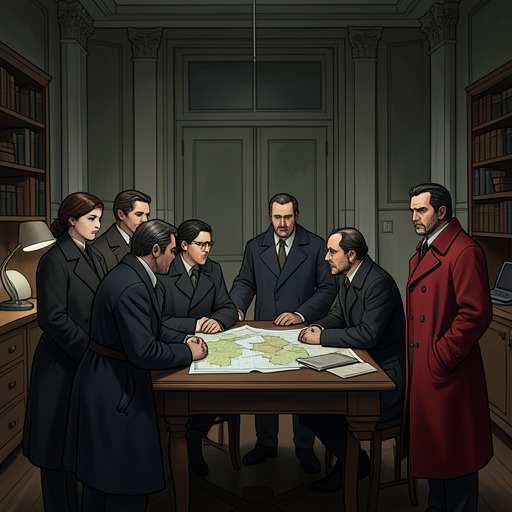
The infiltration’s effects became visible during the coup and its aftermath. At first, Tabini and his bodyguard gradually came to understand that Murini alone had not caused the events. Tabini’s bodyguard and Ilisidi’s bodyguard quietly gathered intelligence, including accounts from retired associates that conflicted with information from other sources. Their inquiries were constrained by Guild procedures and secrecy; some potential sources had died or been replaced, while other lines of inquiry could not be trusted. False information had already nearly led to Tabini’s death on the peninsula.
The decisive realization was that the coup had originated inside the Assassins’ Guild, rather than in a broad conspiracy of lords or a general revolt among the population. A portion of the body charged with enforcing the law had fractured and seized the government for Murini, a man who should not have held office. After Murini was removed, fighting continued against a Guild splinter. Many members who fought Tabini’s forces had been misled by forged orders, whose stated authority could not be verified. Their participation did not make every action innocent, but it showed how the network had made the Guild’s own membership a tool of deception. The damage arose from infiltration high in the institution: a handful of people in useful positions had introduced misinformation into multiple operations over a long period.
The network had limits as well as reach. Its senior figures included skilled and intelligent people, but its recruits were not all elite. When the Shadow Guild attempted to govern the country, it needed far more personnel than it could supply. Many legitimate Guild members retired or left headquarters rather than carry out the new Guild Council’s orders. Control of the headquarters did not mean control of the membership, and the effort to rule depended on misleading members whose cooperation could not simply be commanded.
Procedure, Proof, and Legitimacy
The infiltration was especially destructive because the Assassins’ Guild’s authority rested on a formal legal process. A Filing of Intent began with a document entered into the state registry, recording the dispute in a sealed and archived form; an answer to the filing was recorded as well. The Guild Council then had to advise the public of impending action, obtain depositions, consider whether adequate cause existed, and debate whether a remedy short of lethal action was possible. A filing approved by a Council vote could specify a date after which action was permitted. In smaller cases, an office of the Council could approve a filing on the basis of witness depositions, ordinarily subject to a ninety-nine-day limit.
Those steps were not incidental formalities. The filing and review process created a record, gave both parties opportunities to be heard, and left room for negotiation. A Filing of Intent was required before action against a person or institution, except when defending against an illicit attack. The Shadow Guild violated the Guild’s long-established rules and laws, while the legitimate Guild, even as its members mistakenly followed conspirators’ orders, continued to adhere to its procedures. Its members’ commitment to the rulebook could preserve the institution’s principles, but it also left them vulnerable to officials who manipulated the channels through which orders and information traveled.
After the infiltration was exposed, the question was how to restore the law without replacing proof with force. Ilisidi’s allies feared that a confrontation with members who had been misled could end with the wrong side prevailing or destroy the evidence needed to establish the case. Shishogi might destroy records if he anticipated dismissal, and without proof the Guild could not demonstrate to its membership that its Council had broken the law. If Tabini had to uphold the returning leadership by decree and the power of his office alone, the Guild would lose the legitimacy the investigation was meant to recover. The objective was therefore not merely to remove compromised officials, but to establish the breach through the Council’s own lawful process.
Exposure and Restoration
The investigation eventually identified Shishogi as the senior figure behind the network. The evidence against the infiltration also clarified its scale: the problem was concentrated in upper levels, where a handful of strategically placed people had caused extensive damage, rather than spread throughout the rank and file. Tabini and Ilisidi’s bodyguards believed they had identified people on both sides of the conspiracy, but the continuing danger of misdirection meant that even naming the responsible individuals required caution. The Shadow Guild might still have pockets of activity, and people with secrets from Murini’s rule had reason to fear what the records could reveal.
The return of legitimate Guild members put the dispute into institutional practice. Their restoration was not simply a change of personnel: it aimed to reunite written rules with the rules actually followed. In the operation that enabled the returning Guild to enter the building, the plan secured access to the heart of headquarters while a separate action took place in the administrative wing. The operation’s damage was limited to three deaths in total, including the target. Afterwards, Algini observed that juniors who had entered the Guild during the preceding three years would now learn that the rules on the books and the rules in operation were the same. The statement marks the infiltration’s aftermath as a repair of institutional practice as well as a defeat of its hidden network. The Guild’s credibility depended on whether members could again rely on its assignments, records, and procedures to mean what they formally claimed.