Cloister of Saint-Merri
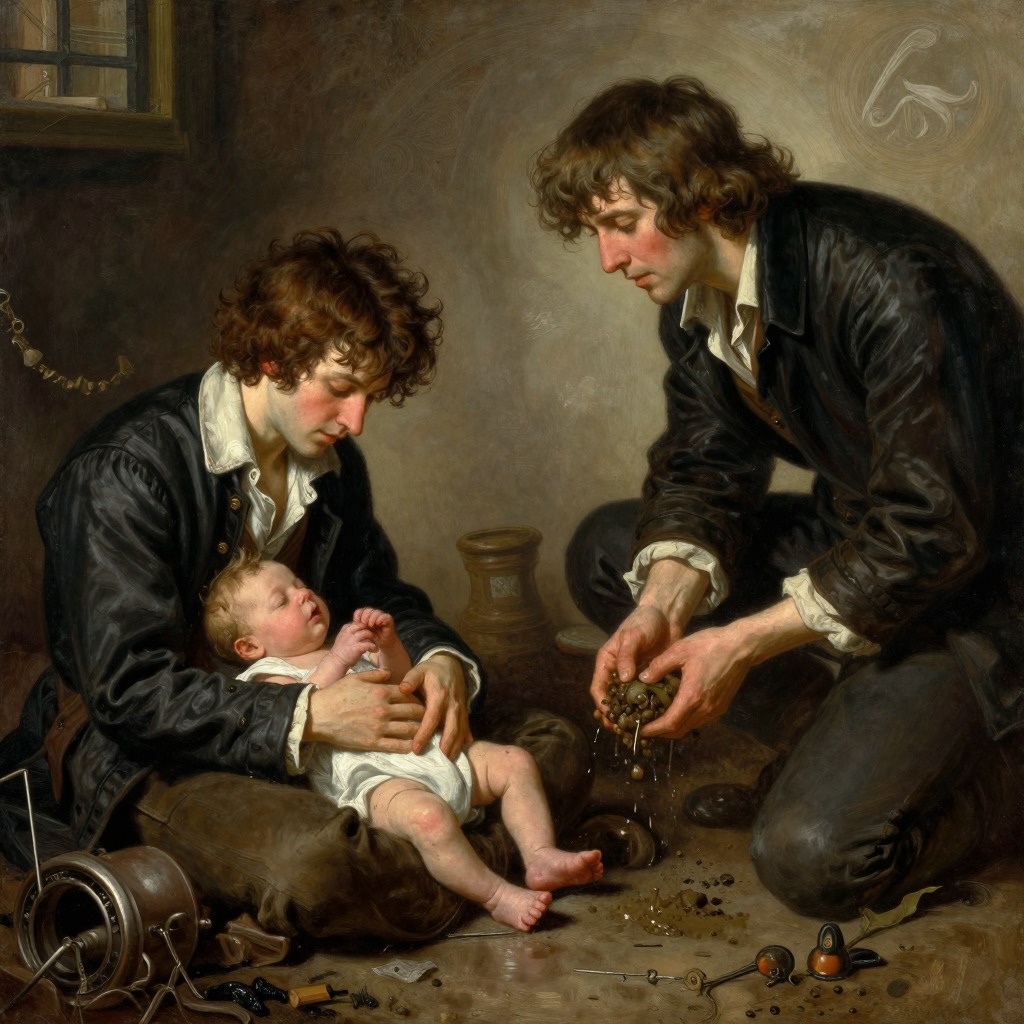
PerfumeThe Cloister of Saint-Merri, located in the rue Saint-Martin in Paris, is the ecclesiastical institution that first takes responsibility for the infant Jean-Baptiste Grenouille after his birth and his mother's arrest. It is here that the foundling, discovered beneath a fish stall at the Cimetière des Innocents, is baptized with the name Jean-Baptiste. Because the prior is in a good mood and the eleemosynary fund is not yet exhausted, the cloister decides to pamper the child at its own expense rather than shipping him to the great public orphanage in Rouen, as was the usual practice for foundlings. To this end, Grenouille is given to a wet nurse named Jeanne Bussie, who lives in the rue Saint-Denis and is to receive three francs per week for her trouble.
The Return of the Infant
A few weeks later, the wet nurse Jeanne Bussie returns to the gates of the cloister, market basket in hand, and declares she will no longer keep the child. She claims the infant is "possessed by the devil" because he does not smell the way a human child should. Father Terrier, the bald monk of about fifty with a faint odour of vinegar who administers the cloister's charities, attempts to reason with her, arguing that an infant cannot be possessed and that the child's lack of smell is a sign of health. Despite his efforts, the wet nurse is adamant, and Terrier, after a theological cross-examination, reluctantly accepts the return of the child. He discharges Jeanne Bussie and takes the basket containing the sleeping infant into the cloister.
The Monk's Unease and the Decision to Remove the Child
Father Terrier, an educated man who prides himself on his critical faculties and despises superstition, initially dismisses the wet nurse's fears as primitive nonsense. He rocks the basket on his knees, stroking the infant's head and repeating the soothing nonsense word "poohpeedooh." However, when the child awakens, Terrier experiences a profound and disturbing sensation. The infant's nose seems to fix on him, smelling him with an eerie intensity, as if it is devouring something from him. Terrier feels naked and ugly, his most tender emotions and filthiest thoughts laid bare. Overcome with nausea and a sense of a hostile, cold creature in his lap, he decides he must get rid of the child immediately. He hitches up his cassock, grabs the bellowing basket, and runs through the tangle of alleys to the rue du Faubourg Saint-Antoine, far to the east beyond the Bastille. There, at an address near the cloister Madeleine de Trenelle, he hands the still-screaming child over to Madame Gaillard, a woman who takes children to board for a fee. He pays a year in advance and flees back to the cloister, casting his clothes from him as if they were foully soiled, washing himself from head to foot, and creeping into bed, crossing himself repeatedly and praying long before finally falling asleep.
Later Involvement and the Bishop's Anathema
Years later, the Cloister of Saint-Merri ceases to pay its yearly fee for Grenouille's care, a decision that prompts Madame Gaillard to get rid of the boy by handing him over to the tanner Grimal. The cloister's role in Grenouille's life thus ends, but the institution reappears in the narrative during the series of murders of young girls in Grasse. In their desperation, the town council of Grasse writes an abject petition begging the bishop to curse the monster who murders young girls. The bishop, acting from the pulpit of Notre-Dame-du-Puy, makes the murderer anathema and excommunicates him both in writing and from all the pulpits of the city. This act, a formal ecclesiastical curse, is a direct echo of the cloister's earlier authority over matters of the soul and the supernatural. The murders cease from one day to the next, and the people of Grasse celebrate a mass of thanksgiving, believing the bishop's power has driven the monster away.
The Bishop's Rapture at the Execution
At the climax of the novel, during the attempted execution of Grenouille on the parade grounds before the city gates, the Bishop of Grasse is present in the grandstand. As Grenouille, wearing the ultimate perfume that commands love, steps out of the carriage, the bishop is overcome with religious rapture. He slumps forward, banging his forehead against his knees, sending his little green hat rolling. He believes a miracle has occurred: the Lord God has personally stayed the executioner's hand by disclosing as an angel the very man who had appeared to be a murderer. The bishop feels splendid humiliation and sweet abasement, chastised by God for his own lack of faith. This moment reveals the profound irony of the institution's power: the same ecclesiastical authority that once excommunicated the murderer now worships him, completely deceived by his artificial scent.