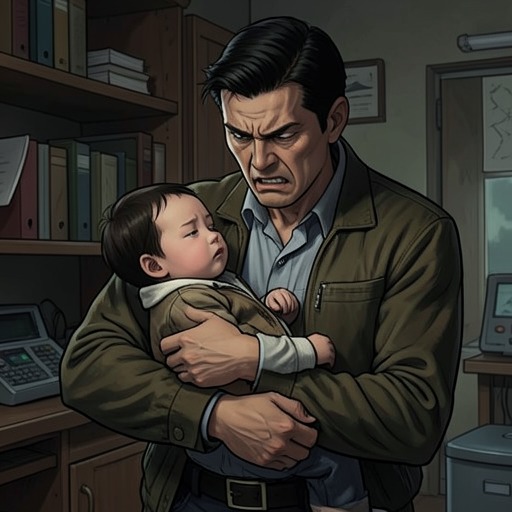
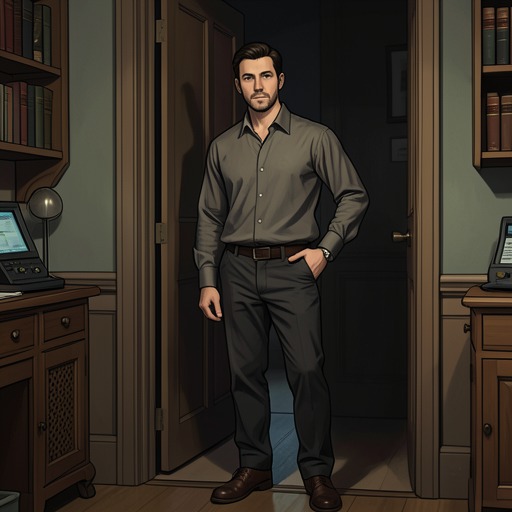
Kawashima approaches his daughter's crib with an ice pick
PiercingKawashima approaches his daughter's crib with an ice pick during a late-night vigil over his four-month-old daughter, Rie. The scene turns a parental act of watching into a tense test of self-control: he tells himself that he will not harm the baby, yet feels compelled to stand over her with the very object that frightens him. Yoko’s waking intervention interrupts the vigil, but does not end the fear that has brought him to the crib.
Domestic Setting and Growing Fear
The episode takes place in the couple’s bedroom after midnight, while Yoko sleeps and Rie lies in her crib. Kawashima uses a penlight to see the baby without lighting the whole room. His attention to her is bound up with an anxious thought about inheritance: he has suffered from insomnia since elementary school and worries that Rie might also have difficulty sleeping. He understands newborns to sleep for much of the day, but the possibility that his daughter could share his sleeplessness has made her sleep a focus of concern.
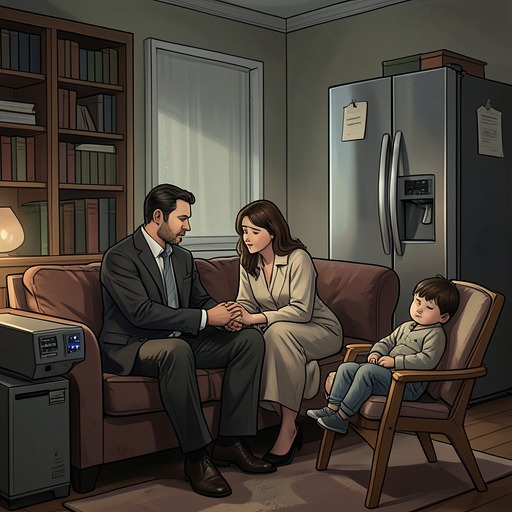
The scene also establishes the household’s ordinary rhythms, against which Kawashima’s nightly conduct stands out. Yoko is twenty-nine, rises early, and has left her former job after marrying. She now teaches bread and pastry classes in the couple’s one-bedroom apartment, with students ranging from housewives and schoolgirls to elderly widowers and middle-aged men. The lessons are popular, and students often help with the baby. The smell of Yoko’s baking has come to signify happiness for Kawashima. That domestic comfort does not dispel his fear; instead, the crib stands within a home he cherishes, making the possibility he dreads feel especially close.
Kawashima has been watching Rie this way for ten consecutive nights. The vigil is not presented as a single, planned assault: he has made up his mind that he will not stab her, and the approach is framed as a repeated attempt to reassure himself. But reassurance requires him to return to the feared situation, so the nightly check keeps the possibility of harm present rather than putting it to rest.
The Approach to the Crib
During this particular vigil, a narrow band of moonlight falls across the crib. It recalls the long, narrow roads Kawashima used to draw as a boy when moonlight was his only source of illumination. The remembered image links his present watch to an earlier private world without explaining away the immediate danger. He takes the Ice pick from his pocket, holds it in one hand, and draws back Rie’s blanket with the other. He then directs the penlight toward her face and neck.
The scene slows around his attention to the instrument and the baby. Kawashima regards the pointed tool as an object whose presence in the world is difficult for him to understand; he cannot treat it as a neutral household implement. At the crib, the Ice pick becomes the material focus of the conflict between his stated resolve and his fear that he might act against it. He touches Rie’s fine hair first with a fingertip and then with the instrument. The action crosses a boundary of proximity, even as he continues to tell himself that he will not stab her.
His body registers strain that he has not consciously noticed. He sees perspiration fall onto the blanket and experiences a sense of estrangement from himself, as though the sweating figure were someone else. This detail sharpens the difference between his deliberate reassurance and his involuntary physical response: his words insist on control, while his body shows how little calm the ritual has brought him.
Yoko’s Interruption and the Recurring Vigil
Yoko’s voice breaks the silence by asking what he is doing. Kawashima’s body tenses; he switches off the penlight, turns toward her, and slips the Ice pick into his pocket before approaching the bed. He apologizes for waking her and kisses her cheek. The interruption stops the isolated vigil from continuing in the same way, but the scene does not show him explaining his fear to her. Instead, he conceals the instrument and returns to the ordinary gestures of a husband beside his waking wife.
The later account of the incident makes clear that the image of the pointed Ice pick remains with him. Kawashima repeatedly tells himself that he would never stab Rie, but an answering possibility persists in his mind. From then on, he cannot go to bed until he has stood over the crib with the Ice pick in hand to confirm that he will not harm her. The action therefore becomes a recurring compulsion rather than a resolved crisis: each check is meant to reassure him, yet its repetition shows that reassurance does not last.
Narrative Significance
The approach establishes a sharp contrast between the tenderness of caring for a sleeping infant and the presence of a weapon at her bedside. The penlight, blanket, crib, and Ice pick belong to one domestic scene, but their proximity makes the scene’s central conflict impossible to keep abstract. Kawashima’s fear is not confirmed as an act of violence; the evidence instead shows a man distressed by the possibility of harming his daughter and caught in a ritual that repeatedly brings him back to that possibility.
The episode also introduces a pattern of delayed consequence. Yoko’s question ends the immediate encounter, but it does not settle what the encounter has revealed about Kawashima’s state of mind. The memory persists, and the nightly inspection continues. His devotion to Rie and his fear of himself occupy the same space, leaving the crib both a place of parental watchfulness and the setting of an unresolved inner crisis.