Avoid the warning "16"
PiranesiThe warning to avoid 16 is a rule The Other imposes on Piranesi, telling him to hide from any unfamiliar person in the labyrinth and, above all, not to listen if that person speaks. Presented as protection against an enemy who can supposedly unravel Piranesi’s thoughts, the warning also limits his access to information and prepares him to distrust the person who might challenge The Other’s account of the world.
The Rule and Its Rationale
The Other asks Piranesi to promise that if he ever sees someone in the labyrinth whom he does not know, he will not approach or speak to them. Instead, Piranesi must hide and avoid being seen. The instruction directly opposes Piranesi’s instinct: he imagines that a new person could provide knowledge of distant regions and help fill gaps in what the two living inhabitants know. The Other’s rule therefore does more than prescribe caution; it blocks a possible encounter and the exchange of knowledge that might follow.
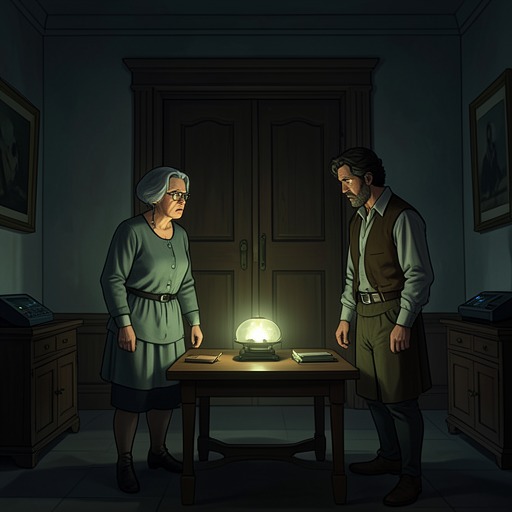
The warning becomes personal when The Other reveals that he has already met 16, whom he calls his enemy and, by extension, Piranesi’s enemy. He says 16 is opposed to what he and Piranesi value, including reason, and claims that 16 seeks to tear reason down. Piranesi initially tries to imagine a misunderstanding that he could resolve by explaining The Other’s good qualities. The Other rejects that possibility, framing 16 not as someone with whom Piranesi might reason, but as a danger beyond reasoned reconciliation.
The Other also makes the threat psychological. He warns that 16 will want to speak to Piranesi and that listening could lead to madness and terror: her words, he says, could make Piranesi doubt what he sees and even doubt The Other. He emphasizes that Piranesi is particularly vulnerable because he forgets things and repeats himself, describing him as mentally unstable. This argument converts Piranesi’s memory difficulties into a reason to obey The Other and distrust a potential alternative account.
Uncertainty and Control
The warning is delivered alongside claims that initially seem to reduce its urgency. The Other says there is only a small chance that 16 will come to the labyrinth because she does not know the way. When Piranesi asks when The Other met her, he learns it was only the day before yesterday. Later, The Other’s language shifts: if 16 comes, he says, it is Piranesi she will be looking for, and he insists that the consequences of hearing her would be awful. The instruction to avoid her thus grows more urgent even as the means by which she might find Piranesi remain uncertain.
The Other’s account contains a significant tension. He warns Piranesi that 16 can make him doubt what he sees and whom he trusts, while demanding that Piranesi accept The Other’s own explanation of 16 without testing it through conversation. Piranesi’s wish to meet the newcomer is not simply curiosity about distant halls; it is a willingness to listen and consider that another person may know something important. The rule pre-empts that possibility by defining the encounter itself as dangerous.
Routes, Messages, and Reversal
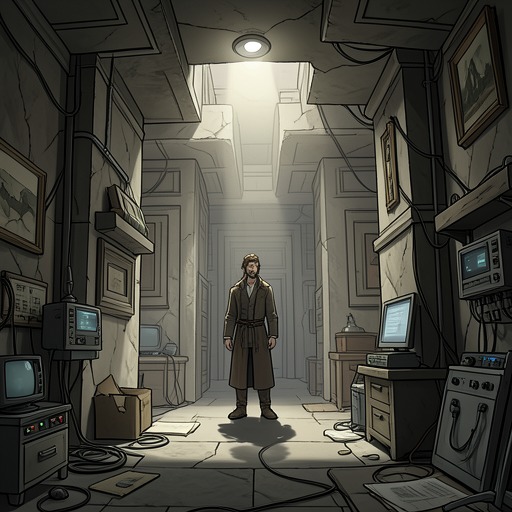
The geography of the House gives the prohibition a practical dimension. Piranesi knows that reaching the One-Hundred-and-Ninety-Second Western Hall requires crossing the Seventy-Eighth Vestibule, where tides scatter sharp debris from the Lower Halls. With his shoes gone, broken marble can cut his feet and expose him to infection. Movement through the labyrinth is therefore not an abstract matter of choosing whether to obey: routes carry physical risks, and what a person knows about the passages can determine where and how they can travel.
The existence of written traces gradually complicates the idea that 16 is merely an unseen threat. Piranesi recalls fragments of writing found in the Eighty-Eighth Western Hall, including the words kill him, and wonders whether the papers belong to one of the dead or to someone unknown. Later, he follows directions left by 16 from the Sixth North-Western Hall toward the First Vestibule. Yellow chalk marks each doorway; the directions are repeated beneath the doorframes so a tide or accident will not erase the whole route. Their position, somewhat below Piranesi’s eye level, suggests that 16 is shorter than he is. These marks turn a feared stranger into a person whose careful method can be followed through space.
Piranesi responds by leaving a message of his own. Using blue chalk, he returns to the Sixth North-Western Hall and writes beneath 16’s directions. The exchange reverses the warning’s intended isolation: instead of hiding from the unknown person, he uses the House’s passages and writing surfaces to make contact. The Other’s rule has not vanished, but the route and message provide Piranesi with evidence beyond The Other’s description of 16.
The Warning’s Limits
By the time Piranesi’s priority is to find 16 and ensure her safety, the warning has lost its authority as a simple instruction to keep away. He believes The Other has set a trap for her, perhaps by promising to meet her and tell her how to find Matthew Rose Sorensen. Piranesi reasons that finding The Other may be the surest way to find 16, even though he would rather avoid The Other. Remembering the Prophet’s warning that The Other will become more dangerous as 16 gets closer, he hopes to reach her before she reaches him.
The rule’s changing force exposes its central conflict: The Other calls avoidance protection, but Piranesi’s growing knowledge gives him reasons to seek 16 rather than fear her. The House’s immense distances, hazardous passages, and marked doorways make information inseparable from movement; a person who controls what another person may hear can also shape where that person dares to go. Piranesi’s eventual choice to search for 16 marks a break with the isolation The Other prescribed and makes the possibility of another voice part of his effort to keep her safe.