Maze leads to memory and time perception damage
PiranesiThe House’s labyrinth impairs memory and timekeeping without erasing every kind of knowledge equally. Piranesi can remember thousands of halls with precision even as he loses dates, forgets other parts of his life, and confronts evidence that his own earlier writing has become incomprehensible to him. This uneven damage makes the rule more than a practical hazard: it destabilizes his sense of personal history and identity, while shaping the routes, records, and choices through which he tries to understand himself.
The Pattern of Forgetting
The Other explains that the labyrinth can make people forget things and, if they are not careful, can unpick their entire personality. He says that this is not the first time Piranesi has proposed stopping their search for knowledge and then been persuaded to continue. It is the third such conversation, with the impulse recurring roughly once every eighteen months. Piranesi’s surprise is part of the evidence: what feels to him like a new decision has already happened twice before.
The loss is selective rather than total. Piranesi insists that he remembers every hall he has visited, numbering them at 7,678. The Other confirms that Piranesi never forgets anything about the labyrinth, which is precisely why his contribution to the Other’s work remains valuable. But Piranesi does forget other things, and loses time. The preserved map of the House and the damaged record of everything beyond it coexist within the same mind.
The disruption appears in ordinary scheduling as well as in more dramatic gaps in self-knowledge. The Other says Piranesi gets days and dates wrong, sometimes arriving out of sync with everyone else. On occasions when the Other has come to meet him, Piranesi has been nowhere to be found because he has lost a day; the Other says he has had to correct him numerous times. Time loss is thus not merely an internal confusion: it interrupts their meetings and sets Piranesi’s calendar against the Other’s.
The House as a Spatial and Cognitive World
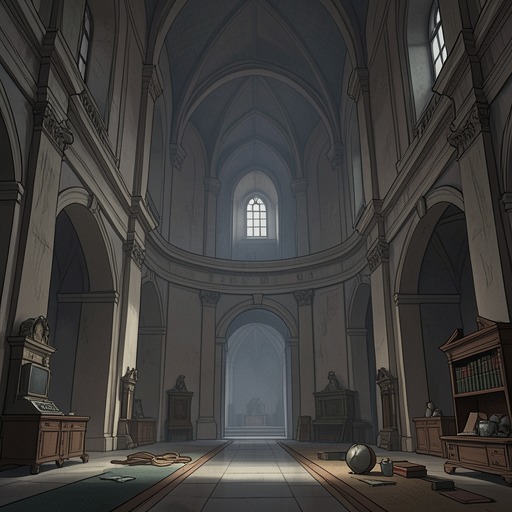
Piranesi’s own account of the House establishes the scale and variety of the world in which this impairment occurs. He has travelled as far as the Nine-Hundred-and-Sixtieth Hall to the west, the Eight-Hundred-and-Ninetieth Hall to the north, and the Seven-Hundred-and-Sixty-Eighth Hall to the south. He has climbed to the Upper Halls, where clouds move and statues emerge from mist; explored the Drowned Halls, whose dark waters are covered with white water lilies; and visited the damaged Derelict Halls of the east. In all these regions, he sees halls and passages continuing into the distance rather than signs that the World is ending.
This immense, traversable environment clarifies the distinction between spatial memory and personal continuity. Piranesi can retain a detailed geography even while his understanding of time and his earlier life falters. The House’s passages also carry practical risks: on the route to the One-Hundred-and-Ninety-Second Western Hall, the Seventy-Eighth Vestibule is subject to flooding, and tides scatter broken marble whose jagged edges make passage difficult. Piranesi explains that the path is possible but laborious and will take time. The House’s conditions therefore make navigation a daily bodily and logistical undertaking, even as his extraordinary route knowledge remains intact.
Route knowledge can also be recorded and shared. Following the directions left by 16, Piranesi traces her path back from the Sixth North-Western Hall to the First Vestibule, marking each doorway in yellow chalk. He notices that the marks are below his eye level and estimates that 16 is between twelve and fifteen centimetres shorter than he is. She has repeated her directions beneath each doorframe so that other marks might survive a tide or mishap. The detail shows how written instructions and physical marks compensate for the hazards of a changing environment; they also preserve knowledge across distance, rather than relying on memory alone.
Journals and the Recovery of a Past
The rule becomes personally undeniable when Piranesi reads old journals. After encountering entries containing words such as Birmingham and Perugia, he finds that they look like words but mean nothing to him: he cannot connect them to anything in the World he knows. The entries are in his own handwriting, yet he experiences their contents as gibberish. He concludes that he has forgotten many things and may have been seriously deranged when he wrote them. The shock is not simply that he lacks information; it is that the person who recorded it is both himself and, to his present understanding, a stranger.
His journals’ numbering deepens the problem. Piranesi concludes that he must have renumbered them himself and realizes that twenty journals are missing. He estimates that he is about thirty-five years old, while the ten journals he possesses cover only five years. He is left asking what happened during the unrecorded earlier period. The missing volumes make the gaps in his memory material: the absence is counted, but its contents cannot yet be recovered.
Piranesi’s response shifts from panic to cautious investigation. Although he has imagined throwing all ten journals and the index into a raging tide to free himself from them, he decides that the records may contain information about former inhabitants as well as clues to his own illness. He wants to understand what triggers the episodes and how he might guard against their return. Because reading the journals can itself provoke painful emotions and nightmarish thoughts, he resolves to read only small portions at a time. The records are both a possible instrument of understanding and a source of renewed distress.
Belief, Survival, and the Rule’s Consequences
The Other and the Prophet both state that the House itself causes madness and forgetfulness. Piranesi accepts their conclusion because he regards them as scientists and men of intellect, but acceptance does not amount to distrust of the House. When he asks himself whether he trusts it, he answers yes. The tension is central to the rule: the House can be the source of cognitive harm and still be the world to which Piranesi feels attachment and in which he has built a life.
The rule affects his choices about safety and dependence on others. When the Other explains that Piranesi has repeatedly reconsidered the search for knowledge, he uses the pattern of forgotten conversations to keep the search going. The disclosure therefore gives the Other an advantage: Piranesi’s confidence that he is making a fresh decision cannot be relied upon, and the Other can present an earlier argument as though it has to be made anew. At the same time, the Other’s account provides Piranesi with information he could not otherwise verify from memory alone.
The impairment does not erase Piranesi’s capacity for care or purposeful action. When he believes the Other has set a trap for 16, his priority is to find her and ensure her safety. He reasons that the most reliable way to locate her may be to look for the Other, but recalls the Prophet’s warning that the closer 16 gets, the more dangerous Ketterley will become. He hopes to reach her before she reaches the Other. The rule thus operates amid urgent decisions: Piranesi must weigh what he remembers, what another person tells him, and what the House’s routes make possible.
At the point of departure, Piranesi does not treat the House as a place whose significance can be discarded with the damage it has caused. He takes his journals and favourite pens in his messenger bag, puts on the ornaments he had hidden in a cardboard shoe box, and walks with Raphael toward the passage between two Minotaurs. He takes one last look at the House; Raphael takes his hand, and they enter the corridor together. His preserved journals accompany him out, carrying evidence of both lost history and the effort to reclaim it. The rule’s lasting force lies in that unresolved coexistence: the House has impaired his memory, but it remains a trusted world whose record he chooses to keep.