Conjunction of Four Tides
PiranesiThe Conjunction of Four Tides is an extraordinary alignment in the House’s tidal cycle and the warning sign of a coming Great Flood. Piranesi discovers it while checking calculations he has neglected, then uses his Tide Table to estimate the flood’s scale and timing. His warning establishes both the House’s dependence on interacting natural forces and the peril of failing to understand them in time.
The House’s Tidal System
The Lower Halls are the Domain of the Tides, where the changing waters provide fish, crustaceans, and sea vegetation. Their fluctuations are part of the House’s ordinary conditions of life, but they can also alter the spaces available to travel and gather food. During a Low Tide in one Lower Hall, the water had drawn back so far that the Hall was entirely empty, leaving seaweed, pebbles, starfish, and shells scattered over its stone floor.
The House’s weather and architecture are not fixed backdrops to this tidal system. After the ceilings of the Twentieth and Twenty-First North-Eastern Halls collapsed, clouds began to drift through the broken openings and into the Middle Halls, changing the weather in that region. Against this background, the Conjunction is a forecastable but dangerous convergence of tides: Piranesi’s observations and invented equations let him recognize an approaching exceptional event within a larger, changeable environment.
Discovery and Forecast
Maintaining a Table of Tides is one of Piranesi’s regular duties. Every few months, he applies his observations and equations to check whether extraordinary occurrences are expected in the coming weeks. Recently occupied with other matters, he had let this work lapse; when he resumed it, he discovered that the Conjunction of Four Tides would occur in less than a week. His last calculations covered a period that had ended more than two weeks earlier, leaving him close to missing the warning altogether.
Piranesi responds first with alarm at the danger his neglect has exposed him and the Other to. He then turns from regret to further calculations. Because the waters’ force and volume are difficult to predict exactly, he cannot give a single certain figure: he estimates that between forty and a hundred Halls will be flooded. The range makes the warning concrete while preserving the uncertainty of forecasting the House’s waters.
Warning and Imminent Danger
Piranesi brings the discovery to the Other at one of their regular meetings in the Second South-Western Hall, arriving almost half an hour early because he is anxious to speak. He tells the Other that a Great Flood is coming and that, without proper preparation, they risk being swept away and drowned. When the Other asks when, Piranesi gives a precise forecast: the flood will begin in six days, on Thursday, rising approximately half an hour before midday. He begins to explain the sequence of tides that will produce it.
The Other initially relaxes on hearing that the predicted day is Thursday, saying that he will not be there then. His response contrasts with Piranesi’s attempt to make the shared danger impossible to ignore. The Conjunction therefore matters not only as a natural event but as a crisis of warning and response: recognizing the danger is not the same as ensuring that the people exposed to it will prepare.
Course and Significance
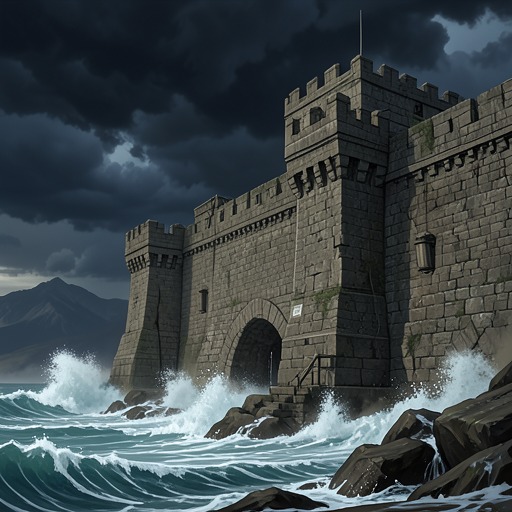
At noon during the rising of the final two tides, the waters in the Tenth and Twenty-Fourth Vestibules are already rising and filling the surrounding area with tempestuous water. Piranesi and 16 reach a high cornice in a Hall, about seven metres above the floor, as they seek safety. From there, Piranesi sees that the Other has not yet got into his boat; instead, the Other runs to the Northern Wall to retrieve his gun and fires at them. The impending flood thus coincides with an immediate human threat, turning the search for refuge into a confrontation as well as a struggle against the waters.
The Conjunction brings together the House’s ordinary provision and its capacity for sudden danger. Tides that shape food, movement, and daily observation become a flood that may overwhelm dozens of Halls. Piranesi’s missed calculations make the risk more urgent, his forecast makes it legible, and the Other’s response shows how a warning can fail to become common preparation. The event gives practical stakes to the knowledge Piranesi has built by attending carefully to the House.