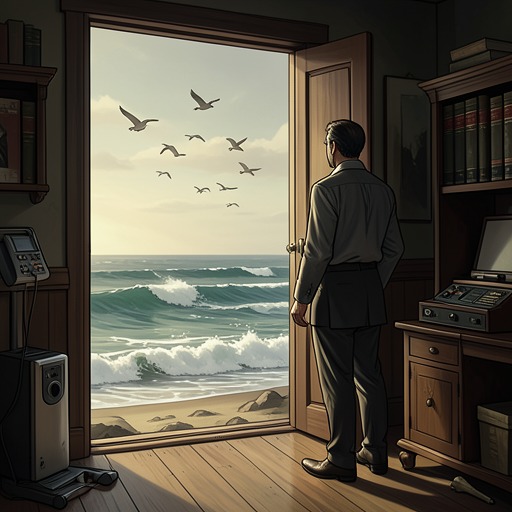
The Year the Albatross Came to the South-Western Halls
PiranesiThe Year the Albatross Came to the South-Western Halls is a named period in Piranesi’s chronology, defined by a pair of albatrosses settling in the House and raising a chick. The year’s entries place this intimate story of attention and care beside Piranesi’s practical work of keeping journals and discovering that his system for numbering years has become inconsistent. Its name makes an animal’s arrival—not a political event or a human milestone—the measure by which a stretch of life is remembered.
Naming the year
Piranesi dates the journal that begins this period to its fifth day of the fifth month, and a later entry explicitly declares that he has named the year after the albatrosses’ arrival in the South-Western Halls. The name is therefore both a chronological label and a record of what mattered to him: the birds’ presence gave this year a distinct identity within the sequence of years he had previously named by travels, discoveries, or other changes in the House.
The timing of the naming belongs to a larger habit of recording and organizing experience. Piranesi explains that he uses a separate notebook as an index to the other journals, assigning pages to letters of the alphabet and listing subjects with their locations in the notebooks. While writing about that tool, he realizes that he has been using two systems to number the years. The discovery exposes a gap between the orderly archive he has built and the inconsistencies within it: his records preserve detail, but their chronology is not perfectly settled.
The birds arrive and seek a nest
The albatrosses’ arrival unfolds through successive observations rather than a single announcement. Piranesi first describes one bird spreading its wings and stretching its throat toward the ceiling, making a clacking, whirring sound that he takes for a greeting. Its dark wing backs bear a white, star-shaped mark. As Piranesi gathers seaweed, the bird walks around the hall, its greyish-pink feet slapping against the pavement, and periodically approaches to inspect his work.
The next day, the bird has climbed the staircase to the Forty-Third Vestibule, where Piranesi finds a second albatross. He cannot determine which bird is male or female and explicitly treats the apparent pairing cautiously. The newcomer’s wings have a different pattern, white flecks like silver rain. Together, the birds spread their wings, dance, point their beaks toward the ceiling, shriek, and tap their long pink beaks together. Their courtship briefly transforms the vestibule into a scene of energetic welcome.
A few days later, Piranesi finds the pair subdued. The bird he thinks of as male has carried up damp seaweed from the Lower Hall and repeatedly rearranges it into a heap, only to reject each placement. Piranesi interprets the difficulty: the birds need dry material for a nest and an egg, not the cold, wet seaweed available there. He offers his own supply, approaching their predicament as a practical need he can answer rather than merely an animal behavior to observe.
Piranesi helps them build
To provide nesting material, Piranesi lines a fishing net with heavy-gauge plastic and fills it with dry seaweed. He estimates the amount as roughly three days’ fuel, recognizing that giving it away may leave him colder. He nevertheless considers that cost minor beside the prospect of a new albatross in the World. He adds clean white feathers he had kept because he liked them and an old woollen jumper, too full of holes to serve well as clothing but potentially useful as a soft lining for an egg.
He drags the net to the Forty-Third Vestibule. The bird he identifies as male immediately takes a beakful of dry seaweed and tests it in different places, a small confirmation that the materials have met the need Piranesi inferred. His help is concrete and costly: fuel, saved feathers, and a garment become resources for the nest. The scene also shows how his attention works. He notices repeated behavior, imagines what the birds lack, and responds with materials gathered from his own precarious stores.
The birds soon construct a tall nest, about a metre wide at its base, and lay an egg. Piranesi records that they are devoted to the egg and later equally diligent with their chick. The chick grows slowly and has not yet shown that it is ready to fledge. The record thus does not end at the spectacle of an egg; it follows the prolonged work of parenting and leaves the bird’s development unfinished.
A year measured by care
The year’s title gathers these observations into a lasting point of reference. Its central event is modest in scale but changes the life of the vestibule: a lonely visitor becomes a pair, a pair becomes nesting parents, and an egg becomes a slowly growing chick. The progression gives the named year its emotional shape while preserving uncertainty about the birds’ sexes and the time still required for the chick to fledge.
The albatrosses’ story also belongs to Piranesi’s broader effort to make the House legible through attention. Elsewhere in the same named year, he describes the immense distances he has traveled through halls to the west, north, and south, and the distinctive conditions of the Upper, Drowned, and Derelict Halls. Against that scale of exploration, the birds’ nest is a concentrated episode: not a discovery of the House’s limits, but a new form of life made possible within it. By naming the year for their arrival, Piranesi places care and companionship among the events that structure his memory, alongside journeys and discoveries.