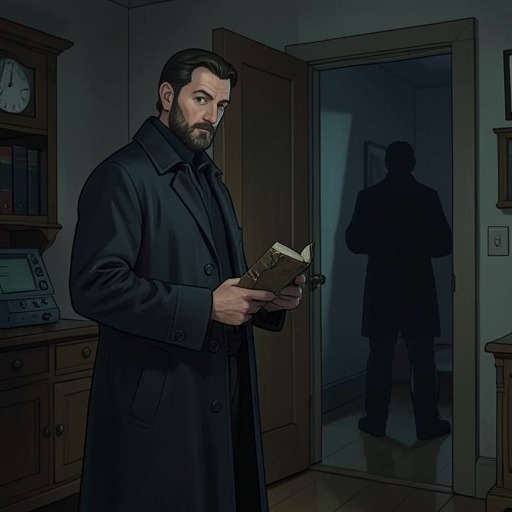
Kately's inflatable boat
PiranesiKetterley’s inflatable kayak is both an escape device and a failed instrument of control. Discovered in the First Western Hall on the eve of the Great Flood, it is prepared for Ketterley’s planned flight with Piranesi, while the rising waters turn it into a shifting presence that eludes him. The boat eventually survives the flood; Ketterley does not.
Discovery and construction
Piranesi finds the kayak while moving his belongings to high places in preparation for the flood. In the First Western Hall, near the statues of the Horned Giants, he comes upon a large grey fabric bag and two black canvas objects. The bag is about eighty centimetres long, fifty centimetres wide, and forty centimetres deep; inside are a gun, folded heavy plastic, a small lidded cylinder containing unidentified pieces, a hose-equipped pump, two extendable black rods, and four paddle-shaped pieces. The practical identity of the unfamiliar components emerges through close inspection: the paddles attach to the rods, and the folded material unfolds into a long, pointed shape that the pump can inflate into a boat about four metres long and one metre wide. The two canvas objects appear to belong to the boat, though Piranesi cannot determine their purpose.
The object arrives at a moment when Piranesi has been trying to secure what the flood might destroy. He has already carried his journals and index in a messenger bag to the Upper Halls, wrapped in heavy plastic, and moved his other possessions to high places. The kayak therefore appears at first to belong to the same practical problem of survival. But the bag also contains a gun, and that detail makes a benevolent explanation difficult for him to accept: although he considers whether the House has sent the boat to protect him, he cannot imagine why it would send a gun. He concludes that the gun identifies the equipment as Ketterley’s property, and packs the boat and its components back into the bag.
Ketterley’s plan
When Piranesi later sees Ketterley cross the First Vestibule in jeans, a jumper, sneakers, and what appears to be a life jacket, the equipment takes on its intended role. Ketterley goes directly to the bag in the First Western Hall and begins unpacking the kayak. Piranesi watches from a niche, hoping to intercept 16 before she reaches him; elsewhere, floodwaters are already moving through the halls. In the nearby Twenty-Second Vestibule, another tide is rising, while water washes in through the north-western doors of the First Western Hall.
Ketterley inflates the boat with the small foot pump. As he prepares it, he tells Piranesi that Raphael is coming and that they will finish matters, then orders him to help attach the seats. His plan is not simply to use the kayak to escape the rising water: he instructs Piranesi to strike Raphael’s hands and head with a paddle if she tries to climb aboard or hold on. The boat is thus incorporated into a violent plan that treats it as a means of escape for Ketterley and Piranesi, and as something to be defended against Raphael. Ketterley’s confidence in that plan depends on the assumption that the boat will remain available to him once the flood arrives.
The flood and the boat’s apparent agency
That assumption fails as the water rises. Piranesi and 16 take shelter by the body of a Horned Giant, whose projecting back shields them from Ketterley’s gun. Ketterley turns away from them and struggles towards the kayak, but the waters reach his knees and the waves drag at him. The boat, by contrast, grows lighter and freer: it spins from one side of the hall to another, repeatedly moving beyond his reach. The contrast turns the object’s intended function against its owner. Ketterley is burdened and slowed by the flood; the boat is carried over it.
For an instant, the kayak seems to reverse this pattern. It turns directly towards Ketterley, as if it has decided to save him, and he reaches for it. It comes within about half a metre of his grasp; Piranesi thinks Ketterley may briefly touch its bow. Then it turns away and is borne towards the western end of the hall. Piranesi shouts for Ketterley to climb, but the roar of the water drowns him out, and Ketterley continues wading after the boat. A great wave then throws Ketterley against the southern wall, where he crashes into the statues high above the floor. Piranesi imagines that this is when he dies. The boat, meanwhile, continues to whirl in the flood, submerged briefly at times but always resurfacing. It might have saved Ketterley if he had reached it, but its movements never grant him that escape.
Aftermath and significance
After the flood, Piranesi finds Ketterley’s body in the Eighth Vestibule and tends to it with the care he gives the dead. He does not find the gun; the tides have carried it away. Later that morning he discovers the kayak idling unharmed on the now ankle-deep water of the First Western Hall. Its survival sharply contrasts with Ketterley’s death and with the violent, unstable scene in which it had been set in motion.
Piranesi tells the boat that he wishes it had saved Ketterley, but it gives no sign of responding. Without the rushing water that animated its movement, it seems drowsy and only half alive; the same kayak that had danced over the waves, first appearing to mock Ketterley and then seeming to abandon him, is now still enough to seem inert. The passage does not settle whether this apparent agency belongs to the boat, to the House, or to Piranesi’s perception of events. It does show that human intention does not master the flood’s material forces: Ketterley brings the kayak as equipment for a controlled escape, yet the water makes its movement unpredictable, and survival depends instead on Piranesi and 16 reaching the shelter of the statue. The kayak remains a practical object, but in the decisive scene it is also part of the House’s volatile environment—capable of offering the image of rescue without delivering Ketterley to safety.