Film: The Castle
PiranesiThe Castle is the usual name for an untitled, technically poor Betamax film by Sylvia D’Agostino. Its meandering images of vast rooms, statues, and floor-level puddles have never been conclusively matched to real locations; for believers in Laurence Arne-Sayles’s theories, the footage may record one of his other worlds. Piranesi later recognizes in its imagery evidence that D’Agostino, like James Ritter, had visited the Halls he calls the World.
Film and Imagery
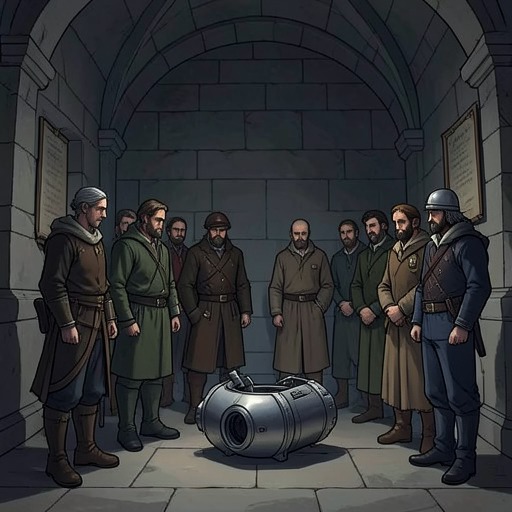
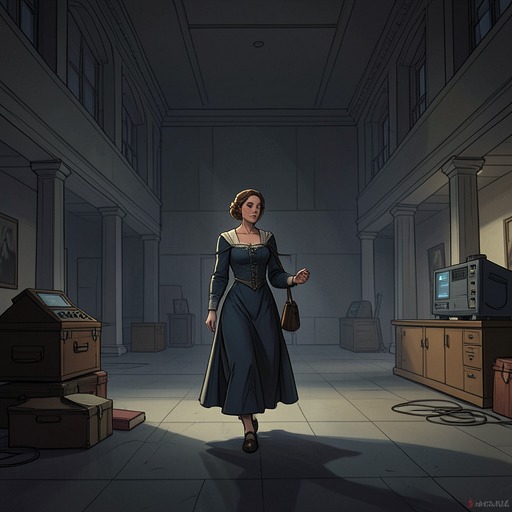
The camera wanders through a succession of enormous rooms, apparently in different castles or palaces: the spaces are so extensive that they cannot plausibly belong to one building. Statues line the walls, while puddles crowd the floors. The film offers no confirmed place names or route, and its poor Betamax image preserves an impression of spaces rather than a verifiable geography.
That combination of monumental interiors, ubiquitous sculpture, and waterlogged ground closely accords with Piranesi’s account of the World. In his description of the Halls, statues occupy nearly every available surface, while the Drowned Halls hold dark water carpeted with white water lilies. The resemblance is substantial, but the film’s rooms are not definitively identified as any particular Halls; its evidentiary force lies in the correspondence, not in a proven map.
Possible Record of Another World
Some viewers interpret the footage as a record of one of Arne-Sayles’s other worlds, perhaps the world described in his 2000 book, The Labyrinth. Others have tried to identify its locations to establish that the film depicts no other world. Neither position has been settled: no location has been conclusively identified, and the film itself cannot establish where its rooms are.
Notes in D’Agostino’s handwriting were found with the film, but they remain unreadable. They use the same peculiar code as her final diary, so the accompanying material deepens the mystery without resolving it. The film survives as a visual document whose spaces invite recognition while resisting ordinary verification.
Place in D’Agostino’s History
The Castle is one of two surviving films by D’Agostino; the other is Moon/Wood. By the time she disappeared in spring 1990, she was working as a receptionist in a doctor’s surgery in Whalley Range and keeping a diary in a mixture of hieroglyphs and English descriptions of images. Her friend Robert Allstead recalled that she described a life of drudgery while remaining grateful to Arne-Sayles for opening a way to a more beautiful world. Her coded writings and the unexplained film belong to the same unresolved record of her connection to his ideas.
Piranesi’s reading of the old journals supplies a further connection. He recognizes that D’Agostino’s description of The Castle indicates that she too had visited these Halls. The inference places the film alongside the journal accounts of people who entered the World, while preserving the distinction between what Piranesi can recognize and what the surviving evidence can prove.
Significance
The film’s uncertainty is central to its significance. It is neither a confirmed record of another world nor a dismissed curiosity: unidentified rooms, statues, and water echo the World closely enough to support Piranesi’s recognition, yet not closely enough to establish a location. Its wandering camera also makes the footage a counterpart to travel without a reliable itinerary, registering an immense architectural environment while withholding the knowledge needed to master it.