Message Carved on a Pebble
PiranesiThe Message Carved on a Pebble is 16’s large-scale question to Piranesi, assembled from white marble pebbles at the Twenty-Fourth Vestibule: “ARE YOU MATTHEW ROSE SORENSEN?” The message does more than name the identity hidden beneath Piranesi’s life in the House. Reading it precipitates a vivid but vanishing vision of the Real World, and its later destruction by The Other makes the pebbles a physical record of both attempted recognition and active concealment.
Setting and Construction
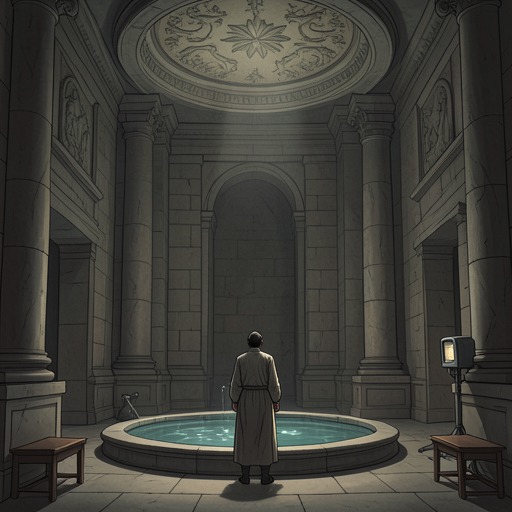
Piranesi encounters the message while retrieving two plastic bowls used to collect fresh water. They are in the Eighteenth North-Western Hall, across the Twenty-Fourth Vestibule from the Sixth North-Western Hall. The vestibule is marked by a shallow, sloping bank of white marble pebbles, deposited by the Tides near the mouth of the staircase to the Lower Halls. Piranesi knows the bank through repeated use: he has climbed over it to fish and gather shellfish, dislodging a few pebbles at a time without changing its overall shape.
On this visit, a hollow in the bank immediately signals that something is different. Piranesi is astonished by the removal of so many stones, since he has seen rooks and crows take small ones to break shellfish but has no reason to think birds would move a great number. He then notices white material scattered across the pavement in the vestibule’s north-eastern corner. Approaching it, he realizes that the pebbles form words. The message’s material is familiar and tactile, but its deliberate alteration of the bank makes it suddenly legible as a human communication.
The words are approximately twenty-five centimetres high: “ARE YOU MATTHEW ROSE SORENSEN?” Their scale matters to the encounter. The question is not a private mark easily overlooked; it is a painstaking arrangement across the pavement, made from the vestibule’s own stones and addressed directly to the person who will read it. Piranesi later understands that making the sentence must have taken a long time. Its effort gives the message the force of 16’s sustained search, not merely the force of the name it contains.
Recognition and the Vision
The name initially reaches Piranesi as language before it becomes knowledge. He registers “Matthew Rose Sorensen” as three words that make up a name, then experiences an image rising before him “like a memory or a vision.” The message does not restore his identity in a calm, continuous recollection. Instead, the written question opens a brief breach in the amnesia that has shaped his understanding of himself.
In the vision, he stands at the junction of many streets in a city under dark rain. Lights are reflected in wet tarmac; buildings and moving cars surround him; people fill the streets in numbers beyond anything he has conceived. The scene overwhelms his earlier sense of the world, but its name does not reach conscious thought. Just as the word is about to emerge, the image vanishes, and Piranesi finds himself back in the Real World, dizzy, thirsty, and breathless. His immediate request for water registers the bodily shock of recognition without turning it into a complete recovery of memory.
The question therefore supplies a crucial identity clue while preserving the gap between a name and a recovered past. Piranesi has encountered his former name, and the city vision suggests a life beyond the House, but he cannot yet hold the vision or identify the city. The message changes what he can suspect about himself without instantly freeing him from the effects of forgetting.
16’s Search and the Message’s Destruction
Piranesi later reads the pebbles as evidence of 16’s patience, resolve, and ingenuity. The sentence would have taken considerable time to arrange, and its direct question shows that 16 is trying to reach him through the name he no longer recognizes. This recognition belongs to a broader exchange of messages: Piranesi remembers that 16 has also left written communications elsewhere, including a message in the Sixth North-Western Hall, and understands that she is still looking for him.
After Piranesi begins to recognize the danger of forgetting again, the message’s method becomes a model for his own attempt to preserve knowledge. He resolves to gather marble pebbles from the vestibules and form letters a metre high, writing warnings to himself if necessary across hall after hall. The stones that carried 16’s question can thus also carry Piranesi’s countermeasure against the House’s effects on memory: a visible reminder that The Other is not his friend and that he was brought into this world for The Other’s advantage.
The original question does not remain intact. When Piranesi passes through the Twenty-Fourth Vestibule again, the pebbles are scattered far and wide over the pavement, and the words have been utterly destroyed. He concludes that The Other did it. The destruction is not simply the disappearance of an inscription: because the message had helped connect Piranesi to his former identity and to 16’s search, its erasure removes a material sign of that connection. Piranesi also finds that his own flood warning to 16 has been erased, strengthening his conviction that The Other is interfering with their attempts to communicate.
Significance
The message’s significance rests on the collision between a name Piranesi cannot remember and a world he can scarcely comprehend. Its question gives 16 a way to address the missing person inside his current identity, while the city vision shows how much of that person’s experience remains inaccessible. The message opens the route to recognition but cannot, by itself, make memory whole.
Its stones also make communication vulnerable in a way that Piranesi can see. The question’s painstaking construction, its eventual scattering, and Piranesi’s plan to write much larger warnings with the same kind of pebble turn the vestibule into a contested surface: a place where signs can recover identity, resist forgetting, and be deliberately erased. The Message Carved on a Pebble is therefore both a personal appeal from 16 and a turning point in Piranesi’s understanding that memory and identity are at stake in his relationship with The Other.