House Statues
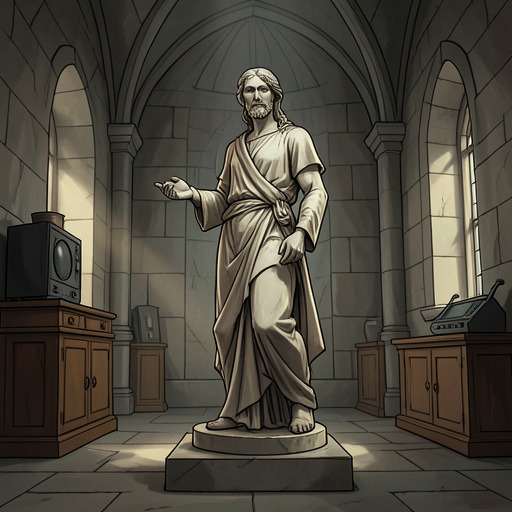
PiranesiThe House Statues are the labyrinth’s pervasive inhabitants and enduring landmarks, at once varied works of art, practical features of its architecture, and a language through which Piranesi understands the world and the people around him. They help define his reverence for the House, protect him and 16 during the Great Flood, and continue to shape his judgments after he has entered the New World.
Presence and Variety
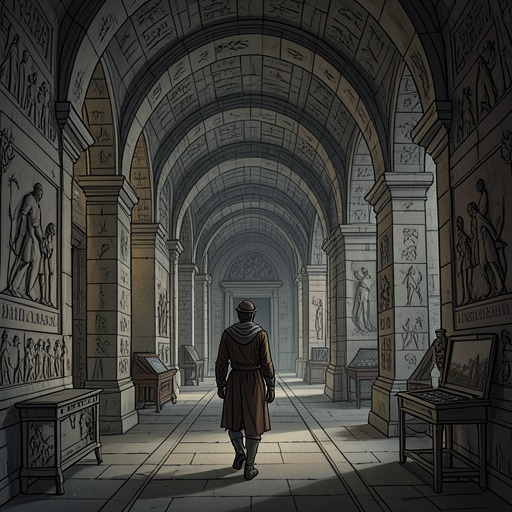
Piranesi’s account presents statues as nearly inescapable: no Hall, Vestibule, Staircase, or Passage lacks them, and in most Halls they occupy almost every available space. Their abundance does not make them interchangeable. The Halls differ in their architectural forms and openings, and the statues themselves are unique, as far as Piranesi can tell; any repetitions must lie at great distances. Empty plinths, niches, apses, and bare patches amid the sculptural profusion are therefore striking absences, mysterious in their own right.
The statues also anchor a world whose extent seems without end. Piranesi has travelled west to the Nine-Hundred-and-Sixtieth Hall, north to the Eight-Hundred-and-Ninetieth, and south to the Seven-Hundred-and-Sixty-Eighth. He has crossed the cloud-filled Upper Halls, the water-lily-covered Drowned Halls, and the damaged eastern region, where floors, ceilings, and sometimes walls have collapsed. From doorways in all these regions, he has seen only Halls and Passageways continuing into the distance, not evidence that the World is ending. Against that seemingly endless expanse, the statues provide recurrent presences without reducing the House to sameness.
Living World and Conflicting Views
Piranesi’s reverence for the statues is part of a broader conviction that the House is beautiful, active, and merciful. He understands signs of animal life—including bird droppings—as evidence that the Halls are inhabited, and rejects the Other’s dismissal of the House as a monotonous collection of decaying figures. For Piranesi, the architecture varies, the statues are distinct, and the tides and living creatures make the environment dynamic. His declaration that the House’s beauty is immeasurable and its kindness infinite expresses a relationship of gratitude, not simply an aesthetic preference.
That outlook also determines how he understands the boundary between image and reality. In conversation with Raphael, he resists the suggestion that a sculpted river or mountain is merely an inferior copy of something in the Older World. A statue, he argues, is perfect, eternal, and not subject to decay. The exchange makes visible a disagreement about what counts as real: Raphael distinguishes the represented landscape from the actual river or mountain, while Piranesi refuses to treat the House’s sculptural forms as lesser because they are representations. The statues make the House’s distinctive reality legible without requiring that it be measured against another world.
The same contrast illuminates why another person might fail to see what Piranesi sees. When the Other complains that the House contains nothing alive, Piranesi privately observes that its sea creatures, plants, birds, and people testify to life, while its statues are individually distinct. He does not voice the rebuttal because he expects it would only irritate the Other. His restraint does not weaken his own account; instead, the scene shows how two inhabitants can occupy the same environment while assigning radically different meanings to it.
Guidance, Danger, and Shelter
The statues belong to the House’s practical geography as well as its imaginative life. Tides can sweep debris from the Lower Halls into surrounding regions, leaving jagged marble that threatens an unshod traveller’s feet. Passage through such ground requires careful movement and takes time. In this world, knowledge of routes and changes in water level matters, but so does the embodied terrain: broken marble can injure, and a safe path can become arduous when a person has no shoes.
In Piranesi’s warning to 16 about the flood, the statues are not simply landmarks to avoid. He urges her to climb if caught by the rising water, assuring her that the statues are gracious and will protect her. That faith becomes materially consequential when the two are caught in the Great Flood. The Horned Giants beside the Eastern Door offer no usable footholds at floor level, their bodies emerging from the wall two metres above the ground. Piranesi instead climbs into the niche of a nearby statue of a father holding his young son and plucking a thorn from the child’s foot. He uses the niche and plinth, then the father’s arm, shoulder, and head as footholds to reach the triangular pediment above.
Piranesi helps 16 up after she reaches the statue’s lap but cannot continue by herself. They climb from the pediment to a deep cornice about seven metres above the floor. When the Other fires at them, their exposed position becomes unsafe. A Horned Giant’s back and upper arms project from the wall, leaving a marble pocket between the figure and the wall. Piranesi jumps into it, then catches 16 as she follows. The Giant’s body shields them from the gun. The sequence turns sculptural form into refuge: the statues do not stop the flood or the attack, but their niches, projecting bodies, and high ledges make survival possible.
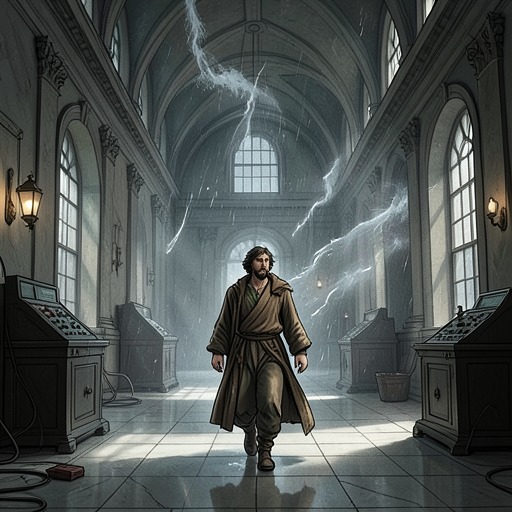
The flood also tests Piranesi’s belief that the statues will protect those who climb. Waves crash against the walls, spray bursts across the Hall, and water covers the bottom tier; at times it passes over the pair’s heads. They are soaked, numbed, blinded, and deafened, yet survive. When the waters subside and drain toward the Staircases and Lower Halls, the heads of the bottom tier reappear. The statues remain embedded in the same environment of danger, but their height and structure provide the means to endure it.
Memory and Moral Interpretation
After leaving the House, Piranesi continues to consult its statues inwardly. He once assumed that in the New World they would become irrelevant, but finds that when he confronts a person or situation he does not understand, his first impulse is still to seek a statue that might enlighten him. They have become more than features of a place: they are a durable interpretive practice, carrying the habits of attention and judgment that he formed in the labyrinth into a different life.
His memory of Dr Ketterley takes the form of a man kneeling beside the shattered remains of a sphere. The man has broken it with his sword in an attempt to understand it; the blade lies in five pieces, and he stares at fragments as though they might still yield knowledge. The image gives material form to a pattern of destructive inquiry: the effort to master an object has ruined both the object and the instrument, yet the search for understanding persists. As Piranesi’s chosen image for Dr Ketterley, the statue interprets him through the damage his pursuit leaves behind.
Laurence Arne-Sayles is evoked differently, by the figure of a bloated, repulsive pope enthroned on a magnificent seat that his bulk threatens to split. His expression suggests that he takes pleasure in being shocking. The statue’s contrast between imposing throne and self-indulgent occupant becomes a portrait of a person who revels in his own transgression. These remembered images show that Piranesi does not use the statues as a simple catalogue of likenesses; he reads posture, objects, setting, and expression as moral evidence.
Raphael and the Statues Beyond the House
Piranesi’s memory of Raphael divides into two images, revealing both his gratitude and his later understanding of her character. One is a queen in a chariot, protector of her people, embodying goodness, gentleness, wisdom, and motherhood. This is Piranesi’s image of Raphael as the person who saved him. The other image is a solitary, androgynous figure holding up a lantern and peering into a vast darkness. For the older narrator, this figure better expresses Raphael’s courage and the loneliness of her decision to enter danger, whether by choice or because no one else would follow.
The two images are not competing verdicts. Together they preserve different truths: Raphael’s rescue of Piranesi and the cost, courage, and solitude involved in finding him. Piranesi says that she is the person he knows and loves most, and recognizes more fully the magnitude of what she did. She returns to the labyrinth often, sometimes with him and sometimes alone; its quiet and solitude continue to draw her as she seeks what she needs. The statues thus remain a means of seeing people more clearly even beyond the place that first taught Piranesi to attend to them.
Their meaning finally rests in a relationship between presence and witness. Piranesi believes that the World, or House, wishes for an inhabitant who will witness its beauty and receive its mercies; leaving therefore entails the knowledge that the House will be empty of him, even though Raphael has promised to return. The statues make that attachment concrete: they are the silent presences among which he lived, and the forms through which he receives comfort and enlightenment. They endure not only as images fixed in marble, but as companions in perception whose significance travels with him.