Memory Loss and Personality Erosion
PiranesiMemory Loss and Personality Erosion names a defining danger of the House: it can leave a person’s knowledge of its physical spaces intact while eroding personal memory, mental stability, and confidence in identity. Piranesi’s experience makes this division concrete. He can remember thousands of halls and navigate intricate routes, yet discover that he has forgotten whole periods of his life and written entries whose references have become unintelligible to him.
The House and Uneven Memory
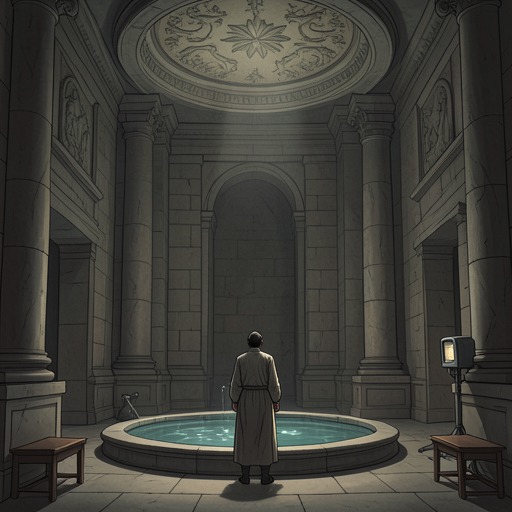
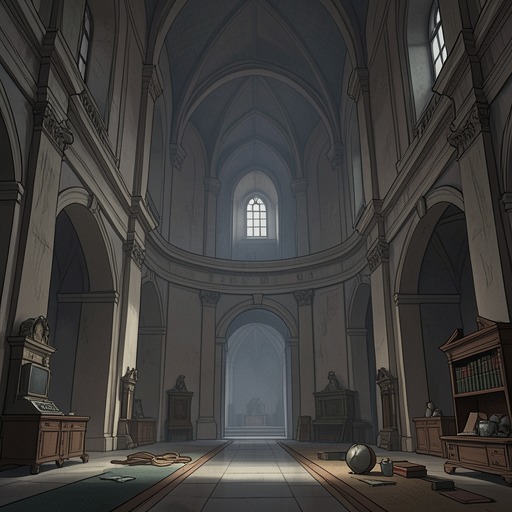
The House’s effect is not a simple loss of all memory. Piranesi recalls having visited 7,678 halls, and he can describe distant regions he has reached: the Upper Halls, the flooded spaces of the Drowned Halls, and the damaged halls in the east. He has travelled far west, north, and south, and his knowledge of the House supports the Other’s work. Yet this remarkable spatial memory coexists with losses elsewhere. The Other tells him that he forgets other things and loses time, distinguishing his reliable recollection of the labyrinth from an increasingly unstable grasp of his personal past.
That imbalance has practical consequences. The route toward the One-Hundred-and-Ninety-Second Western Hall passes through a vestibule where tides scatter debris from the Lower Halls. Piranesi knows the terrain and its hazards, but no longer has the shoes he once wore; jagged fragments make the journey riskier and more laborious. His knowledge of the route cannot restore what has changed in his circumstances. Memory’s limits are thus bound to daily survival as well as to abstract questions of identity.
Repetition and Recognition
The Other reveals that Piranesi has proposed stopping the search for knowledge before. Their discussion, he says, has happened twice already, making the current exchange their third repetition. The desire to abandon the search appears roughly once every eighteen months. Piranesi cannot recall those earlier conversations, so repetition becomes evidence of a recurring pattern that he cannot recognize from within his own memory.
The Other describes the House as capable of unpicking an entire personality and warns that lingering can lead to amnesia and mental collapse. He contrasts Piranesi’s relative coherence with James Ritter’s condition after a shorter period in the House, underscoring that exposure does not affect everyone in the same way. The Other’s account is therefore both an explanation of Piranesi’s missing memories and a warning about what prolonged residence may do. It also places Piranesi in a difficult position: the person who explains his impairment is also someone whose judgment and intentions matter to his safety.
The Journals and the Missing Years
Reading his old journal entries turns the Other’s warning into a personal discovery. Piranesi encounters words such as “Birmingham” and “Perugia” but cannot connect them with anything in the world as he understands it. He concludes that he has forgotten much more than he knew and that, when he wrote those entries, he had been seriously mentally unwell. The journal is at once his own writing and something he cannot read as meaningful evidence of a life he recognizes.
The scale of the missing past is also material. Piranesi believes he is about thirty-five, but the ten journals he possesses cover only five years. He concludes that he must have renumbered them himself and that twenty earlier journals are missing. The gap raises questions his surviving records cannot answer: what he did in those years and what further parts of his history have disappeared. The journals preserve evidence of continuity in handwriting and record-keeping, even as their contents expose discontinuity in memory.
At first, the discovery provokes fear and a wish to distance himself from the records. He leaves the journal behind rather than throw it away, and later decides to study it cautiously, in small portions. He sees two reasons to continue: its entries may contain information about people who lived before him, and they may help him understand what triggers his illness and how to guard against it. The records are therefore both a source of distress and a possible instrument of self-knowledge.
Living with the Constraint
Piranesi accepts the Other’s explanation that the House causes his forgetting, noting that both the Other and the Prophet have reached that conclusion. Acceptance does not mean surrendering trust in the House: when he asks himself whether he trusts it, he answers yes. The tension between the House as a source of impairment and as a trusted environment remains unresolved in his account. He attempts instead to manage the danger through practical care, making time to fish, repair his clothes, and attend to his health rather than becoming wholly absorbed in scientific work.
His adaptation also depends on method. In a separate encounter, he follows 16’s carefully written directions from the Sixth North-Western Hall toward the First Vestibule, marking doorways with yellow chalk and adding blue-chalk instructions beneath the existing route notes. The directions have been repeated under each doorframe so that they can survive a tide or accident. This procedure shows how written and spatial records can compensate for uncertainty: paths are made retraceable, and information is deliberately duplicated. Yet Piranesi’s own journals demonstrate the limit of such safeguards when the person reading the record no longer understands its words.
Later, the threat of memory loss shapes his decisions about 16’s safety. He believes the Other has set a trap and reasons that finding the Other may be the most reliable way to find 16, while also wishing to avoid him. Remembering the Prophet’s warning that Ketterley will become more dangerous as 16 approaches, Piranesi hopes to reach her first. The House’s effects on memory are thus not merely retrospective: uncertainty, dependence on other people’s accounts, and the need to preserve information influence immediate choices.
Identity, Records, and Departure
The surviving evidence does not reduce Piranesi’s identity to either his lost past or his present life in the House. His journal entries establish that he once knew a world whose names now seem meaningless; his detailed knowledge of the House and his care for its inhabitants belong to the person he is now. The gap between these forms of knowledge is the central strain of the condition: he can be exact about the labyrinth and profoundly uncertain about himself.
When Piranesi prepares to leave with Raphael, he takes his journals and favourite pens in his messenger bag. The records that once seemed to prove his madness are still worth carrying into the new world. Their presence makes departure more than a change of location: it preserves the possibility of continued inquiry into the person he was, without treating recovery of every lost memory as a condition of the life he has built. Memory loss remains a genuine constraint, but it does not erase his capacity to choose, care for others, and carry his own record forward.