James Ritter’s Imprisonment
PiranesiJames Ritter’s imprisonment by Laurence Arne-Sayles became public in 1997, when a cleaner discovered Ritter hidden in a room behind a false wall in Arne-Sayles’s house. The crime ended Arne-Sayles’s academic career, but it did not settle what had happened: Ritter could not initially give a coherent account, and his later insistence that he had lived in a house of statues and flooded halls remained at the center of competing explanations. The imprisonment is both a documented act of concealment and an unresolved point where the ordinary criminal record meets Ritter’s account of another world.
Discovery and Legal Consequences
In April 1997, a woman employed to clean Arne-Sayles’s house noticed liquid emerging from beneath a wall in a bedroom he described as unused. The room was in fact being cleaned, and when the cleaner pressed the wall, it shifted. She alerted the police, who found a concealed room behind the false wall and Ritter inside, seriously unwell and incoherent. The discovery made the imprisonment a matter of public and legal record, but it did not immediately establish how long Ritter had been held there or why.
Arne-Sayles’s academic career ended abruptly. Following a widely reported trial, he was initially sentenced to three years in prison. While incarcerated, he was convicted of encouraging other inmates to violence and riots; he ultimately served four and a half years and was released in 2002. He did not testify at trial and never explained why he had imprisoned Ritter, leaving a central question unanswered even after the prosecution and sentence.
Ritter’s Condition and the Uncertain Duration
After his discovery, Ritter was taken to hospital and treated for pneumonia, malnutrition, dehydration, and bipolar disorder. The police tried to establish the length of his confinement, but Ritter was unable to provide a coherent answer. They instead sought information from people who knew him, including drug users, social workers, and staff at hostels for homeless people. Their inquiries established only that Ritter had been seen in and around Manchester in early 1995. This made a confinement lasting as long as two years possible, but not definite.
Ritter’s own account, as he gradually became able to speak, did not resolve the timeline. He said that he had spent only brief periods at Arne-Sayles’s house in Whalley Range and had been at another house for most of the time. He often seemed to believe he was still there. In hospital, he became agitated on several occasions and said he needed to return because the minotaurs would have his dinner. Medication intended to control his delusions did not dislodge his account of a house with statues and a flooded basement. The contrast between the uncertainty of the police chronology and the persistence of this specific setting defines the record of his imprisonment.
Competing Explanations
Two theories were advanced about Arne-Sayles’s purpose. The first held that he had brainwashed Ritter to support his claims that other worlds existed and that he and others had visited them. Ritter’s description of the house resembled the vast, empty rooms in Sylvia D’Agostino’s film, The Castle, as well as the other world Arne-Sayles described in his prison book, The Labyrinth. Yet the resemblance does not establish how the account arose: Arne-Sayles might instead have elaborated on Ritter’s hallucinations. The theory also leaves a pointed difficulty unresolved—if Arne-Sayles wanted a witness to establish the reality of another world, Ritter’s history of delusional illness would seem to make him a questionable choice.
The prosecution offered a different line at the October 1997 trial, arguing that the kidnapping had more to do with Arne-Sayles’s unusual sexual interests than with his theories about other worlds. That account, too, fails to explain why Ritter spoke about a house with the sea in its basement. Neither explanation became a definitive account of motive. Arne-Sayles’s silence and Ritter’s persistent description keep the case from closing into a single, established interpretation.
The Account Persists
Angharad Scott attempted to interview Ritter for her biography of Arne-Sayles, but he refused to speak to her after taking offence that people did not believe his account of the house with the ocean imprisoned in it. In 2010, journalist Lysander Weeks tracked him down for a retrospective article on the scandal. Ritter was then working as a caretaker at Manchester Town Hall. Weeks described him as calm and self-possessed, and Ritter said he had been drug-free for a decade. Despite this change in circumstance, his account remained the one he had given the police.
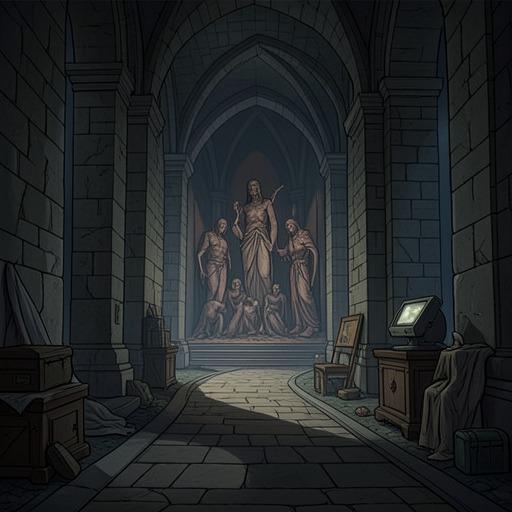
Ritter told Weeks that, for about eighteen months between 1995 and 1997, he had inhabited a large house where the sea flooded the basement and sometimes rose to the ground floor. He said he slept in a white, translucent cave beneath the marble sweep of a great staircase. These details were not independently established as an explanation of his imprisonment; they are the continuing form of Ritter’s own testimony. His refusal to abandon the account, even after leaving the hospital and rebuilding his life, makes it more than a transient statement made at the time of discovery.
Aftermath and Significance
Ritter credited his work at Manchester Town Hall with saving him. The building, with its large rooms, statues, and staircases, resembled the other house Arne-Sayles had taken him to, and that resemblance calmed him. The aftermath therefore did not simply erase the setting associated with his account: a comparable architectural environment became a source of reassurance in his later life. The same features that linked the Town Hall to the remembered house also gave Ritter a way to live with that association outside the confinement itself.
The imprisonment remains divided between what can be established and what cannot. The false wall, Ritter’s discovery, his hospital treatment, Arne-Sayles’s conviction, and the period of uncertainty about Ritter’s whereabouts belong to the documented criminal case. The reason for the confinement, its precise duration, and the status of Ritter’s flooded-house account remain unsettled. That unresolved boundary gives the episode its lasting significance: the record confirms the imprisonment, but does not make either the proposed motive or Ritter’s account fully legible.