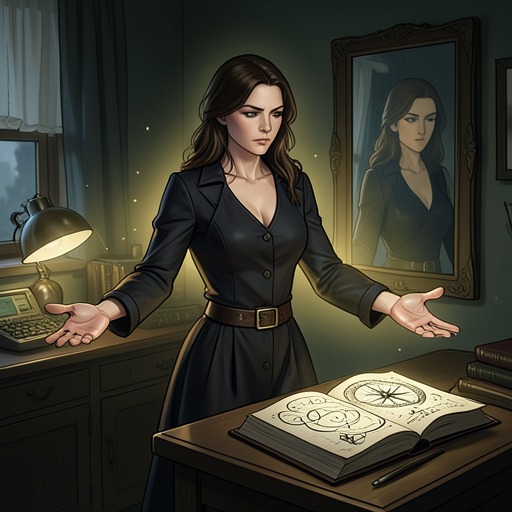
Magic and Its Moral Laws
PleasureMagic and Its Moral Laws is the ethical framework that separates Valera’s natural-born Witchcraft from necromancy, a practice that corrupts its users and turns power toward cruelty. Its decisive principle is that magic is not inherently evil: intention matters, but so do necessity, restraint, and the consequences of a spell. The distinction lets Valera defend herself without becoming what she fears, while forcing Sagan to reconsider beliefs that treat every human magic-user as an enemy.
Origins and the Divide Between Witchcraft and Necromancy
Valera’s understanding of magic begins with a dangerous misidentification. Before she knew what set her apart, she was relieved to find other people like herself among the necromancers. She later witnessed them capture Demons and stake out Vampires without evidence of wrongdoing, apparently for the pleasure of making them suffer. Seeing their cruelty changed her judgment: she fled, recognizing that the people she had mistaken for allies were becoming corrupted by their magic.
The distinction is also one of origin. Penchant tells Valera she is a natural-born Witch: her power comes whether she summons it or not, and her task is to learn control and use it well. Necromancers, by contrast, can be made. A Witch can also be turned into a necromancer if she lacks guidance or uses magic without care. Valera’s grandmother recognized the family’s gift and guided her before she fell in with necromancers, giving her an ethical foundation that helped her leave them.
The Nightwalkers’ hostility has a history behind it. Their people have been hunted and tortured by necromancers, whose black magic leaves a detectable stain and whose power can be deadly to Shadowdwellers. Sagan associates that corruption with an offensive odor, likening it to gasoline and fetid garbage. To him, magic is not an abstract danger: it is bound to the harm his people have endured.
Intention, Restraint, and Corruption
Valera’s rule is that a spell’s moral quality depends on its intent. Healing and protection can be good when used to help; the same capacity can be abused. A person who uses a stasis spell to escape responsibility for a crime, or heals a serial killer so that he can continue killing, directs power toward a harmful end. Repeated misuse makes wicked choices easier, and the resulting darkness can eventually overwhelm the person who once wielded the magic.
Good intent alone does not make every use harmless or automatically wise. Even healing and protection can turn the soul bad when used without moral discretion. Magic therefore demands judgment about both purpose and circumstance, rather than a simple division between benevolent-looking spells and dangerous ones. Valera’s fear of harming someone—or herself—reflects this continuing responsibility: she has learned to use power cautiously, not to regard herself as incapable of wrongdoing.
The cost of her earlier mistakes makes that caution concrete. Valera says it took five years to cleanse the stain left by four months of bad magic. She remains afraid of making another mistake. When she finally uses magic against someone after nine years without doing so, she expects the blackness she associates with corruption and is devastated by the deaths connected with the encounter. But that anticipated stain does not arrive. The use is judged proper; the deaths are treated as unfortunate collateral damage rather than evil she placed into the world. The distinction rests on the circumstances: evil entered the safety she was protecting, and her magic drove it out.
Power, Practical Limits, and Risk
Valera’s magic is visible and potentially dangerous to Shadowdwellers. When she invokes an aggressive spell, blue energy radiates from her and can sear them almost instantly. She demonstrates the danger when she gathers strength through her body, thrusts out her hands, and sends crackling blue fire at two men. The balls strike both targets; a bright field envelops them, delivering an electrical shock intended to knock them unconscious and holding them in stasis for as long as she sustains the spell. The power’s capacity to protect her is inseparable from its capacity to injure someone vulnerable to its light.
Not every spell produces that light. Valera shows Sagan a quiet alternative by sweeping two fingers and lifting muffins from their pan into a neat circle on a nearby plate. He identifies the act as passive telekinesis, but she does not claim that convenience makes every use ethically neutral. Household magic occupies a gray area: she can do the task herself, so using magic simply to avoid effort can become abuse. If illness or disability made the spell necessary, its purpose would be different. The example makes the moral law practical: the same ability may be acceptable in one circumstance and excessive in another.
Sagan’s Recognition and the Meaning of the Rules
Sagan initially understands magic through the experience of his kind. He knows that necromancers have destroyed those they capture and that their corruption is perceptible to Shadowdwellers. Valera’s past therefore gives him reason to fear her, but her memories also show that she rejected the necromancers after witnessing their treatment of a Demon. She had not embraced their cruelty; she had escaped it, despite the attraction and addictive pull of black magic.
What changes Sagan’s understanding is the absence of the mark he expects. Though Valera has recently used power he considers a dark art, he detects no stain on her. He concludes that the magic did not corrupt her because she is fundamentally unlike the people his kind has fought. He compares evil magic to cocaine or methamphetamines: one taste can initiate corruption, which then deepens. Against that pattern, Valera’s ability to break away becomes evidence of moral strength, not proof that she was always one of the enemy.
The framework does not erase the danger between them. Sagan explains that Valera’s light can hurt Shadowdwellers, and she fears that he will kill her if he discovers she uses magic. Their exchange instead distinguishes power from identity: magic can be dangerous without making its user evil, and a history of corruption need not define someone who has resisted and escaped it. The rules make intention accountable, but they also leave room for discernment, recovery, and trust.