London Library
PossessionThe London Library is a private scholarly institution and Roland Michell’s favourite place, but in the novel it is more than a hospitable setting for research: its stacks preserve a material trace of Randolph Henry Ash’s thought that unsettles the boundaries between book, archive, and manuscript. In September 1986, a volume retrieved from a locked safe yields Ash’s own annotations and interleaved papers, giving Roland the first evidence from which he begins to pursue Ash’s connection to Christabel LaMotte. The Library’s decision to let him study the fragments, and his decision to copy and keep them, make its collections the starting point of both discovery and ethical conflict.
Setting and Collections
The Library is shabby but civilised, a place where historical memory coexists with working intellectual life. Roland remembers its metal-floored stacks, where poets and thinkers sit among the books or pause to argue on the stairs. Carlyle and George Eliot belong to its history; Ash, too, had used it, filling his mind with material drawn from subjects as various as history, topography, science, dancing, death, dentistry, dreams, and domestic servants. Its catalogue preserves signs of older habits of knowledge: works on evolution had once been listed under “Pre-Adamite Man.”
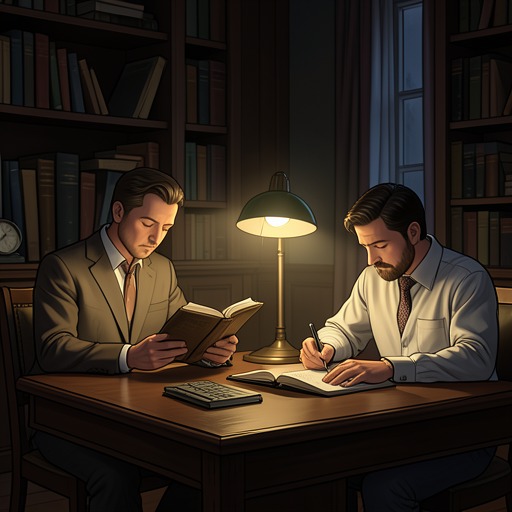
That layered past makes the Library particularly meaningful to Roland, whose attachment to it is both professional and personal. He prefers a small table behind a square pillar in the Reading Room, with a clock in view and a sunny window looking onto St James’s Square. The scene of discovery is grounded in the ordinary arrangements of research: a requested book, a designated reading place, a librarian, and rules for handling fragile material. The extraordinary archive is not found in a remote ruin but inside a working library where the past remains physically accessible.
Ash’s Vico and the Hidden Papers
Roland has recently learned that the Library owns Ash’s copy of Vico’s Principi di una Scienza Nuova. Ash’s books are scattered across Europe and America, while the largest single collection is at the Stant Collection at Robert Dale Owen University, where Mortimer Cropper is preparing an edition of Ash’s correspondence. Roland therefore suspects that the London volume might preserve marginalia that Cropper has missed. He is also looking for sources for Ash’s poem The Garden of Proserpina, and values the prospect of reading the sentences Ash himself had read.
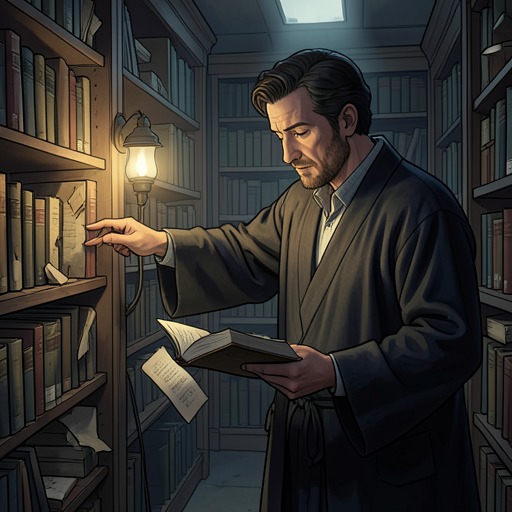
The volume arrives from Locked Safe no. 5, where it normally stands between Pranks of Priapus and The Grecian Way of Love. Thick, black with dust, bowed, and missing its spine, it has been bound about with dirty white tape. When Roland opens it, the book springs apart and releases faded leaves in blue, cream, and grey. They bear rusty writing in Ash’s hand, but are not conventional inserted pages: they are notes on Vico written on the backs of bills and letters, concealed among the leaves. Their soot-black edges align precisely with the stains on the surrounding pages, suggesting that the fragments have remained in position, undisturbed, for a very long time.
The discovery joins the material history of a book to the history of an idea. Roland finds Vico’s account of seeking historical fact through the poetic metaphors of myth and legend, a method Vico calls his “new science.” Vico’s Proserpine represents corn and the origins of commerce and community; Ash’s Garden of Proserpina had instead attracted interpretations concerning religious doubt, resurrection, and the personification of early mythical history. The annotations therefore matter not only as traces of Ash’s reading but as possible evidence for the intellectual sources and meanings of his poetry.
Access, Custody, and Roland’s Choice
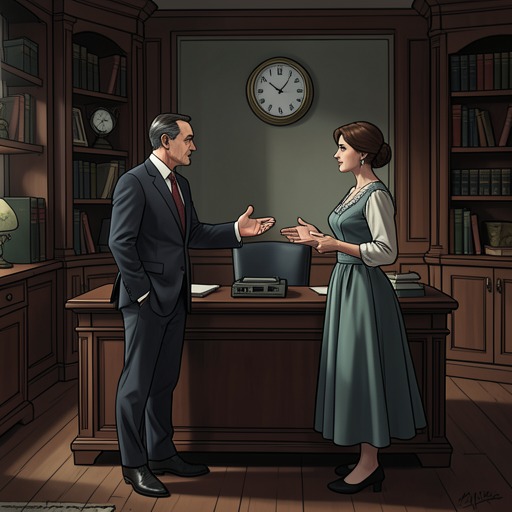
Roland asks permission to study the jottings and gives his credentials as a part-time research assistant to Professor Blackadder, who has been editing Ash’s Complete Works since 1951. The librarian telephones before agreeing, and permits the research on the condition that Roland not disturb the sequence of fragments before they have been listed and described. The institution thus grants access while asserting a duty of preservation: the order of the papers is itself evidence, not an inconvenience to be rearranged during reading.
Roland later makes photocopies of two letters, records the modest copying charge in a departmental notebook, and recognizes the difference between lawful consultation and his own desire to possess the originals. The Xerox images are cleaner than the faded, coppery-grey writing; nevertheless, he wants the source papers, not merely reproductions. Although he has been critical of people who treasure objects because a celebrated person touched them, the original fragments exert precisely that pull. His growing sense that the papers are his leads him to withhold his discovery from Blackadder until he has satisfied his own curiosity and returned the documents. The Library’s access rules cannot by themselves settle the question of scholarly ownership or ethical responsibility.
The institution’s role becomes explicit when Roland explains the chain of discoveries: he found two draft beginnings of a letter among the papers in Ash’s Vico, investigated the breakfast meeting with Crabb Robinson, identified Christabel LaMotte, and then sought out Maud Bailey. The research grows outward from a physical document, but the Library supplies the first link in the chain. Roland’s account makes clear that the book’s contents lead him toward a private history that its owner never intended as a public archive.
Interpretive and Narrative Significance
The London Library is where reading turns into a material encounter. The book is at once a text Roland consults, a container that releases fragments, and an object whose dust, bindings, stains, and sequence help establish the history of those fragments. Its transformation from an apparently neglected volume into a source of new evidence makes archival knowledge dependent on attention to physical form as well as interpretation.
The Library also stages a tension between public scholarship and private possession. It allows Roland to read Ash’s papers but expects them to remain intact and properly documented; Roland, meanwhile, wants both the intellectual discovery and the originals themselves. That conflict anticipates the novel’s wider questions about who may claim, reproduce, interpret, or disclose private papers. When Roland later remembers the dark leaves flying out of Ash’s Vico, the Library remains the scene that connects scholarly curiosity with the pleasure of reading and the responsibilities attached to discovering what the past has left behind.