Stant Collection
PossessionThe Stant Collection is the largest single gathering of Randolph Henry Ash’s dispersed books and papers, housed at Robert Dale Owen University in New Mexico and associated with Mortimer Cropper’s monumental edition of Ash’s correspondence. More than a repository, it is a center of scholarly authority and a contested point in the novel’s history of documents: what survives, who can consult it, and what custodians choose to preserve or destroy all affect the story reconstructed from the archive.
Institutional Role and Holdings
The Collection brings together Ash materials otherwise scattered across Europe and America. Its significance is sharpened by the contrast with the London Library, where Roland Michell discovers Ash’s own copy of Vico’s Principi di una Scienza Nuova, concealing interleaved notes that may have escaped even Cropper’s attention. Books can travel electronically, but the originals retain a distinct evidentiary force: their arrangement, material traces, and annotations can disclose what an established edition has not captured.
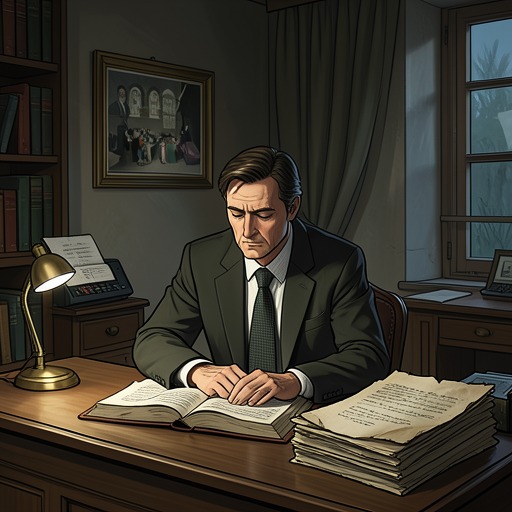
Cropper works at the Collection on his monumental edition of the Complete Correspondence of Randolph Henry Ash. His editorial enterprise gives the institution a public scholarly purpose, but it also places him in a position to shape how Ash’s papers are interpreted. A letter from Cropper’s great-grandmother, Priscilla Penn Cropper, appears in Cropper’s Collected Letters and is excerpted in the notes to Mummy Possest in the Complete Works, under the overall direction of James Blackadder. The Collection’s scholarly output thus depends on acts of selection and annotation as well as on the documents themselves.
Access, Custody, and Archival Gaps
The novel repeatedly distinguishes possession of a document from authority to read or interpret it. Roland’s discovery of Ash’s Vico notes begins in a different library, where a librarian permits him to study the fragile fragments only on condition that he preserve their sequence until they have been listed and described. The episode makes original order part of the evidence: the papers’ placement within the book and their soot-darkened edges testify to their long, undisturbed custody. Such care contrasts with Roland’s later desire to keep the original letters for himself rather than return them after making photocopies.
The Collection’s holdings are also incomplete. Christabel LaMotte’s papers, deposited in an archive through Maud Bailey’s family, include manuscripts, undated lyrics on loose slips, a commonplace book, friends’ letters, revisions of Melusina, and a three-year diary by Blanche Glover. Maud reports that no care was taken of some materials and that no further papers have surfaced. The absence is not simply an empty space around an otherwise complete record: it limits what researchers can establish about LaMotte’s life and writing.
Competing Claims and the Ethics of Preservation
The Collection is implicated in a wider struggle over access to private papers. Leonora Stern reports that Cropper has been reading faxes of letters from LaMotte to Priscilla Penn Cropper, material that brings the institutional archive into contact with a private family correspondence and its expressions of guilt. Elsewhere, Leonora describes rumors of manuscripts disappearing from small collections after Cropper had tried to acquire them, including a letter concerning Margaret Fuller. Roland offers a sympathetic explanation—that Cropper feels the objects are his because he loves them most—but the account leaves the ethical tension intact: scholarly devotion can coexist with acquisitive control.
The novel sets this impulse against the destruction and concealment of private records. In Ellen Ash’s journal, she recalls Randolph’s request to burn what others should not see and describes burning some papers while deciding that she could not destroy the letters between him and LaMotte. She buries those letters with him instead. Later, Cropper’s opening of the specimen container from the Ashes’ grave reveals a bundle of letters tied with ribbon, a hair bracelet, a plaited lock of pale hair, and a sealed letter addressed to Ash. The objects expose the limits of any archive built only from what remains accessible: some records have been burned, others deliberately hidden, and still others recoverable only by violating a grave.
Narrative Significance
The Stant Collection embodies the novel’s central question of how documentary survival becomes historical knowledge. Editions and institutional holdings make texts available, yet annotations, missing papers, private transfers, and contested access mediate every account. Cropper’s collection-building and editorial work gives him exceptional reach over Ash’s legacy, while discoveries made elsewhere reveal that the archive’s apparent completeness cannot be trusted as final.
By placing a powerful research collection alongside dispersed manuscripts, damaged records, family archives, and concealed letters, the novel makes preservation an ethically charged act rather than a neutral end point. The Stant Collection can conserve and circulate evidence, but it also concentrates the authority to decide what counts as evidence—and leaves the past vulnerable to the choices of collectors, editors, heirs, and readers.