Ash Factory
PossessionThe Ash Factory is James Blackadder’s research and editorial operation devoted to Randolph Henry Ash, based in the British Museum and sustained by a small grant from London University and a larger grant from the Newsome Foundation. Part scholarly workshop and part contested archive, it organizes the labor of editing Ash’s writings while making visible the obstacles that shape that labor: precarious funding, dispersed manuscripts, rival claims to custody, and an ever-growing mass of evidence. Its name suggests a single enterprise, but its work is defined by many hands, incomplete records, and the difficulty of bringing a life’s writing into order.
Purpose and Institutional Setting
Blackadder’s Ash Factory operated from the British Museum, where many of Ash’s poetry manuscripts had been deposited by his wife, Ellen, after his death. Blackadder had been editing Ash’s Complete Poems and Plays since 1959, initially imagining the edition as a finite undertaking that would eventually give way to other work. Instead, the project expanded into an enduring institution of research. By 1986, Roland Michell was employed there part-time as a research assistant, and the operation remained a workplace as well as an editorial enterprise: its grants, staff, and access to manuscripts shaped what its scholars could investigate.
Its institutional support connected it to a wider contest over Ash’s papers. The Newsome Foundation’s trustee Mortimer Cropper was simultaneously producing a monumental edition of Ash’s complete correspondence from the Stant Collection at Robert Dale Owen University in New Mexico. Blackadder suspected that Cropper was cultivating the goodwill of owners of manuscripts deposited in Britain but not owned by the British Library, with the aim of gaining access to them. Blackadder’s conviction that British writings should remain in Britain and be studied by British scholars made editorial work inseparable from questions of national custody and scholarly authority. The competing projects did not amount to a harmonious division of labor: they were rival approaches to a dispersed archive and to who could claim leadership in Ash scholarship.
Workspace and Working Methods
The Ash Factory occupied a lower, enclosed part of the British Museum, sharply contrasted with the luminous, ordered Reading Room above. Blackadder’s editing operation was surrounded by metal cabinets and glass-fronted compartments; typewriters clattered under neon lighting, and micro-readers glowed in the dimness. The contrast gives the institution a double character: the great reading room evokes the collected authority of learning, while the Factory’s cramped rooms show the material labor required to assemble that apparent order.
Within the workshop, disorder and system coexisted. Blackadder sat among paper slips, index cards, and bulging files, sorting fragments of research into the apparatus of a major edition. His assistants were dispatched to libraries with numbered queries, half-lines of possible quotation, or names to locate. Their work ranged across the extraordinary breadth of Ash’s interests, from astronomy, transport, and mythology to natural history and religious subjects. The accumulation could become unwieldy: the footnotes threatened to engulf the poems, and every answer seemed to generate further questions. For Blackadder, that growth was not a reason to abandon documentation; the expanding apparatus was necessary to make Ash’s wide-ranging writing intelligible.
The operation’s methods were not uniform. Cropper’s practice required researchers to transcribe Ash’s texts, transcribe their own transcriptions, and compare them closely for errors, a discipline he continued even when photocopying made reproduction easier. Blackadder, by contrast, was not associated with that same formal routine, though he corrected numerous errors and criticized students’ preparation. The comparison presents editorial accuracy as both a technical procedure and a professional ethic: texts do not become reliable merely by being copied, and an edition depends on decisions about how much verification its editors demand.
People, Records, and Access
Blackadder’s operation brought together workers with unequal roles and differing access to the archive. Roland entered it as a part-time research assistant after completing a doctorate on the presentation of historical evidence in Ash’s poems under Blackadder’s supervision. Blackadder’s demanding, discouraging manner formed part of the professional environment in which Roland worked. Paola, Blackadder’s clerical assistant, moved among the files and papers, while Beatrice Nest worked in a separate, cabinet-enclosed room among Ellen Ash’s diary and correspondence. The Factory was therefore not simply a single editor’s desk: its research depended on specialized labor and on collections held in distinct rooms and under distinct custodial circumstances.
The surviving records were uneven. The archive associated with Christabel LaMotte contained manuscripts, undated lyrics on loose slips, a commonplace book, letters, revisions of her poem Melusina, and one of Blanche Glover’s diaries, but Maud Bailey acknowledged that little material survived and that earlier papers had not been carefully preserved. LaMotte was not known to have kept a journal; a letter to a niece instead advised against habitual self-examination, distinguishing artistic discipline and daily obligations from a written record of the self. These absences matter to the Factory’s wider world: scholarship can describe only what has survived, and a missing document is not proof that an event or relationship never existed.
The Archive’s Fragility and Consequences
The material history of Ash’s papers repeatedly unsettles the idea that the archive is a stable, complete body of evidence. At the London Library, Roland found Ash’s copy of Vico’s Principi di una Scienza Nuova apparently undisturbed for a very long time. When the bindings were opened, interleaved notes on faded scraps of paper emerged from the book. The fragments retained their sequence and the darkened edges of their former position; the librarian permitted Roland to study them only on condition that he not disturb their order before they were listed and described. Here the research ideal of access meets a custodial obligation: the discovery’s value depends not only on reading the fragments but also on preserving the arrangement in which they were found.
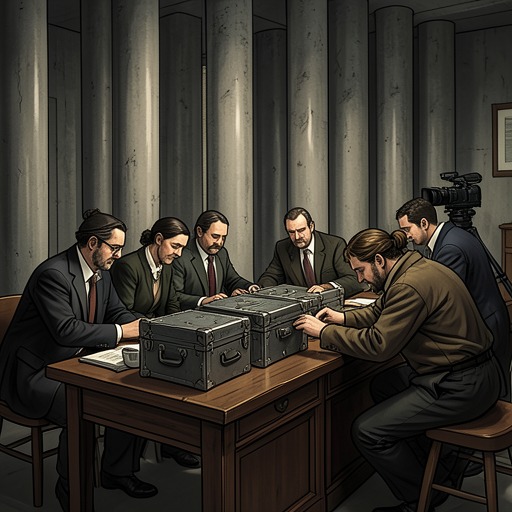
Other records had been deliberately destroyed or concealed. Ellen Ash wrote that after Randolph’s death she burned materials she believed should remain private, fearing that future biographers would turn intimate papers into curiosities. She could not burn everything, including letters that were not hers to destroy, and decided to place those letters with Ash in his grave. Much later, when Cropper opened the recovered specimen container, it yielded a hair bracelet, a finely plaited thread of pale hair, a bundle of ribbon-tied letters, and a sealed envelope addressed to Randolph Henry Ash. The items made material custody central to interpretation: what was preserved, what was burned, and what remained unopened determined which evidence later researchers could encounter.
The Factory’s significance lies in this tension between editorial order and archival incompleteness. Its workers seek to correct, classify, and explain Ash’s writings, yet the papers themselves remain dispersed among institutions and private custodians, shaped by family decisions and uneven preservation. The expanding notes and unresolved questions are not incidental to the project; they show why editing a poet’s work can never be reduced to producing a clean text. The Ash Factory makes scholarship visible as labor over both what survives and what the surviving record cannot settle.