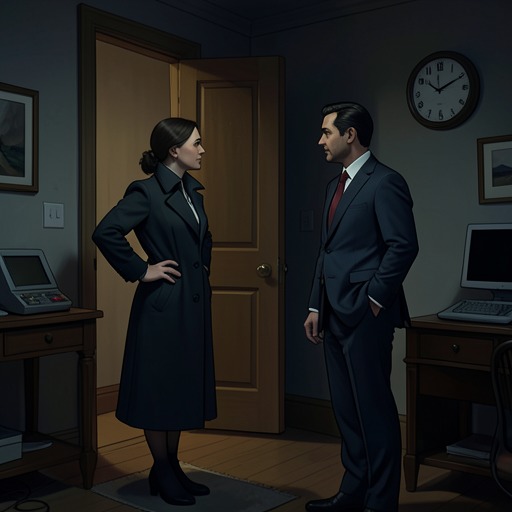
Queenie and Cassandra’s friendship breakdown
QueenieQueenie and Cassandra’s friendship breakdown turns a hidden relationship into a rupture that neither apology nor their nearly decade-long history can immediately repair. When Queenie discovers that Guy is Cassandra’s boyfriend, she insists she did not know; Cassandra instead sees Queenie’s sexual behavior since her breakup with Tom as evidence of self-destruction and betrayal. Their fallout moves from a confrontation in Cassandra’s home to silence, repeated attempts at contact, and Cassandra’s decision to leave London with Guy.
Background: loneliness and casual sex
After her separation from Tom, Queenie is left without the partner she describes as an ally. At a party, Darcy Betts and Fran recruit a group of six school friends to make Queenie an OkCupid profile. Queenie says she does not want to participate, but she is tipsy and goes along as Fran takes her phone and directs her to pose against a white wall. The scene presents dating not as a settled new beginning but as an activity assembled around Queenie while she is drinking to drown her sorrow.
Another encounter underscores her wish to escape the loneliness of going home. In an Uber, a Welshman suggests going back to her place. Queenie tells herself the encounter can remain a fling without personal details, partly because she cannot bear another night alone in a cold bed, wrapped in Tom’s T-shirt. The man’s touch becomes forceful: he digs his nails into her thigh, bites her cheek, and grabs her head to force a kiss. Queenie punches him in an attempt to make him stop. This episode does not involve Cassandra, but it shows the painful mix of loneliness, boundary-setting, and casual sexual encounters that forms the context for Cassandra’s later accusation that Queenie is using sex to fill a void.
The discovery and confrontation
The rupture becomes explicit when Cassandra identifies Guy as her boyfriend. She pushes Queenie’s shoulder and says that the two have barely been having sex because Guy has been sleeping with Queenie. Guy lowers his head into his hands and apologizes. Cassandra charges toward him, trips on the first step, and falls onto her knee; Queenie rushes to help her. The physical scramble does not interrupt the disclosure: Queenie has been involved with her friend’s partner, even though she says she did not know who he was.
Queenie pleads that she met Guy at a party, that he told her nothing about himself, and that she would not knowingly do this to one of her best friends. Cassandra answers that Queenie is miserable and pathetic, and accuses her of sleeping with Guy and many others since breaking up with Tom. She says Queenie makes her sick, then leaves, slamming the front door. Queenie turns on Guy as well, telling him to get out; she feels overwhelmed by disgust, regret, and distress. Cassandra’s accusation that Queenie knew, and Queenie’s insistence that she did not, become the irreconcilable accounts at the center of the break.
The conflict continues beyond the room. When Queenie gets home, a notification in The Corgis group chat announces that Cassandra has left. The departure makes the loss public to their circle rather than leaving it as a private argument between the three people involved. Queenie’s immediate response is to try to restore contact: three weeks later, she sends Cassandra an apology and says she does not know what to do. The iMessage bubble turns green, leading Queenie to wonder whether Cassandra’s phone is off or whether she has blocked her. She has tried every means of communication she can think of except fax and telegram. Kyazike suggests going to Cassandra’s home to speak with her directly, while Darcy Betts advises giving her space and time.
Silence, messages, and the move
Cassandra eventually sends a message saying they can talk that evening if Queenie will stop sending messages; she calls the pursuit tiresome. Queenie tries calling twice, but Cassandra does not answer, and the conversation proceeds by text. When Queenie visits, boxes in Cassandra’s room make clear that the matter is no longer only whether they will speak: Cassandra is leaving and moving with Guy to Winchester.
Queenie had expected an apology. Instead, she lays out why Cassandra’s choice seems incomprehensible to her: she has talked about a boy for months, the two women have not been sleeping together, and Cassandra has now seen Guy leave Queenie’s bedroom. Queenie argues that Guy cheated throughout his relationship with Cassandra and asks why Cassandra would choose him, especially when she does not know him well. Cassandra refuses Queenie’s attempt to stop her packing, saying the move is about her own life rather than a choice between the two of them. She says Guy offers stability, that she loves him and believes he loves her, and that she cannot keep having Queenie’s problems as the only consistent feature of her life.
As she packs, Cassandra’s explanation turns into a personal indictment. She calls Queenie damaged and self-destructive, says Tom was too good for her, and argues that Queenie is so closed off from love that she settles for sex. She also invokes Queenie’s mother. The remarks strike at Queenie’s self-worth as well as at the immediate betrayal; Queenie asks how Cassandra can say them after almost a decade of friendship. Cassandra seals a box with brown tape, tells Queenie to take care, and continues packing. The ordinary action of preparing a move gives the end of their friendship a material form: Cassandra is not merely walking out after an argument but putting her life into boxes.
Wider pressures and significance
The breakup unfolds amid other forms of instability in Queenie’s life. At work, Ted Noman files an HR complaint accusing her of paying him attention and making suggestive remarks, and Gina Row tells Queenie she is being suspended while the complaint is investigated. Gina also points to Queenie’s lateness, distraction, failure to contribute to the paper, and difficulty looking after an intern. These workplace problems are not presented as consequences of Cassandra’s departure, but they help establish that the friendship rupture takes place within a broader period of impaired functioning and strained relationships.
Later, speaking with Janet, Queenie describes how being a Black woman shapes her everyday encounters and the sexual attention she receives. She contrasts the dinner invitations her friends get with men’s assumptions that she is available for sex, and connects those experiences with a fear of being rejected for who she is. Her account gives wider context to the loneliness and sexual objectification behind Cassandra’s charge that Queenie uses sex to fill a void. It does not erase the harm between the friends or settle their conflicting accounts of what Queenie knew; instead, it shows the larger pressures under which intimacy, self-worth, and fear of rejection have become entangled for Queenie. Cassandra’s departure to Winchester leaves the relationship unresolved in the evidence presented: Queenie seeks forgiveness, while Cassandra chooses distance and a new life with Guy.