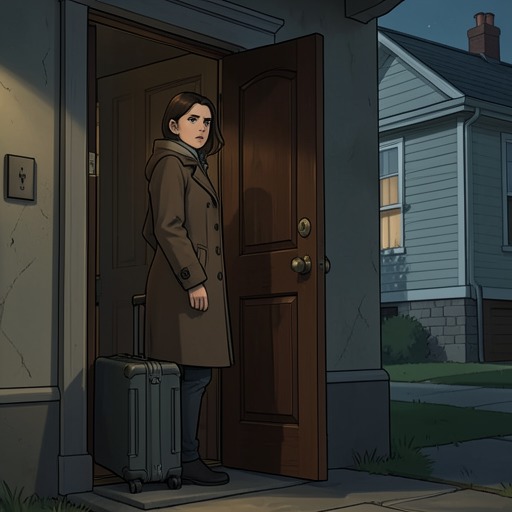
Queenie’s night terrors and sleep paralysis
QueenieQueenie Jenkins’s night terrors and sleep paralysis make her distress intrude into sleep and the shared space of family life. They are not presented as an isolated symptom: Queenie describes being frightened at night, exhausted, unable to sleep well, and anxious about ordinary activities, while also fearing that her sleep will disturb the grandparents with whom she is living. Later, she takes comfort in a stretch of time without the most disruptive episodes, but treats that improvement as real without assuming it will last.
Symptoms and Their Effects
In a conversation with her therapist Janet, Queenie describes nightmares and sleep paralysis alongside persistent tiredness and a sense of being frightened, especially at night. She says that, while asleep, she physically fights the people who share her bed. The account gives the night terrors a bodily and relational consequence: sleep is not simply difficult for Queenie, but can become an experience that affects those close to her.
Her nights sit within a broader pattern of anxiety. Queenie tells Janet that she worries something terrible is about to happen, even when she cannot identify a reason, and that small tasks she once managed without thinking—going to the shop or eating—now make her nervous. Her stomach repeatedly flips, her appetite closes off when she is upset, and she sometimes feels frantic, as though several problems are unraveling at once. The night terrors are therefore one part of a distress that reaches across sleep, appetite, concentration, and everyday functioning.
Life with Her Grandparents
After moving in with her grandparents, Queenie has to adjust to a household routine that includes being sent to bed at 10 p.m. The rule does not make night restful: she says she lives in fear that her night terrors will scare either grandparent. That fear adds anticipation to the symptoms themselves, making bedtime a point at which she worries not only about what may happen in her sleep but about its effect on the people sharing her home.
The episodes also leave traces in family life beyond the immediate night. Queenie later measures improvement partly by the absence of incidents in which she has punched her grandmother during the night or fallen out of bed. These concrete signs show why the symptoms matter to her: their easing means a reduction in the risk of physical disruption as well as a reprieve from fear and poor sleep.
Wider Distress and Context
In therapy, Queenie struggles to explain her condition in clinical language and apologizes for not knowing the right terms. Janet tells her that finding those terms is the therapist’s responsibility and invites her to describe what she feels. Queenie’s account is consequently grounded in her own experience—fear, exhaustion, bodily discomfort, disrupted sleep—rather than in a diagnosis supplied by her. Her image of several balls of wool unraveling conveys how she experiences the symptoms as interlocking and increasingly hard to manage.
Queenie also confronts the pressure of trying to become normal again. In another session, she insists that she cannot set aside being a Black woman as she moves through work and public life, and describes the racist and sexualized assumptions imposed on her. At work, she has also tried to argue that Black Lives Matter responds to lives that have not been valued, only to leave a meeting feeling defeated and more alone. These scenes establish the social pressures surrounding her distress; the narrative does not identify them as a single cause of the night terrors, but places her symptoms within a life shaped by fear, isolation, and repeated exposure to racism.
Change and Significance
Queenie considers whether her pregnancy and miscarriage brought her unresolved feelings about her mother back to the surface. In speaking with Janet, she reflects on her mother’s hardship after Roy drove the family out and recognizes a resemblance between her mother’s earlier collapse and her own self-destructive period. The conversation ends with her dark thoughts quieting, but it does not establish a definitive explanation for the night terrors. Instead, it shows Queenie beginning to connect present distress with painful family history while remaining uncertain about what started it.
Later, Queenie tells herself that the night terrors have eased, noting that she has not punched her grandmother in her sleep or fallen out of bed for a significant time. She places this change beside other signs of recovery and the coping tools she has acquired, including deep breathing and finding safe spaces. Her qualification matters: improvement is not a promise that the symptoms are gone forever. The movement from fearing what may happen at night to recognizing a sustained interval without those incidents gives the state a non-linear arc, in which relief is meaningful precisely because it does not erase the possibility of recurrence.