Queenie’s Experiences of Anti-Black Racism and Racialized Sexualization
QueenieQueenie’s Experiences of Anti-Black Racism and Racialized Sexualization are not confined to public slurs or strangers’ advances: they shape what safety and intimacy mean to her, and how she is treated by partners, friends, and colleagues. The novel places overt hostility beside fetishizing attention and institutional disbelief, showing how different forms of racialized treatment can converge on Queenie’s body and leave her questioning whether she can be loved without fear of rejection.
Racism in Intimate and Family Settings
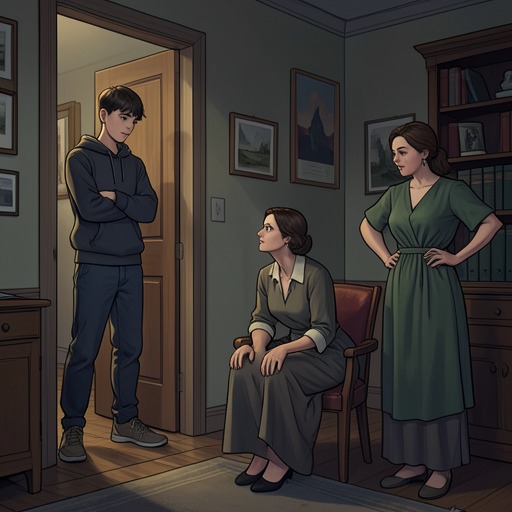
At Tom’s mother’s birthday party, Queenie hears Tom’s uncle Stephen make a racist joke using an anti-Black slur. When she turns to Tom for support, he avoids her gaze and looks toward Adam; Adam dismisses the remark as a joke and points out that the Clue character is Black. Queenie challenges them for acting as if she is not present and says she will leave if they continue to ignore what was said. As she rushes out, she collides with Viv, who is carrying a birthday cake made by her ninety-five-year-old great-aunt. The cake falls, its iced “60” still intact, and Tom responds by blaming Queenie for what she has done rather than addressing the insult that drove her from the room.
Queenie leaves the house and sits alone at a bus shelter until it grows dark. In the quiet, she wonders whether Tom would defend their children if his uncle continued making racist jokes, or whether the children would have to face hostility from their own family. She also begins to recast the incident as something she should have handled better, repeating to herself that Stephen did not mean it. Her self-correction makes the cost of the encounter visible: in the absence of anyone affirming her account, she tries to reduce the harm and locate the fault in her own response.
Tom eventually finds her, apologizes for getting angry, but then tells her she cannot keep reacting this way. He contrasts her family’s loud arguments with his family’s way of handling problems, says he cannot protect her when she sees his relatives as the threat, and invokes Stephen’s generation as an explanation for the slur. Although he adds that this does not excuse it, he also insists that Queenie cannot ruin his mother’s birthday over it. The exchange turns the question from what Stephen said to how Queenie responded; Tom’s eventual gesture is to hand her coat and rucksack, containing her belongings, rather than offer the defense she had sought.
Dating, Fetishization, and the Search for Attention
After the separation from Tom, friends rally around Queenie at a party and, despite her reluctance, take her phone to build an OkCupid profile. The exercise begins as a group attempt to cheer her up, but it also turns her body into the profile’s selling point: Fran pushes her against a white wall and urges her to emphasize her voluptuous figure and lips. Too tipsy to stop the process, Queenie is placed in the position of being presented to potential dates before she has decided she wants to date at all.
The app’s first messages make the limits of that attention plain. One man asks, “How big would your tits be in my hands?”; another asks what else her mouth does. A third reduces her to “Chocolate girl ;)”. The sequence moves from sexual appraisal to racial fetishization with almost no transition, as if Queenie’s body and Blackness were interchangeable invitations. Her profile also attracts a man who praises it before claiming that, although he is not Black, she would not know it from his penis. The attention is not the recognition she wants: Queenie adds details to her profile’s About Me section in the hope of reminding men that she is a person as well as someone they might have sex with.
A later encounter repeats the same uncertainty in person. After drinking heavily and dancing at a party, Queenie meets an unnamed Welshman at the bar. He compliments her hair and reaches to touch it; she ducks away and tells him not to, and he acknowledges that he should not touch a Black woman’s hair. They kiss soon afterward. He tells her he worked in Cameroon for a year and therefore has a thing for Black women, leaving Queenie unsure whether he is fetishizing her or simply finds her attractive. She pushes the question aside because he is a good kisser, but the doubt remains part of the encounter rather than being resolved by his attention.
In the Uber, Queenie frames the night as a fling with boundaries and no personal details. Her reasoning is bound up with the loneliness she is trying to escape: going home would mean another cold, empty bed and falling asleep in Tom’s T-shirt. The Welshman’s behavior soon exceeds the terms she has set in her own mind. He digs his nails into her thigh, bites her cheek, and grabs the back of her head to force their faces together; when she punches his leg to make him stop, he questions whether she dislikes it. The scene sharply separates being desired from being safe. Queenie seeks a temporary reprieve from rejection, while the man’s racialized interest does not guarantee care for her boundaries.
Hair, Public Space, and Bodily Boundaries
The attention directed at Queenie’s body is not limited to dating. In describing Kyazike, Queenie dwells on the way her friend’s dark skin, sharp eyes, carefully chosen weave, and athletic figure attract frequent advances; Kyazike’s appearance is treated as a public invitation, even as she and Queenie share the language of comparing their bodies. Kyazike counters Queenie’s silent comparisons by reminding her that she can tone up and that body is not everything. The friendship offers a counterpoint to the men’s appraisals: Queenie’s body is discussed between friends, but Kyazike’s reassurance does not make the outside scrutiny disappear.
At a club, that scrutiny becomes an overt violation of Queenie’s bodily boundary. After someone reaches to touch her hair, the bouncer directs Queenie and Kyazike to leave. Kyazike challenges the club’s tolerance of patrons who touch Black people as if they were animals in a petting zoo, but the women are still ejected. Riding home, Queenie is astonished by what happened and not entirely surprised; she sees the incident as evidence that even in Brixton, where Black people are supposed to be the majority, they do not necessarily have the power to make their needs matter. She begins an internal list of people permitted to touch her hair, starting with herself and a hairdresser. The list converts a violated boundary into a rule she can name for herself.
The contrast between Queenie’s self-definition and the assumptions imposed on her becomes explicit in therapy. Recalling her fear of Black men, she tells Kyazike that she thinks they hate her and will always think so. Kyazike responds with reassurance, but Queenie connects her fear to feeling damaged by what happened with Tom, Ted, and others, and identifies Roy as the person who crushed what self-esteem she had. These are not interchangeable injuries: the fear shapes how Queenie approaches intimacy, while her account also places it within a longer history of harm and diminished self-worth.
Stereotyping, Credibility, and the Limits of Attention
In therapy, Queenie describes how racialized expectations follow her across ordinary settings: the bus, the Tube, work, and the cafeteria. She catalogues the labels attached to Black women, from loud, brash, and confrontational to well-spoken, surprisingly intelligent, and exotic. Even praise can mark her as an exception or an object of fascination rather than recognize her on her own terms. The word sexy sits uneasily among these supposed compliments because, as Queenie explains, attention often arrives as a demand on her body rather than an invitation to intimacy.
She makes the disparity concrete by contrasting how men approach her friends with how they approach her. Her friends receive invitations to dinner; men instead touch Queenie’s body and proposition her for sex. The contrast links the dating-app messages and the Welshman’s advances to a wider pattern: desire does not mean that she is being treated as a whole person, and being noticed can intensify rather than relieve her fear of rejection. Queenie says she has begun to doubt that she can have a loving relationship without fearing that she will be rejected for being Black.
That vulnerability also meets institutional judgment at work. After Ted Noman files an HR complaint, Gina tells Queenie she is being suspended while the complaint is investigated, describing Ted’s allegations that Queenie has pursued him and behaved inappropriately. Gina also points to Queenie’s lateness, distraction, unfinished contribution to the paper, and failure to look after an intern, while stressing that the complaint must be taken seriously and that Queenie has already received an official warning. The scene establishes real performance concerns as well as the immediate workplace consequence; it does not resolve the complaint in this moment. Read alongside Queenie’s account of racialized sexual attention, the suspension underscores how precarious her position is when she is already struggling to be seen as a person rather than through others’ interpretations of her body and conduct.
Queenie’s experiences are therefore not a single episode of prejudice but a recurring conflict over who gets to define her: relatives who minimize a slur, strangers who turn Blackness into a sexual invitation, club patrons who disregard her hair boundary, and colleagues whose accounts shape her standing at work. Against those pressures, her own descriptions—to Kyazike and in therapy—make the pattern legible without reducing every injury to the same cause. The distinction matters: attention, affection, safety, and recognition are not interchangeable, and the novel follows Queenie as she struggles to claim them as separate needs.