Sylvie and Roy’s abusive relationship
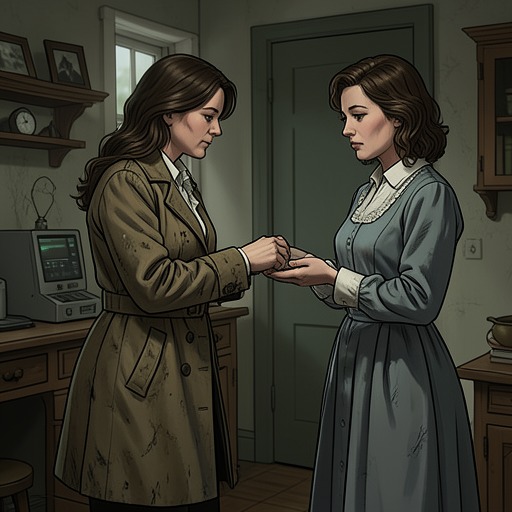
QueenieSylvie and Roy’s abusive relationship is a long-running source of harm in the novel, shaping both Sylvie’s life and Queenie Jenkins’s childhood. The relationship is revealed not as one isolated incident but as a pattern of emotional, financial, and physical abuse, alongside Roy’s efforts to control the household. Its consequences persist after Sylvie has left him: she faces an extended court case, while Queenie must reckon with the neglect and fear that marked her upbringing and the distance it created between mother and daughter.
A Relationship Sustained by Fear and Control
Sylvie later tells Maggie that she had been afraid of being alone after Queenie Jenkins’s father left. When Roy entered her life, she felt that someone wanted her and initially idealized him. Looking back, she describes him as manipulative and regrets that her fear influenced her choices. Her account gives the relationship a history rooted in vulnerability, but does not excuse Roy’s conduct or suggest that Sylvie understood its consequences at the time.
The abuse reaches beyond the couple’s private relationship into the conditions of family life. Queenie Jenkins recalls that Roy alternated between screaming at her and ignoring her. When she tried to avoid drawing his attention by speaking less, he found other ways to upset her: he broke her belongings, falsely accused her to Sylvie, and made her sleep in the car. Queenie also remembers that Sylvie gradually stopped speaking with her about anything beyond school and bedtime. The pattern left the child without dependable protection or ordinary closeness with her mother, while Roy’s behavior shaped what home felt like.
Roy’s control also involved money and housing. After Queenie Jenkins’s family lived in a small house, he had it sold and used the proceeds to buy another property. The family moved there, and the new home was expected to remain spotless. The details connect financial power to the domestic rules Roy imposed: the house was not simply a setting for family life but part of the environment in which he asserted control. Later, Sylvie’s lawyers found a private bank account where he had placed the money from the sale, giving her a possible route to recover it, though she did not know whether she would receive any of it.
The Household and Its Children
The relationship’s effects on Queenie Jenkins are visible in the arrangements Roy made for her and Sylvie. When Queenie was eleven, Roy initially had a flat rented for the two of them after wanting them out of his home. Before long, the flat was only for Queenie: Sylvie remained with Roy. Queenie describes staying away from Roy as preferable to continuing to live under his treatment, but Janet later identifies the arrangement as an unlawful and dangerous situation for a vulnerable child. The contrast between Queenie’s childhood interpretation and the therapist’s response makes the seriousness of her isolation explicit.
Roy’s cruelty also enters the family’s ordinary gatherings. At weekly dinners, he could keep Sylvie and Queenie Jenkins together long enough to belittle one or both of them. He mocked Queenie’s prospects and directed blame at her when Sylvie did not eat, turning the meal into another occasion for humiliation and intimidation. Sylvie’s attempts to smooth over the situation did not stop it. The recurring dinners show how abuse could be made to look like routine family life even as Roy used the shared table to reinforce his authority.
The pattern extended to physical violence against Sylvie. During a later conversation overheard by Queenie Jenkins, Sylvie recalled Roy causing a car crash and then telling the judge that she had crashed because she had been drinking. She also described an occasion when he returned after being away for a weekend and she confronted him about his infidelity; when she later arrived at the flat, she had visible injuries. These disclosures add physical danger and deception to the broader pattern Queenie had described, while showing how Roy’s account of events could obscure responsibility for the harm.
Separation and the Court Case
By the time Queenie Jenkins overhears Sylvie and Maggie talking, Sylvie is pursuing a case against Roy. She says that seeing him during the proceedings makes her feel physically unwell, and that the process has lasted two and a half years. She is reluctant to have Maggie attend hearings because the lawyers repeatedly bring up what happened and she feels ashamed of having to revisit it. The legal process thus becomes a second setting in which the relationship’s history is repeatedly brought into the present.
The case also concerns the money Roy took from the sale of the family home. The discovery of his private account gives Sylvie a concrete development in her effort to recover the proceeds, but not a guaranteed result. She is still unsure whether any of the money will come back to her. At the same time, the account of the car crash shows that the proceedings involve more than financial recovery: Roy has disputed or distorted the events surrounding the abuse, requiring Sylvie to face his version of the past as well as her own memories.
Sylvie’s emotional response is divided between recognizing what Roy did and blaming herself for the consequences. She says she should have been better to Queenie Jenkins and worries that she left her daughter alone. Maggie urges her not to remain fixed on past decisions, but to focus on recovery and rebuilding the relationship. Sylvie fears that the closeness she once shared with her daughter may be gone. The conversation does not establish that reconciliation is complete; instead, it identifies rebuilding trust as an uncertain task still ahead.
Continuing Effects and Narrative Significance
For Queenie Jenkins, understanding Sylvie’s history does not erase the harm of being left to live apart from her mother. While listening to the conversation, she is moved by Sylvie’s distress but resists feeling sorry for her, believing that both of them must live with the consequences of what happened. Her reaction holds anger and emotional attachment together: she can hear her mother’s regret and still remember the childhood abandonment that regret cannot undo.
The account given in therapy further clarifies how the relationship shaped Queenie Jenkins’s understanding of care. She minimizes being screamed at or ignored by listing more ordinary details about Roy’s home, such as its garden and his cooking. Janet challenges that minimization, directing attention back to the instability and fear. Queenie’s account also makes clear that she did not leave the household because she was indifferent to her mother; she felt unable to keep living with Roy’s treatment and believed it was destroying her.
Sylvie and Roy’s relationship therefore remains consequential even after their shared household has ended. Its effects appear in the court proceedings, Sylvie’s remorse and fear, the mother-daughter distance, and Queenie Jenkins’s later efforts to name what happened in therapy. The novel presents recovery and repair as ongoing rather than automatic: Sylvie can acknowledge that she failed to protect her daughter, and Queenie can recognize the abuse, but neither recognition by itself restores what was lost.