2045
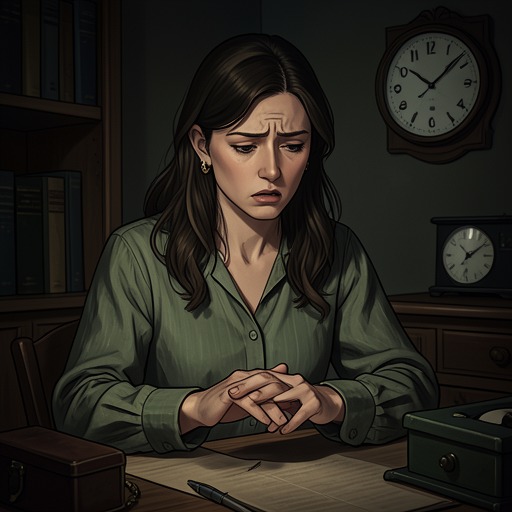
RE2045 is the future year from which Tabitha Moore’s consciousness is displaced back to 1998, making it the decisive temporal anchor of the novel’s time-travel structure. It is not presented as a utopian destination: advanced medicine, holographic interfaces, and personal computing coexist with declining life expectancy, unhealthy lifestyles, loneliness, grief, and Tabitha’s deep exhaustion with the life she has lived. The year therefore functions both as a technological future and as the burden of an unwanted past that Tabitha is compelled to revisit.
The Future World and Its Medical Technology
In 2045, Tabitha is sixty years old, petite and frail, with short gray hair, weathered skin, and a history she describes as hard and unforgiving. Medical breakthroughs have extended life expectancy, but that progress has plateaued since the 2020s, and life expectancy is slowly declining across succeeding generations because of increasingly unhealthy modern lifestyles. Tabitha recognizes herself as implicated in that decline rather than standing outside it, which makes 2045 a future of compromised progress rather than uncomplicated advancement.
Her medical surroundings nevertheless demonstrate how far technology has developed. At the University of Louisville Hospital, she is examined in a hypermodern complex with glossy white walls, glass-like enamel resin, and a nurse who navigates holographic menu screens projected from a ring worn on her hand. Tabitha also relies on a bracelet-PC and has lived for years with ordinary web access through that device. The contrast between these conveniences and her physical frailty establishes 2045 as a world that can make machines more sophisticated without necessarily making an individual life more bearable.
The MRI Incident and Temporal Displacement
Tabitha reaches the future’s advanced medical system because persistent migraines have begun making her miss work. After Springton repeatedly responds by prescribing different medications, she insists on a more thorough examination in Louisville and is placed inside a large custom MRI machine. The machine is roughly half a century old, yet it can read extremely fine deep-tissue electrical activity and track individual neurons as they fire. Its continued use is enabled by a legal arrangement involving its unreleased patent technology and a loophole available to the University of Louisville Hospital.
The machine’s age becomes the first clue that 2045 is connected to Tabitha’s earlier life. Its appearance feels familiar before she understands why. When the MRI malfunctions, Tabitha realizes that she herself had been inside the same kind of machine forty-seven years earlier, as a child receiving treatment for a concussion. The hospital staff’s date confirms the displacement: May 7, 1998. The future year is therefore not merely a setting remembered from afar; it is the point from which the story’s central temporal rupture begins.
Tabitha initially struggles to distinguish time travel from a neurological catastrophe. She considers the possibility that electrical signals from the malfunctioning MRI are producing a seizure or otherwise frying her brain. Her adult awareness remains intact while her body becomes that of a fat adolescent girl, producing a violent mismatch between what she remembers from 2045 and what she can see and physically inhabit in 1998. The temporal return is consequently experienced as bodily humiliation as well as historical displacement.
What 2045 Represents to Tabitha
The future is inseparable from Tabitha’s accumulated losses. Before the MRI incident, she has attended Northern Kentucky University, returned home, worked for years at the Safety plant in Fairfield, and later worked at Springton Town Hall. Dating has left her more frightened of intimacy than solitude, and she describes becoming older, fatter, and increasingly miserable. She leaves the trailer after her relationship with Shannon Moore deteriorates, and Shannon dies not long afterward. Alan Moore dies of cancer and a brain tumor, while Tabitha’s one close writer friend dies by suicide. These memories make 2045 a ledger of endurance rather than a clean promise of freedom.
That history explains the intensity of Tabitha’s reaction when she understands that she has returned to childhood. She recognizes that her father is still alive, that her mother is probably alive, and that she is again in middle school. Her dread is not simply fear of the unknown. It is terror at being required to repeat a life marked by poverty, self-hatred, social isolation, and the body she once regarded as proof of her uselessness. In this sense, 2045 is the future she wants to escape even as it is the only life she knows how to measure the past against.
The technological gap makes the return materially concrete. In 1998, Tabitha finds herself trapped in the dial-up era, without her bracelet-PC or web access. She must think about obtaining a library card, a word processor, and a storage medium such as a CD or floppy diskette if she wants to begin writing novels. The future has given her habits and expectations that cannot simply be carried backward. Her knowledge remains powerful, but the infrastructure that made that knowledge usable has vanished.
Uncertainty, Recurrence, and Narrative Meaning
Tabitha later explains to Alicia Brooks that the MRI sent her mind back from 2045 into her younger self at the children’s hospital. She is careful about the limits of what she knows: the machine may be a time machine, but she believes the displacement required her past self to have interacted with it. Even after describing the events, she cannot completely separate verified experience from coma, dream, or neurological disturbance.
That uncertainty becomes more severe after Erica Taylor attacks Tabitha at the Williams family lake house. Tabitha believes she dies and that the timeline begins again at the MRI in May 1998. She remembers fighting hospital staff, trying to climb back into a dream or another timeline rather than remain in 2045 as if the intervening life had never happened. A cerebral hemorrhage, a vision of her future self dying inside the MRI, and a descent into empty darkness complicate the status of the event. The narrative preserves the possibility that the second restart was real, a coma dream, or a mixture of both.
The future’s role is therefore deliberately unstable. It supplies Tabitha with knowledge of consequences, including her own death, but it cannot guarantee that every remembered event belongs to an objective timeline. Her memories alter how she interprets the present, while the present repeatedly challenges the authority of those memories. Rumors at Springton High even distort her rescue of Officer Darren MacIntire, confusing him with Officer Williams and falsely suggesting that Matthew Williams took Tabitha to Louisville and kissed her. The future gives Tabitha a privileged viewpoint, but not perfect control over how events unfold or how others understand them.
The Vanishing Future and Tabitha’s Second Chance
The most painful consequence of the temporal rupture is the possibility that everything Tabitha gained after 1998 can be erased. When the MRI’s shriek ends in darkness and the power fails across Jefferson County, thirteen-year-old Tabitha lies motionless inside the machine. She has just been pulled from the immediate danger at the lake house, yet her return to the hospital feels like a loss of the relationships and experiences built during the altered timeline. The future she remembers appears to drain away, leaving her frightened that every friendship, reconciliation, and rescue has been taken from her.
Yet 2045 also gives the story its measure of transformation. Tabitha knows what a lifetime can become, and that knowledge drives her to act differently even when it makes her frightened, obsessive, or emotionally overwhelmed. She begins with the plan to lose fifty pounds before high school, believing that avoiding the body she once hated will prevent the loneliness of her first life. She studies medical material because she expects to confront a fatal gunshot wound, though the knowledge only intensifies her fear of failing to save the victim. Her future knowledge is thus both practical resource and psychological burden.
By the time she speaks with Alicia and Elena Seelbaugh, Tabitha can compare the emotional distance of her first life with the intense, often destabilizing feeling of the new one. In 2045 she remembers herself as trapped, lonely, and unable to change; in the altered timeline she cries frequently, makes impulsive decisions, and experiences near-daily emotional breakdowns. The future is consequently not treated as a final answer but as a standard against which two versions of Tabitha’s life remain in conflict. Its decisive significance lies in that contradiction: 2045 is the endpoint she escaped, the evidence that a life can harden into misery, and the uncertain future whose disappearance makes every present relationship precious.