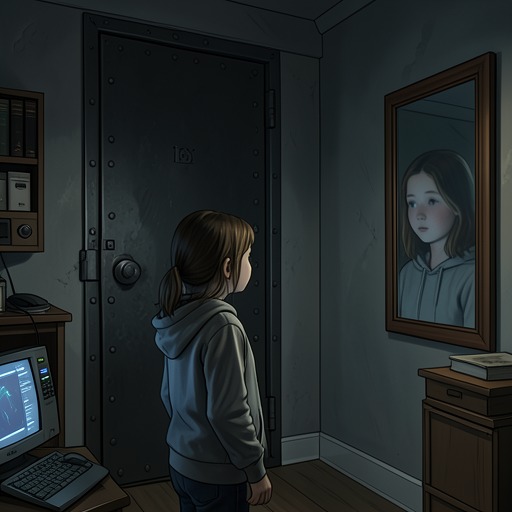
May 7, 1998
REMay 7, 1998 is the pivotal date of Tabitha Moore’s first time displacement: the day a prototype MRI accident at Emsie St. Juarez Children’s Hospital sends the consciousness of her sixty-year-old future self into the body of her thirteen-year-old self. The date is therefore both a medical event and a temporal rupture, forcing Tabitha to confront the life she remembers, the body she once hated, and the possibility that the past can be altered.
The MRI Accident and the Date’s Discovery
On May 7, 1998, the prototype MRI device at Emsie St. Juarez Children’s Hospital emits an impossible screech that rises from scraping-glass noise into a painful, high-pitched crescendo before ending with the pop of an electrical breaker. The sound affects people within a quarter-mile of the hospital, and the resulting failure cuts power across Jefferson County. Inside the machine, thirteen-year-old Tabitha Moore is still screaming when backup generators restore electricity to the MRI room.
The enclosed room has become dangerously hot, rising more than thirty degrees, and smoke rapidly fills the space. The fire alarm sounds while Tabitha’s body twitches and shudders inside the machine; the intense pain begins to recede only as panic takes its place. A man’s familiar-sounding voice orders rescuers to get her out, and Tabitha struggles with the hospital gown in which she has become entangled. Her immediate response is terror and refusal: the MRI has become, in her experience, a deathtrap rather than a neutral instrument of medical progress.
The date is not identified immediately. After the accident, Tabitha notices that the hospital’s sterile plastic walls look archaic compared with the medical facilities she knows from the future. When she asks whether she is at University of Louisville Hospital, the man who appears to be a younger version of her father tells her that they drove to St. Juarez. A doctor then checks the chart and gives the decisive answer: Thursday, May seventh, nineteen ninety-eight. Tabitha’s disbelief becomes recognition when she understands that the forty-seven-year interval she had been counting is not abstract chronology. She herself had been inside the MRI during the earlier catastrophe.
A Future Mind in a Teenage Body
The date’s significance depends on the difference between Tabitha’s remembered age and her physical condition in 1998. Her adult consciousness carries knowledge of 2045, including the later MRI incident that sends her mind backward, but she wakes to small hands, chubby fingers, and the body of the girl she remembers as Tubby Tabby. The return is not experienced as a clean rebirth. It arrives through confusion, pain, and the humiliating recognition of a body associated with years of self-hatred.
Tabitha fears that the event may be a terminal neurological failure rather than time travel. She wonders whether electrical signals in the MRI are merely frying her brain, and she pleads internally not to be forced into the life she has already endured. The date thus opens a conflict between knowledge and embodiment: she knows what this girl’s future contains, yet she must once again inhabit the physical, social, and emotional conditions from which that future emerged.
Her first practical responses reveal how radically 1998 differs from her accustomed world. She discovers that she is trapped in the dial-up era, misses the bracelet-style personal computer she had worn for years, and begins calculating how to obtain a word processor, a library card, and a usable storage medium. She is unsure whether flash drives exist and considers a CD or floppy diskette instead. Even basic domestic tasks become part of temporal adaptation: she searches for wearable clothes, considers washing them in the bathtub, and boils a dwindling supply of eggs because the refrigerator contains little she finds appetizing.
The Date as a Branch Point
May 7, 1998 becomes the first major branch point in the novel’s alternate history. Tabitha believes that her adult memories can help her pass middle-school finals without serious review, while her knowledge of later technology and vocabulary must be concealed from her parents. She plans to use unusually advanced words so that her intelligence will appear to be an adolescent phase rather than evidence of an impossible identity. The strategy shows that the time displacement is not only a supernatural event; it is also a sustained performance required to make a future consciousness legible inside a child’s life.
The date also becomes entangled with events that Tabitha remembers from her original life. Later, Alicia Brooks photographs Tabitha running toward a police officer who has been shot during the Springton South Main shooting, and Channel 7 News reports that two officers were injured, with one remaining in critical condition. Rumors at school then confuse the injured officer and Tabitha’s actions, leading students to claim that Matthew Williams took Tabitha to Louisville and kissed her. Tabitha’s private irritation over the false story exposes how quickly evidence, publicity, and gossip can produce competing versions of the same event.
The period’s media environment makes that conflict especially concrete. Alicia relies on a Kodak disposable camera and must remember to wind its film before taking the useful photograph; Channel 7 News supplies a public account of the shooting; and later, at a Halloween gathering, Alicia’s mother uses another disposable camera to record the assembled friends and family. These technologies offer forms of memory that are physical, delayed, and limited, unlike the instant access Tabitha associates with 2045. May 7 therefore initiates not only a temporal displacement but also a confrontation with the material conditions under which the past can be documented.
Repetition, Injury, and the Second Restart
The date returns in altered form when the prototype MRI accident happens again. In a later timeline, the same terrible screech rises from the MRI machine in the Emsie St. Juarez Pediatrics ward, power fails across Jefferson County, smoke fills the overheated room, and Tabitha lies motionless inside the device. She has just been experiencing the trauma of the Williams family lake house, where blood is visible on the floor, when the MRI transports her back toward the beginning. The repetition makes May 7 feel less like a single historical point than a wound trapped in a loop.
The second return is accompanied by a more severe collapse of medical certainty. Tabitha has been declared brain dead, removed from life support, and described as permanently comatose, with the Moore family waiting for her quiet death. Instead, her supposedly peaceful body begins to jerk; her brow furrows, her breathing accelerates, and she whispers for help. A doctor explains that she has been legally dead for two days and will have an unusual death certificate, yet she answers his pain question as consciousness returns. The contrast between legal death, neurological diagnosis, and lived awareness makes the date a challenge to every institution attempting to define what has happened to her.
The temporal imagery becomes briefly cosmic during the transition. Tabitha falls through darkness as a Dream F-22 Fighter Jet drops away without her, and she catches a small, delicate hand that keeps her from disappearing. She glimpses the frail sixty-year-old body inside the cockpit’s circular MRI window before the falling aircraft vanishes into the darkness. Whether treated as literal temporal mechanics, dreamlike vision, or an unstable boundary between realities, the sequence gives the repeated date a visual form: the old body and its accumulated history fall away while another possibility remains suspended.
Long-Term Meaning
In explaining her life to Alicia Brooks and Elena Seelbaugh, Tabitha identifies the causal chain that leads back to May 7, 1998. In her first life, she grew up as an overweight girl in a low-income neighborhood, experienced bullying connected to the Taylor sisters, developed severe social anxiety, and remained isolated through school. She later attended community college in Elizabethtown and Northern Kentucky University, struggled with education and relationships, worked for years at the Safety plant in Fairfield, and eventually took a job at Springton Town Hall. At sixty, persistent migraines led to a custom MRI examination in Louisville, and that future machine sent her mind back to the childhood MRI accident.
The date consequently gathers several kinds of evidence without making them fully compatible. A medical chart supplies the day; a body supplies pain and altered consciousness; family recognition supplies the apparent continuity of identity; news reports and photographs supply public records; and Tabitha’s own memories supply a future account that no one else can verify. Her surgical history intensifies the uncertainty: after the later head trauma, an endoscope and surgical bypass drain excess fluid, the clot disappears, and apparent brain activity vanishes, causing everyone to fear the worst. May 7 remains the point at which those medical and temporal contradictions begin.
Its decisive significance is that it converts Tabitha’s past from a fixed source of shame into a contested, revisable world. The first MRI accident gives her a second chance, but the repeated accident warns that return is not the same as escape. Every attempt to live differently remains bound to injury, memory, technology, and the possibility of another restart. May 7, 1998 is therefore both the beginning of Tabitha’s second life and the date on which the novel makes time itself answerable to trauma.