47 year interval
REThe forty-seven-year gap is the decisive interval in Tabitha Moore’s time-displaced life. It is not merely a number separating two dates: it measures the rupture between the adult future Tabitha remembers and the thirteen-year-old body, family, and social world into which she is returned. The gap turns the prototype MRI into a threshold between 2045 and May 7, 1998, and makes memory itself an unstable inheritance—part knowledge of what has happened, part burden of what has not happened yet.
Definition and First Revelation
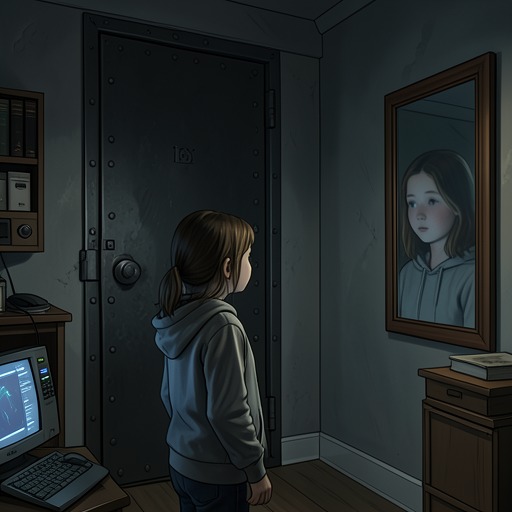
The interval is established when a doctor at Emsie St. Juarez Children’s Hospital identifies the date as Thursday, May 7, 1998. The date confirms Tabitha’s suspicion that she has not simply suffered a medical crisis in her own time. Looking at her small, chubby hands, she recognizes that the machine has placed her in the past and that the distance from the future she knows is forty-seven years.
Tabitha connects the displacement to the MRI accident she remembers from 2045. In her understanding, the same prototype device has gone haywire twice across the temporal divide: the later incident sends her mind back to the earlier machine at the children’s hospital. The logic is horrifying precisely because the two accidents are not unrelated historical episodes. They are connected through her own body and consciousness, making Tabitha both the displaced survivor of the 2045 malfunction and the child caught inside the 1998 event.
The return also restores people whom Tabitha knows as absent or dead in her remembered future. Her father, Alan Moore, is suddenly alive before her, and her mother, Shannon Moore, is probably alive as well. The forty-seven-year gap therefore carries an emotional reversal as powerful as its chronological one: the future has become a source of grief, while the past contains the family members Tabitha has lost or expects to lose.
Living Across the Interval
The gap does not give Tabitha a simple adult identity in a younger body. She tells Alicia Brooks that she is thirteen, turning fourteen in December, and that she has both her thirteen-year-old mind and memories of events that have not yet happened. She can distinguish the two layers, but cannot make them fit comfortably together. Her remembered future suggests the perspective of someone nearly ninety, while her immediate emotional and mental experience remains that of a thirteen-year-old girl.
This mismatch makes the interval a lived condition rather than a piece of chronology. Tabitha must resume school-age life while carrying knowledge of a future that other people cannot verify. She knows what it means to inhabit the body she once hated, and she fears being forced to become the same “fat” and “trailer trash” girl again. Yet the younger body also has capacities the older one lacked: after an hour-long walk through the trailer rows, she is exhilarated by its energy and surprised that joint pain has disappeared, even while the extra weight remains a painful reminder of the image she despises.
Her father’s reaction reinforces the divide between Tabitha’s knowledge and everyone else’s explanation. On the drive home after inconclusive tests, Alan treats the episode as a dangerous prototype-MRI malfunction and considers a malpractice lawsuit against the hospital. Tabitha apologizes for her distressed behavior and calls it melodramatic, but the medical explanation cannot account for what she knows. To Alan, the crisis is recent and physical; to Tabitha, it has opened a forty-seven-year wound in time.
The Gap as a Social Secret
Tabitha initially has to decide how much of the interval can be disclosed. When Alicia asks whether she died, Tabitha says she does not remember dying and recalls only being in a hospital for headaches. Asked how far into the future she went, she answers: 2045, forty-seven years ahead. Alicia is skeptical, imagining that Tabitha may be using an elaborate time-travel story to cope with something frightening, but she does not abandon her. When Tabitha admits that she wanted a friend and did not want to face everything alone, Alicia accepts the friendship even while uncertainty remains.
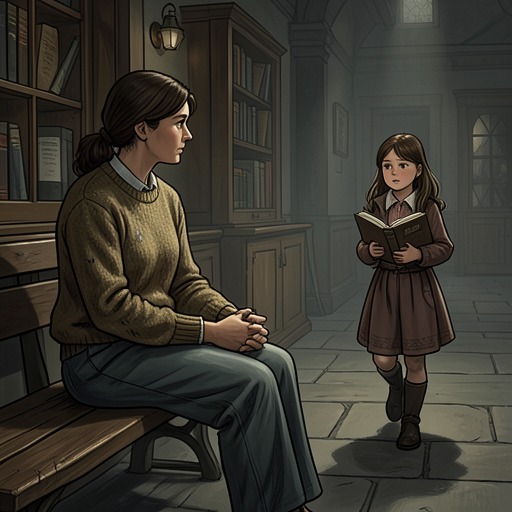
That friendship gives the temporal gap a witness. Alicia is fourteen, while Tabitha is thirteen in the returned timeline, yet Tabitha also carries memories associated with an old woman. The relationship therefore exposes the difference between chronological age, bodily age, and remembered experience. Alicia’s willingness to remain Tabitha’s friend does not erase the contradiction; it gives Tabitha a person with whom the contradiction can be spoken.
The interval also produces public distortions. At school, gossip turns Tabitha’s rescue of Officer Darren MacIntire into a confused story involving Matthew Williams, Louisville, and an alleged kiss. Tabitha knows that Matthew never asked her out or took her to Louisville, and the mismatch between what she remembers and what others claim leaves her furious and bewildered. The forty-seven-year gap is thus not only private memory. It becomes a pressure that changes how events are interpreted, how credit is assigned, and how Tabitha’s identity is judged.
Repetition and Timeline Restart
The original return to 1998 is later repeated in a more violent form. During the prototype MRI incident in the Emsie St. Juarez Pediatrics ward, the machine emits a screech that becomes physically painful before the breaker blows, taking power across Jefferson County. Thirteen-year-old Tabitha lies motionless inside the smoking device as the backup power comes on. In the same moment, she retains the impression of blood on the floor of the Williams family lake house and feels the loss of the life she had built after the first displacement.
The recurrence transforms the forty-seven-year gap from a one-time passage into a loop-like structure. Tabitha understands that she is back at the beginning, facing the younger body and the earlier world again. Later, she tells Elena Seelbaugh that after Erica Taylor attacked her at the lake house, she blacked out and began the timeline again from waking in the MRI in May 1998. She believes she had somehow died, although Elena rejects the wording, and Tabitha explains that she could not bear to lose the moments she and her friends had created or to resolve her relationship with Shannon Moore from the beginning once more.
The second displacement is not a clean restoration. In the void between states, Tabitha reaches for the MRI and falls while a Dream F-22 Fighter Jet drops away beneath her. A small hand catches hers, leaving her suspended in darkness as she watches a frail sixty-year-old version of herself become still inside the cockpit’s circular window. The image makes the gap bodily and visual: the child hangs outside the falling machine while an older self disappears within it, and the two versions are separated not by an abstract calendar but by a churning threshold between possible lives.
Narrative Significance
The forty-seven-year gap organizes the book’s central conflict between repetition and change. It gives Tabitha foreknowledge, but not control; she recognizes patterns, yet the altered timeline produces new relationships, rumors, dangers, and losses. Her knowledge of the future repeatedly collides with the fact that once she acts in 1998, that future is no longer guaranteed to remain the same.
The interval also makes the story’s treatment of identity unusually unstable. Tabitha is simultaneously a child in 1998, a person carrying memories from 2045, and a survivor who has already experienced one life before being required to live its beginning again. The gap separates those identities, but the MRI joins them. Its malfunction turns chronological distance into a psychological and moral burden: Tabitha must decide what to preserve, what to prevent, and whether a second chance can ever reproduce the life that was lost.
By linking the 2045 accident to the 1998 accident and then linking both to the later restart, the gap becomes the story’s recurring measure of return. It explains why Tabitha’s homecoming feels like bereavement rather than rescue, why ordinary adolescence becomes an ordeal of remembered consequences, and why friendship matters as evidence that some parts of a life can survive even when time itself is reset.