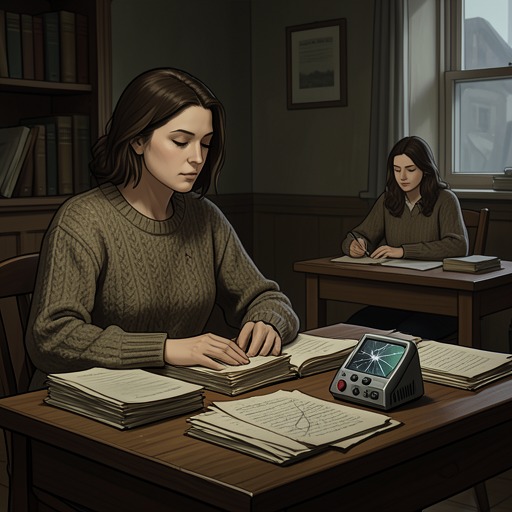
the pre-Internet era
REthe pre-Internet era is the historical and technological environment into which Tabitha Moore is forced after the 2045 MRI accident sends her consciousness back to May 1998. Its decisive significance lies in the collision between a future-trained mind and a world in which information is slower, less searchable, less durable, and more dependent on physical objects and face-to-face networks. The era initially feels to Tabitha like deprivation and temporal imprisonment, but repeated exposure gradually makes it a lived social world rather than a museum of obsolete technology.
Definition and Temporal Dislocation
the pre-Internet era first appears through Tabitha’s shocked recognition that the prototype MRI accident has returned her mind forty-seven years into the past. In 2045, she is accustomed to a bracelet-PC and immediate web access; in 1998, she has only the body, household, school, and local surroundings of her earlier life. Her awareness of the gap is inseparable from bodily estrangement: she looks down at the small, chubby fingers of her younger self and fears having to become the overweight girl she had spent her first life hating.
The period is therefore experienced through a double consciousness. Tabitha remembers the material conditions of 1998 from childhood, yet she evaluates them with the expectations of 2045. A mobile home, worn furnishings, and ordinary domestic inconveniences become newly conspicuous because she knows what later technologies will provide. Even the prospect of obtaining a word processor raises practical questions about whether she will need a CD or a floppy diskette rather than a flash drive. The ordinary objects of the period become evidence of the distance between her two lives.
Media, Information, and Physical Evidence
The era’s communications system is defined less by total absence of information than by friction. Tabitha realizes that she is trapped in the dial-up era and longs for the web access once supplied by her bracelet-PC. She must think about walking more than half an hour to the library, obtaining a library card, and finding a physical medium on which to save her writing. These limitations shape both her ambitions and her movements: planning novels requires access to hardware, storage, and a public institution rather than an instantly available digital environment.
Information in this world also travels through television and local news. Channel 7 News reports the Springton South Main shooting to viewers in the Fairfield, Springton, and Sandboro areas, identifying Jeremy Redford and explaining that two police officers were injured while one remained in critical condition. Mrs. Seelbaugh turns up the volume because the violence occurred locally, showing how television creates shared civic awareness even when information is not yet continuously available online. The report becomes a public account against which later rumors about Tabitha’s role can be measured.
Physical photography gives the period another distinctive form of evidence. When Alicia Brooks sees Tabitha running toward the shot police officer, she raises a Kodak disposable camera and takes a hurried picture. The first attempt fails because the camera is unsteady; the next cannot be taken until she remembers to wind the film. The eventual photograph is useful but imperfect, with its subjects too far away for an ideal composition. Its limitations matter: the event is recorded, but not with instant review, unlimited retakes, or automatic distribution. The camera turns memory into a tangible but fragile object.
The same material logic governs social occasions. At the Halloween gathering, Alicia’s mother brings out a Kodak disposable camera and asks everyone to assemble for pictures. The camera records a moment of family and friendship, but it also makes the group pause and arrange itself before an image that cannot immediately be inspected. In this setting, photographs preserve relationships through a physical medium while remaining subject to distance, framing, and the finite number of exposures.
Social Life Before Constant Connectivity
Tabitha’s later account of her first life shows that the pre-Internet era is also a social condition. She describes a childhood marked by social anxiety, isolation, television, and reading, followed by a period in which her social development occurred largely through early online spaces: LiveJournal, FanFiction.net, Gaia Online, small ProBoards forums, GeoCities webrings, messenger friends, and mIRC. Her list records a transitional digital culture, but its very form emphasizes how different it is from the ubiquitous connectivity of 2045. These were scattered communities and improvised networks, not an all-encompassing interface surrounding daily life.
The contrast between online connection and offline isolation is especially important to Tabitha’s identity. She remembers having few friends and struggling to interact with people, while the older version of her understands that the internet nevertheless supplied forms of community during difficult years. She is embarrassed by some of those communities and asks Alicia Brooks not to record the names, but the recollection establishes that technology offered her a belated route into social development. In the earlier timeline, access to that route is limited, delayed, and dependent on specific devices and institutions.
The era’s lack of instantaneous correction also permits misinformation to circulate casually. While spending time with Moore cousins, Tabitha observes that, in a pre-Internet world, conjecture and misinformation are ordinary conditions. The children confidently repeat things learned from older youths who seem reliable, even when their claims are absurd. Their confusion about left and right becomes comic, yet it also reveals a world in which mistaken knowledge can remain locally persuasive because no immediate search engine is available to settle it. Tabitha’s future associations are themselves out of scale with the children’s political and cultural vocabulary, making her another kind of temporal outsider.
Repetition, Adaptation, and Narrative Function
The pre-Internet era becomes most powerful when Tabitha’s time displacement repeats. The prototype MRI in the Emsie St. Juarez Pediatrics ward emits a shriek, blows the electrical breaker, and contributes to a county-wide power failure; when backup power returns, Tabitha awakens inside the smoking machine in her thirteen-year-old body. Her consciousness has been forced back to the beginning, and the dated world she once regarded as intolerable becomes the setting of another complete attempt at living.
The second restart intensifies the period’s strangeness. In the void between timelines, Tabitha sees an F-22 fighter jet falling away and catches the hand of an unseen rescuer, while the sixty-year-old body inside the MRI disappears into the darkness. The image links future machinery, bodily aging, and temporal rupture, but the return itself deposits her once more among 1998’s physical limits. What seemed like a single technological accident becomes a recurring structure in which the past is not simply remembered; it is inhabited again.
At first, Tabitha treats the dated environment as something she must endure. Later, she admits that she adjusted and acclimated to many aspects of it, including life before the internet and the strange paradigm of the earlier world. That adaptation is not entirely comforting. She recognizes that she may have become accustomed not only to obsolete technology but also to circumstances involving her parents in which she should have resisted sooner. The past’s familiarity can therefore conceal harm: adaptation helps her survive, yet it may also normalize conditions that require intervention.
Significance for Memory and Relationships
the pre-Internet era determines how Tabitha’s knowledge can affect other people. She knows that future events, public reports, and personal outcomes may differ from what she remembers, but she cannot simply retrieve authoritative records or transmit proof from 2045. Rumors at school recast her rescue of Officer Darren MacIntire as a fabricated publicity story, even though the local television report confirms the shooting and Alicia Brooks possesses a photograph of Tabitha reaching the officer. The gap between what happened and what can be convincingly demonstrated exposes the limits of memory without accessible digital verification.
That gap also makes relationships more immediate and more vulnerable. When Elena Seelbaugh approaches Tabitha and Alicia, she explains that her former best friend Carrie has become distant and that school is beginning to feel hostile. Tabitha intervenes and asks that Elena be allowed to explain herself, a small act of social mediation that depends on listening rather than on searchable history or public timelines. In the pre-Internet setting, friendships are carried through conversations, diaries, school corridors, and remembered loyalties; their breakdown cannot be solved by checking a digital record.
The era thus functions as both obstacle and corrective. It frustrates Tabitha’s future habits, limits her access to information, and makes her evidence materially imperfect. At the same time, it places weight on direct attention: Alicia must run toward the shooting, Elena must speak for herself, and Tabitha must learn the world again through bodies, objects, local reports, and shared presence. By the time she plays Nintendo 64 with the Moore cousins, the dated technology still looks primitive to her, but the boys’ enthusiasm gives the experience value beyond graphical quality. Her relationship to the period changes from rejection to partial belonging, without erasing her knowledge that some of its family conditions should never have been accepted.