Blue Album
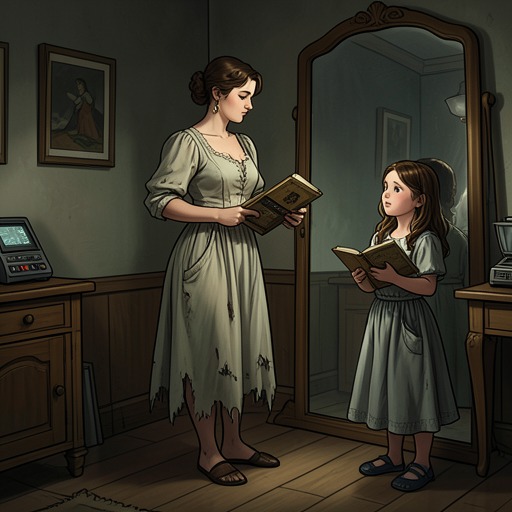
REThe blue album is a hidden scrapbook belonging to Shannon Moore, filled with beauty-pageant photographs and modeling pictures from the period before she became Tabitha Moore’s mother. At first it functions as a forbidden family object, a concealed record of an earlier identity that Tabitha discovers and reads as proof that her birth destroyed Shannon’s beauty, ambitions, and possible future. When Shannon eventually brings it into an open conversation, however, the album becomes a contested memory archive: it preserves the image of a confident young Shannon while also exposing how incomplete that image is. Its movement from hiding place to dinner-table confession marks one of the clearest material signs of the Moore family’s painful attempt at emotional repair.
Appearance and Hidden Status
The album is identified by its blue cover and is kept out of ordinary view. Tabitha tells Shannon that the answer to her question is “in a box at the top of your closet. In a blue album,” revealing that she has entered her mother’s private space and located the object Shannon intended to keep concealed. The discovery immediately produces shock, anger, and humiliation in Shannon, who treats Tabitha’s knowledge as an invasion of privacy rather than as a harmless look through old photographs.
The album’s concealment gives it an importance disproportionate to its physical form. It is not merely stored memorabilia among the clutter of the Moore home; it is a family taboo, described as sensitive contraband that Tabitha should never have been caught examining. Its hidden position turns the scrapbook into a boundary between mother and daughter. As long as it remains private, Shannon can keep her former self separate from the impoverished trailer-park life she inhabits in the present and from the resentment she associates with motherhood.
The Image of Shannon Before Motherhood
Inside the album are beauty-pageant photos and modeling pictures of Shannon as “an impossibly gorgeous young woman with a brilliant, confident smile.” Tabitha experiences the photographs as evidence of a dramatic transformation: the woman in the pictures somehow became the Shannon she knows. The contrast encourages Tabitha to imagine that motherhood erased her mother’s body, confidence, and aspirations, leaving behind someone embittered by a life she never wanted.
Tabitha therefore interprets the album through her own guilt. She believes that her birth made Shannon lose her figure, abandon the possibility of doing more with her life, and settle in a “trashy fucking trailer park.” In this reading, the scrapbook is a visual accusation even before Shannon speaks. The photographs do not literally explain why Shannon’s life changed, but their beauty and confidence allow Tabitha to construct a devastating causal story in which she has “fucked up” her mother’s life.
That interpretation becomes more painful after Tabitha’s rapid weight loss and determined efforts to become attractive. Shannon begins seeing her younger self reflected in her daughter. Tabitha understands that her transformation does not simply concern appearance: it forces Shannon to confront the person she used to be, the future she abandoned, and the possibility that her daughter’s interest in acting could repeat the dangers attached to Shannon’s own earlier ambitions. The album thus links physical resemblance, maternal resentment, and the return of suppressed memory.
The Album as a Confessional Object
During a later conversation, Shannon unexpectedly reaches beneath the front skirting of the sofa, where the family normally keeps its VHS tapes, and withdraws the familiar blue album. The gesture changes the status of the object. Instead of remaining something Tabitha has stolen into and Shannon has defended, it becomes something Shannon deliberately presents. She grips it in both hands as though it carried the weight of the beautiful dreams preserved inside it, dreams that would not come to fruition.
Shannon asks Tabitha whether she knows what it is and acknowledges that Tabitha has seen its contents. She insists that Tabitha was not a mistake but a blessing, even while admitting that she does not feel blessed in the uncomplicated way the word suggests. Her explanation makes the album an incomplete record: it contains the public images of pageants and modeling, but not everything that happened around them. Shannon warns that Tabitha has drawn conclusions from photographs without knowing the experiences those photographs exclude.
The withheld history concerns Shannon Delain’s abandoned acting career. Shannon tells Tabitha that people in the film industry knew about the predatory behavior surrounding young actresses, and that she was ashamed of having accepted or endured circumstances she should have escaped. She explains that God gave her the strength to step away and stay away, and that he brought her back and gave her Tabitha. The album therefore preserves the attractive surface of a former career while its omissions point toward exploitation, fear, and survival. Its silence is not proof that the photographs are false; it demonstrates that photographs alone cannot contain the life they appear to document.
Material Memory and Family Conflict
Tabitha’s relationship with the album is shaped by a collision between future knowledge and obsolete media. In 1998, she is already accustomed to a bracelet-style personal computer and web access from 2045, yet the album is a tactile, irreplaceable archive that cannot be searched, copied, or corrected through a network. The same broader time displacement makes older media newly conspicuous: she is trapped in the dial-up era, considers whether a novel would need a floppy disk or CD, and later encounters disposable-camera photographs and television news as the available means of recording events. Against that technological contrast, the blue album represents memory held in pages and images, dependent on secrecy, custody, and physical discovery.
Its evidentiary power is also unstable. Tabitha treats the photographs as if they reveal the whole truth about Shannon, but Shannon’s disclosure proves that the album contains only selected images and omits the experiences that gave them their meaning. The object can preserve a face, a smile, and a public identity while concealing coercion and regret. It is thus both evidence and misdirection: material proof that Shannon once possessed another life, but an unreliable guide to why that life ended.
The album’s emotional force culminates in the exchange between mother and daughter. Tabitha’s accusation makes Shannon collapse into tears, because it articulates thoughts she has swallowed for years. Later, when Shannon chooses to take the album out herself, the family’s taboo is not erased so much as made speakable. The scrapbook becomes a shared object rather than a weapon possessed by one person and violated by another. Its movement into the conversation creates the possibility that Tabitha can stop treating her mother’s past as a simple indictment of her own existence, while Shannon can finally separate the lost young woman in the pictures from the daughter she feared had inherited her abandoned dreams.
Narrative Significance
The blue album gives physical form to the story’s recurring conflict between appearance and lived identity. It displays Shannon’s former beauty and confidence, but its most important contents are the absences around those images: the career that ended, the exploitation Shannon did not want to describe, and the maternal history that Tabitha initially reduces to blame. The album’s blue cover remains stable while the meaning attached to it changes—from secret, to accusation, to confession, and finally to a medium for repair.
As an object, it also exposes the limits of visual memory. Tabitha sees a version of Shannon and mistakes that version for a complete explanation. Shannon’s later account does not invalidate the photographs; it restores the missing circumstances that make them intelligible. The scrapbook consequently becomes a compact model of the novel’s larger concern with fractured identity and second chances: a person can return to an earlier image without becoming that image again, and a family can revisit an old record without allowing it to dictate the whole truth of the present.