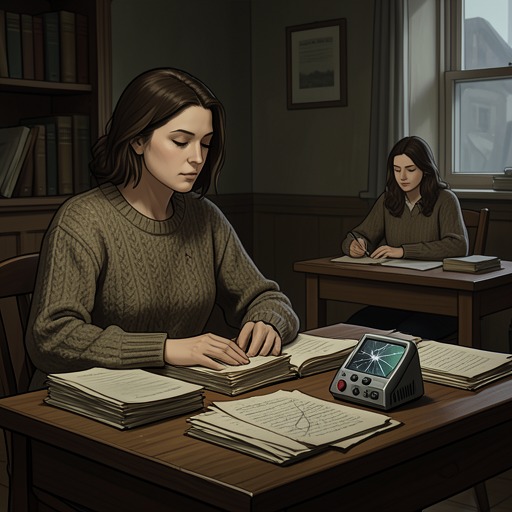
Wristband personal computer
REThe bracelet-style personal computer is the clearest object of technological displacement in Tabitha Moore’s story: a compact future device that carries the habits, knowledge, and expectations of 2045 into a world still organized around paper, floppy disks, disposable cameras, television news, and dial-up internet. Its importance lies not merely in what it can do, but in the way its presence makes Tabitha’s split existence visible. When it is removed, hidden, or rendered difficult to use, the distance between her adult future and her thirteen-year-old life becomes tangible.
Future Technology in a 1998 Medical World
The device first appears as part of Tabitha’s ordinary future routine, but the prototype MRI forces its material difference into view. At University of Louisville Hospital, the nurse explains that the unusually sensitive machine cannot be used while a personal computer is worn inside it. Tabitha therefore slides the bracelet-style PC from her wrinkled wrist, watches its display go dark, and places it on a tray. The action is medically routine, yet emotionally disorienting: she caresses the unfamiliar absence left on her wrist, revealing how thoroughly the device has become part of her bodily habits.
The removal also foreshadows the device’s connection to the MRI-induced time travel that returns Tabitha to 1998. She tells the nurse that she has had a bad experience in an MRI before, while privately recognizing that the supposedly safe machine’s forty-seven-year history is connected to the earlier disaster. The prototype MRI accident then produces the violent temporal rupture: the machine emits an ear-splitting screech, power fails across Jefferson County, and thirteen-year-old Tabitha remains trapped inside the overheating, smoke-filled device. The bracelet PC is not itself identified as the cause, but the contrast between the advanced computer and the unstable medical technology establishes the technological network surrounding her displacement.
Practical Dislocation and Material Scarcity
After returning to 1998, Tabitha repeatedly experiences the bracelet PC through its absence. Her hand keeps creeping toward the wrist where she had worn it for years, and she longs for web access while realizing that she is trapped in the dial-up era. The gesture turns a sophisticated device into a phantom limb of daily life: even when the computer is unavailable, her body continues to search for it.
The object also exposes the economic and infrastructural gap between Tabitha’s former life and the Moore family’s poverty. She needs a word processor to begin work on her novels, but she must calculate how to reach the library, what storage medium might exist, and whether she will need a CD or a floppy diskette because flash drives may not yet exist. Her technological problem is therefore inseparable from money. Her parents cannot provide an allowance, while she needs clothes, detergent, toiletries, makeup, and storage media for school and writing. The bracelet PC represents immense capability, but it cannot simply solve the material conditions of being a minor without cash in a poor trailer-park household.
A Tool for Work, Proof, and Performance
The computer’s functions extend beyond communication. Tabitha identifies herself as a writer and remembers having typed at more than one hundred words per minute while investigating data-entry work. In 1998, she conceals the extent of that ability by telling classmates that she types only a little. The device belongs to the same hidden reserve of adult competence: it supports a future self that Tabitha must continually disguise beneath the expected behavior of a freshman.
Her intellectual abilities can receive public recognition even when the computer itself remains private. Tabitha tells Elena Seelbaugh that a school-board recommendation placed her in AP English because part of her Language Arts final essay was published in the Tribune. The bracelet PC is not credited with producing the essay, but it belongs to the future-oriented identity that makes her literary ambitions and unusual vocabulary possible. Around her parents, she deliberately continues using “big words” so they will interpret her knowledge as an adolescent phase rather than question how a thirteen-year-old acquired it.
The device also becomes linked to engineering and economic ambition. Tabitha studies F-22 schematics saved on the bracelet PC while experimenting with alloys and considering whether the work might eventually lead to a government contract. Her father, Alan Moore, offers to help when she runs the smelter, though he remains uneasy about her handling superheated metal alone. In this setting, the computer is not a decorative symbol of futurity; its stored technical information actively enlarges what Tabitha can attempt in the present, even though she must translate that information through improvised equipment and family labor.
Communication Across Time and the Limits of Access
The bracelet PC can also receive messages from the future. When Alan Moore gives Tabitha a letter from Julia, greenish-blue hologram text projects into the air from the device. Tabitha is delighted that Julia has found her and written at such length, but the reunion is immediately frustrated: she can perceive the general sense of the message without being able to focus on and read every word. The same object that bridges temporal distance cannot guarantee intelligibility. Its information is present, yet access to that information is impaired.
This failure complicates the computer’s role as a perfect archive. It contains documents, correspondence, and technical schematics, but Tabitha’s body and circumstances determine what she can actually retrieve. The unreadable message from Julia makes the device both miraculous and maddening: it proves that connection with the future survives, while withholding the precise language needed to make that connection complete. In this sense, the computer preserves relationships without fully restoring them.
Evidence, Memory, and the Object’s Disappearance
The bracelet PC stands beside other media that shape how the story preserves evidence and memory. Alicia Brooks uses a Kodak disposable camera to photograph the aftermath of the Springton South Main shooting, while Channel 7 News turns the event into a public television record. Tabitha’s computer represents a more advanced and private mode of storage, but it does not replace older forms of proof. The narrative repeatedly contrasts future digital capacity with the physical vulnerability of photographs, binders, letters, and paper records.
Its emotional force comes from this tension between transparency and concealment. The computer makes Tabitha’s future knowledge possible, yet its very existence would expose the secret she is trying to protect. By contrast, Tabitha’s cleaned and nearly emptied room in the Moore family trailer presents a controlled surface that her parents can see without understanding. The bracelet PC belongs to the hidden interior of that transformation: a portable material trace of the person Tabitha was before she became a child again.
Ultimately, the bracelet-style personal computer is both an instrument of agency and a reminder of dependence. It enables writing, technical experimentation, future communication, and access to knowledge, but it cannot provide money, restore ordinary social belonging, or remove Tabitha from the constraints of 1998. Its darkened screen during the MRI and its persistent absence at the trailer establish the object’s deepest significance. The computer is not simply something Tabitha owns; it is part of the world, body, and identity she has lost—and the material promise of the future she is trying to rebuild.