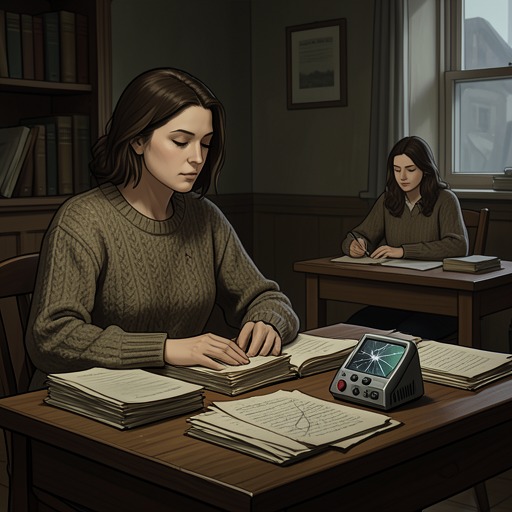
Godzilla Call Button Toy
REThe Godzilla Call Button Toy is a foot-tall electronic Godzilla figure repurposed as Tabitha Moore’s call bell while she recovers from catastrophic injuries. It is both a practical aid and an emotionally complicated gift: its roar summons help when Tabitha cannot safely move, yet its absurdity keeps the hospital routine connected to the teasing, noise, and shared affection of family life. When she finally returns home, the toy remains audible after the crisis, becoming a small material link between medical vulnerability and domestic belonging.
Design and Repurposing
The toy replaces an ordinary hospital bell. Alan Moore explains that Tabitha must rest, limit physical activity, and ask for help whenever she feels tired, unsteady, or has trouble with her balance. Her cousins therefore select something loud enough to summon the adults: a Godzilla toy with a button on its chest that produces a roar. The family calls it a dinosaur, even though Grandma Laurie corrects the boys and identifies it more precisely as a Godzilla figure.
The choice is deliberately excessive. The boys have installed new double-A batteries because the toy is the only available object loud enough for its new task. Pressing the button produces the familiar Godzilla sound, but the cheap electronic mechanism is unreliable: the figure sometimes roars without being touched. Its usefulness is therefore inseparable from its inconvenience. A device intended to make assistance available can also erupt unpredictably into the quiet of the room, making Tabitha’s dependence impossible to ignore.
The Gift and the Recovery Regimen
The toy appears during a period when Tabitha’s body and mind are being placed under strict medical limits. She is told to take frequent naps, avoid strenuous activity, restrict television and reading to short periods, and stop whatever she is doing if balance or fatigue becomes a problem. She is also required not to skip meals and to accept direct assistance from her parents. The call button gives those restrictions a concrete, noisy form: it marks the point at which ordinary independence has to yield to recovery.
Grandma Laurie tries to protect Tabitha from the cousins’ enthusiasm, shooing the boys away so that the patient can breathe and speak. She also keeps a small hand bell beside the bed as a backup, promising that Tabitha can summon Alan and receive full room service. The contrast between the restrained bell and the roaring Godzilla captures two styles of care. The bell belongs to institutional practicality; the toy belongs to the family’s comic, improvised response to danger. Both are instruments of dependence, but only the toy carries the boys’ unmistakable personality.
Family Meaning and Material Presence
The cousins present the toy as an argument that their solution is superior to a stupid bell, and Tabitha answers with careful gratitude. She tells them it is cool and says that looking at it will remind her of them. Her response is affectionate but visibly effortful: she searches for an appropriate thing to say, offers a weak smile, and looks to Grandma Laurie for help when the boys continue urging her to press the button. The object therefore records a social exchange as much as it performs a mechanical function. It is a gift made by children who want to help, entertain, and be remembered.
Its material details preserve the period and the circumstances of the household. The figure is about a foot tall, square-jawed, and associated with the American Godzilla movie released earlier that year; its roar is tinny and distorted in the manner of inexpensive electronic toys from 1998. Those details prevent the object from becoming a generic symbol of comfort. It is conspicuous, cheap, loud, and slightly faulty. Its very awkwardness makes the family’s care tangible rather than polished.
Return Home and Continuing Echo
When Tabitha leaves the hospital and returns to the Moore family’s mobile home, she passes the Godzilla toy to her mother before making her slow way down the hall. She has to keep one hand on the wall for balance, so the toy’s original purpose remains relevant even after the setting changes. The bedroom contains reminders of the ordeal, including the repaired Ariel costume worn during the emergency, a Flounder stuffed animal, get-well cards, letters, and the candy her cousins have saved for her. The Godzilla figure belongs among these objects as a portable sign of the transition from crisis to homecoming.
Tabitha soon becomes too exhausted to continue celebrating and goes to bed, resting carefully so that she does not lie on her stitches. As she falls asleep, the faint roar of Godzilla comes from the living room without waking her. The sound’s persistence gives the toy a final resonance. It no longer simply announces that Tabitha needs assistance; it continues after the family gathering has quieted, accompanying her first sleep at home and turning an emergency signal into an auditory trace of family presence.
Narrative Significance
The Godzilla Call Button Toy compresses the story’s larger tension between bodily vulnerability and the desire for ordinary childhood life. Tabitha is a thirteen-year-old patient subject to medical rules, supervision, exhaustion, and impaired balance, but the object offered to her is not solemn medical equipment. It is a movie monster, a toy associated with noise and exaggerated destruction, pressed into service as a tool of protection. The mismatch lets the narrative acknowledge the seriousness of her condition without stripping the recovery scene of humor or familial spontaneity.
The toy also makes care visible as a collective practice. Alan explains the restrictions, Grandma Laurie manages the room and supplies the backup bell, and the cousins prepare the batteries and insist on demonstrating their invention. No single gesture restores Tabitha’s independence; instead, the household temporarily reorganizes itself around her need to rest, eat, and call for help. The Godzilla Call Button Toy is the clearest emblem of that reorganization: a ridiculous object made useful by affection, and a practical object made meaningful because Tabitha carries its roar from the hospital back into family life.