Prototype MRI Machine
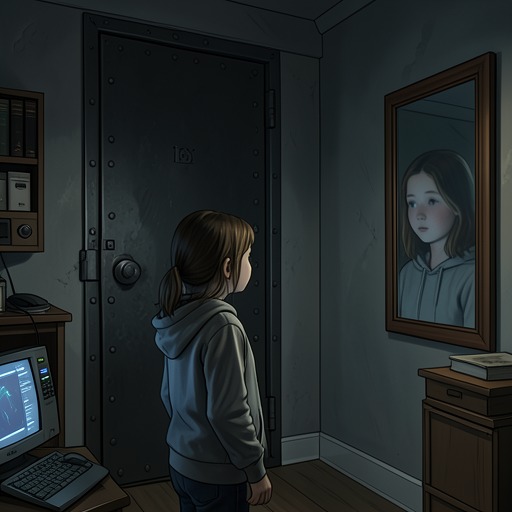
REPrototype MRI Machine is the book’s decisive time-displacement object: a medical device whose catastrophic failures carry Tabitha Moore’s consciousness between 2045 and 1998, return her to an earlier body, and force her to confront the possibility that a second life can be lost and restarted. Although an MRI ordinarily belongs to the transparent background of diagnosis and treatment, this prototype repeatedly becomes violently visible as machinery—screeching, smoking, shorting out, and dragging human bodies across incompatible moments in time.
Definition and First Temporal Rupture
The machine is tied to the Emsie St. Juarez Pediatrics ward and to the accident Tabitha remembers from 2045. When she recognizes that the 1998 incident is connected to the later machine, she understands the apparent impossibility as a causal loop: the enormous MRI that malfunctioned decades earlier is the same kind of device involved in the future event that sent her mind backward. Her realization is not abstract. It is triggered by the date on the medical chart—May seventh, nineteen ninety-eight—and by the sight of a child’s body replacing the body she had known in 2045. The machine therefore exposes the material continuity beneath what initially looks like a supernatural displacement.
In that first recognition, the MRI becomes an object of both technology and dread. Tabitha remembers the prototype as a “multi-million-dollar MRI” and identifies herself as the person who had been inside it when it went haywire forty-seven years earlier. The machine has crossed the boundary between instrument and agent: it is not presented as having intention, but its failure produces an effect normally reserved for deliberate action, sending her mind into the past while leaving her trapped in the consequences. Her immediate fear is that the experience might instead be a seizure or fatal neurological event, which preserves uncertainty about whether the machine has caused time travel, brain injury, or both.
The 1998 Malfunction
The machine’s second major appearance occurs in the Emsie St. Juarez Pediatrics ward. Its operation begins with an escalating screech that becomes physically painful before an electrical breaker blows, shutting off power across Jefferson County. The scale of the failure makes the MRI more than a local hospital object: its malfunction radiates through the surrounding community, turning a private medical procedure into a public disturbance.
Inside the device, thirteen-year-old Tabitha Moore lies motionless while backup power returns to the room. Acrid black smoke pours from the prototype, the overheated room fills with it, and the fire alarm follows. The machine’s physical symptoms—electrical failure, smoke, heat, and unbearable sound—make its temporal violence legible through ordinary industrial damage. The impossible event is anchored in concrete evidence of a machine breaking down.
Mr. Moore’s response reinforces the scene’s emergency logic. A technician and Tabitha’s furious father rush toward the device, while her father demands that she be removed. The command treats the MRI as a dangerous enclosure rather than a neutral diagnostic space. Yet the machine has already altered the terms of the scene: Tabitha is not merely a patient being extracted from faulty equipment, but a consciousness forced into a previous version of her life.
Repetition, Rescue, and the Unstable Boundary of Reality
The prototype MRI’s most consequential function is repetition. After Tabitha’s life has developed—bringing friendships, physical change, family adjustments, and new experiences—the malfunction occurs again and returns her to the beginning. Her orthopedic cast, bearing Alicia Brooks’s artwork and her friends’ signatures, is gone; her previously trained body has become soft and overweight again; and the relationships she had built appear to have been erased. The machine thus makes material objects into evidence of timeline loss. Their disappearance proves that the prior sequence of life was not merely an idea or a dream within the story’s logic.
The device also merges waking reality with a recurring vision of an F-22 fighter jet. Tabitha attempts to escape in the aircraft, but when someone grabs her ankle, the cockpit transforms into the cylindrical opening of the Prototype MRI Machine at the University of Louisville Hospital. Medical personnel struggle to pull her from the screeching apparatus while the fighter’s glass canopy becomes the MRI’s aperture. This transformation makes the machine a hinge between incompatible forms of escape: the imagined aircraft promises forward motion and freedom, while the MRI returns Tabitha to bodily confinement and medical crisis.
The extraction is itself violent and uncertain. A man orders the staff to pull Tabitha out because the tray table has shorted and her thrashing may injure her; a nurse reports that the machine began normally and then produced the terrible noise while Tabitha started screaming and appearing to suffer fits or a seizure. The scene offers a medical explanation without resolving the larger temporal one. Tabitha experiences herself as old, frail, bleeding, and trapped inside the machine, then reaches toward its rear as another blood vessel ruptures. At the point where ordinary bodily survival seems to end, a small hand grasps hers in a black void and prevents her from falling with the aircraft. The MRI has consequently become the threshold through which bodies, memories, dreams, and possible deaths exchange places.
Connections and Narrative Significance
The machine’s importance depends on its recurrence across different technological eras. From Tabitha’s perspective, 2045 represents bracelet computers, web access, and mature online culture, while 1998 is the dial-up era in which she must wonder whether a flash drive exists and whether her writing should be saved to a CD or floppy diskette. The MRI is the object that makes this technological contrast bodily rather than merely historical. It does not simply transport Tabitha to an earlier calendar date; it strands a future mind inside the material limitations of the past.
That displacement also changes how evidence works. Alicia Brooks’s disposable-camera photograph of Tabitha running toward the shot police officer preserves a moment that might otherwise be dismissed or distorted, while later photographs at the Halloween gathering record a renewed network of family and friends. Against these small, human forms of recording, the MRI produces disappearance: the cast and its signatures vanish when the timeline restarts. The contrast gives the machine an archival significance. It can create an experience too large for ordinary records to contain, while simultaneously erasing the physical traces that would verify the life Tabitha has just lived.
The prototype is therefore both a plot mechanism and a material metaphor for traumatic repetition. Tabitha explicitly describes being sent back to the waking point in May 1998 again, and she admits that she feared losing every shared moment and having to resolve her relationship with Shannon Moore from the beginning once more. The MRI turns that fear into structure. Its breakdown repeats the wound rather than allowing time to heal in a straight line, while the effort to narrate the experience to Alicia and Elena Seelbaugh becomes a way of assembling continuity from events that the machine has repeatedly torn apart.
The object remains morally and causally ambiguous. It is not portrayed as a conscious villain, and no explanation establishes a stable scientific law for its effects. Instead, its damaged materiality—burned circuitry, black smoke, shrieking sound, and a shorted tray table—supports an impossible event without making that event fully intelligible. The Prototype MRI Machine matters because it makes the story’s central contradiction tangible: a device designed to look inside the body becomes the force that dislocates identity from the body, turns memory into evidence, and gives Tabitha a second chance only by threatening to take that chance away again.