Uncle Danny’s criminal case and incarceration
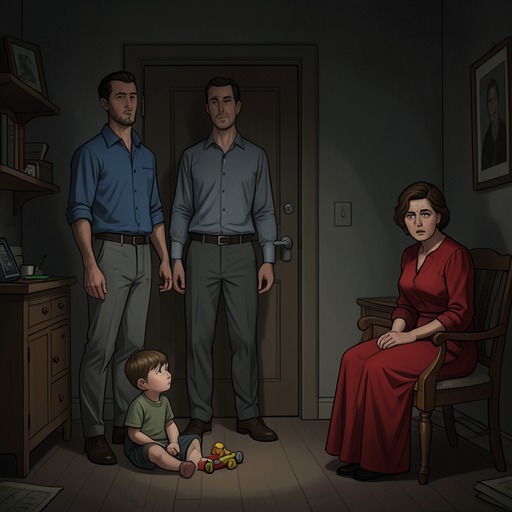
REUncle Danny’s criminal case and incarceration marks the point at which the Moore family’s already fragile domestic life becomes an explicit legal crisis. His arrest removes him from the household, exposes the family to financial and emotional instability, and leaves the care of his sons to Grandma Laurie while Lisa Moore prepares to disappear. For Tabitha Moore, the case also demonstrates that returning to the past does not provide a clean sequence of problems to solve: events overlap, information is withheld, and opportunities for intervention can vanish before she recognizes them.
The Theft and Arrest
Grandma Laurie tells Tabitha Moore that Uncle Danny was arrested roughly a week and a half earlier and is being held in county jail awaiting his court date. The evidence against him is concrete: surveillance cameras recorded him stealing electronics from a pallet behind a Service Merchandise department store at Sandboro Mall. The stolen goods consisted of approximately $30,000 worth of IBM, Compaq, and Toshiba personal computers, a particularly bitter detail because, as Grandma Laurie observes, Danny does not know anything about computers.
The case is therefore presented as an act of theft rather than an understandable attempt to meet an immediate need. Lisa Moore tries to recast it for the children as a victimless crime committed for the family, but Grandma Laurie rejects that explanation. Her position is bluntly ethical: the computers did not belong to Danny, and stealing remains wrong regardless of the family’s financial circumstances. The disagreement reveals the family’s competing ways of interpreting criminal responsibility, with Lisa Moore defending Danny through economic desperation and Grandma Laurie insisting that poverty does not erase ownership or accountability.
Information Withheld from Tabitha
Tabitha Moore learns about the arrest from Grandma Laurie rather than from her parents. When Grandma Laurie expresses surprise that Tabitha did not know, Tabitha admits that Alan Moore and Shannon Moore had told her nothing. The omission intensifies her sense of distance from her parents and makes the legal crisis feel like another failure in the family’s communication system.
Her reaction is shaped by future knowledge. Tabitha remembers that, in her previous life, her parents eventually sat down with her to discuss Danny’s case, and she believed that returning to 1998 would allow her to anticipate important developments. Instead, the arrest has already happened before she understands where it belongs in the renewed timeline. The case becomes an example of the limits of her supposed advantage: memory gives her fragments, not reliable control, and family members can still conceal or omit the facts on which her plans depend.
Incarceration and Family Displacement
When Uncle Danny’s car arrives at the Moore property, Tabitha realizes that the arrest is not an isolated legal fact. The car, a sun-bleached 1988 Oldsmobile Cutlass Supreme Classic, is brought back to the family home, where it appears likely to remain on cinder blocks. Its arrival makes Danny’s absence physically visible: the vehicle returns, but its owner is headed toward imprisonment and cannot maintain his household.
Lisa Moore’s response to that absence is abandonment. She accepts money from Alan Moore and leaves, telling the family she is being driven to Shelbyville. Tabitha understands that Lisa will not merely be away temporarily; she will start a new life elsewhere and will not see Sam, Aiden, Nick, and Joshua again for years. Tabitha does not try to stop her. Although Lisa’s departure is painful for the boys, Tabitha decides that they are better off under Grandma Laurie’s care, and she resolves to look out for them as much as she can.
The incarceration thus transfers the practical burden of care onto Grandma Laurie and, indirectly, onto Tabitha. Danny’s legal predicament removes one parent, while Lisa’s departure removes the other. The children are left in a household where adults argue over morality and money, but where the actual work of protection and stability must be carried by those who remain.
Consequences for the Moore Family
The case deepens the Moore family’s poverty, estrangement, and dependence on informal caregiving. Danny’s stolen computers represent a large material loss to the victims, but within the family the more immediate consequences are the loss of an income-bearing adult, the disruption of the boys’ home life, and Lisa Moore’s abandonment. The legal crisis therefore operates simultaneously as a criminal matter and as a family-system rupture.
Its effects also clarify Tabitha Moore’s altered role after returning to the past. She is not simply a daughter observing adult problems. She monitors the boys’ welfare, evaluates whether Lisa’s presence benefits them, and accepts responsibility for supporting Grandma Laurie’s care. That response connects Danny’s case to the broader pattern of children being forced to absorb adult failures. The boys are expected to endure the consequences of their parents’ choices, while Tabitha attempts to compensate for the protection the adults do not reliably provide.
Narrative Significance
Uncle Danny’s criminal case and incarceration is a decisive example of the novel’s recurring conflict between foreknowledge and actual agency. Tabitha Moore believes that knowing the past should let her prevent harm, yet the arrest is already underway when she hears about it, and the family’s silence has kept her from acting sooner. The result is not a controllable replay of an old story but a disordered present in which legal, financial, and emotional consequences arrive together.
The case also establishes a contrast between Grandma Laurie’s moral clarity and Lisa Moore’s defensive rationalization. Grandma Laurie protects the children by naming the theft as theft and by resisting Lisa’s attempt to make criminal conduct sound altruistic. Lisa, meanwhile, responds to Uncle Danny’s incarceration by leaving rather than sustaining the family through the crisis. Through that contrast, the episode shows how the Moore family’s legal troubles become inseparable from questions of custody, responsibility, and who is willing to remain when the consequences arrive.