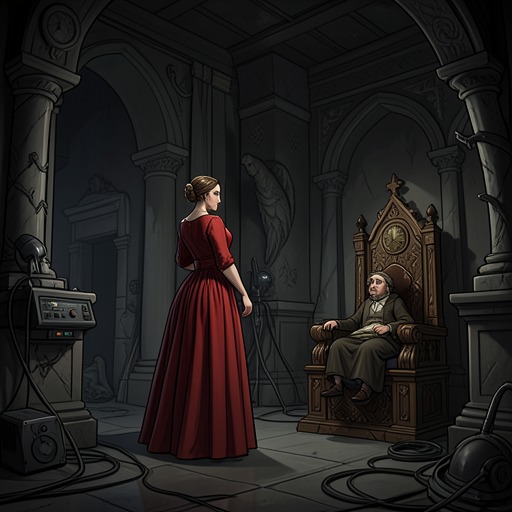
The Magi-goblin caste order
REThe Magi-goblin caste order is the governing hierarchy imagined for Tabitha Moore’s fantasy project Goblina. In its society, magic is universal as a standard of status, but those who cannot use it are deformed by that condition and labeled goblins. They are then either expelled to live outside society or absorbed into it as slaves and servants, making the caste order both a system of bodily stigma and a structure of permanent labor and political inferiority. Its decisive narrative function is to transform a fantasy premise into an allegory of domination, exclusion, and the struggle to become an independent person.
Definition and Social Structure
The order divides the world between the Magi and the goblins, with the latter placed beneath even the enslaved population in the hierarchy Tabitha describes. Goblins are not merely poor or politically powerless: their physical difference is treated as proof of their inferior place, and their classification determines the life available to them. They have no recognized route out of servitude or total subordination, and there is explicitly no accepted way for them to oppose the Magi within the existing order.
This arrangement combines social exclusion with forced inclusion. A goblin may be cast out and left to survive as a savage, or retained as a slave or servant whose value is defined by labor. In either case, the system denies the goblin full membership in society while continuing to govern the goblin’s body and future. The category therefore operates as more than background world-building: it is the mechanism by which the dominant class makes its authority appear permanent.
The Goblin Protagonist and Resistance
Goblina’s protagonist begins at the bottom of this order. Tabitha describes her as “the lowest of the low—beneath the slaves, even,” a figure who starts with nothing while the reader learns the structure of the world alongside her. Everyone calls her a goblin, so the label precedes her individual identity and frames the narrative through the judgments of the society she must survive.
The protagonist’s position also makes her resistance a movement from imposed status toward self-definition. Tabitha explains that the story will follow someone who opposes and ultimately overcomes the Magi. The conflict is consequently not only a rebellion against particular rulers; it is an attempt to break the principle that birth, magical capacity, and inherited social judgment should determine a person’s entire existence.
Allegory and Personal Independence
Tabitha openly connects the caste system to the experience of growing beyond parental influence. She calls the theme an allegory for taking “that final step of personal growth out of your parents’ influence to stand on your own as a person.” The Magi thus represent an authority that presents dependence as natural and permanent, while the goblin protagonist embodies the difficult work of acquiring an identity that is not granted by the ruling order.
The allegory gains force from the protagonist’s complete lack of initial power. She does not begin as a concealed member of the elite or as someone already entitled to recognition. Her story starts from the status the system has assigned her, so any later independence must be constructed against a culture that has made inferiority seem like common sense. Tabitha also intends the theme to be accessible to a young adult audience, using the fantasy conflict to make personal maturation and political resistance illuminate one another.
Expansion Through Magic and Space
The caste order is supported by an elaborate magical system. Tabitha has organized pages of rules governing how magic works and how the Magi’s society and culture fit together, although she plans to reveal that information gradually rather than burden readers with undigested exposition. The protagonist’s limited knowledge becomes a structural device: the audience discovers the hierarchy in fragments as she does, allowing the social order to appear first as lived constraint and only later as a comprehensible system.
The second book expands the order into the built environment. The Magi have goblins construct labyrinths around leylines, arranging the passages so that power from a mana spring is focused and channeled along one precise route. Free goblins then alter those structures by breaking down some walls and building others, turning the designed system into a sprawling maze. Their sabotage forces the Magi to navigate an underground deathtrap populated by rebel goblins and to determine which walls must be repaired or demolished to restore the intended flow of magic.
The labyrinth therefore gives physical form to the caste system. The Magi attempt to impose order through architecture, infrastructure, and control of magical circulation; the free goblins answer by disrupting the pathways that make that authority function. What appears to be stone-working and fantasy engineering is also a contest over who may shape the world’s underlying channels and whose labor, knowledge, and movement the ruling class is allowed to control.
Narrative Significance
The Magi-goblin caste order supplies Goblina with its central opposition: inherited power against stigmatized life, imposed identity against self-definition, and fixed hierarchy against collective resistance. Because the protagonist is identified with the lowest caste, Tabitha’s statement that “I’m the goblin” makes the system personally expressive rather than merely decorative. The fantasy classification carries the emotional weight of feeling marked as inferior, while the protagonist’s eventual opposition promises a redefinition of what the category can mean.
At the same time, the system’s detailed rules keep the allegory tied to a functioning secondary world. Its magic, labor arrangements, bodily consequences, social exclusions, and labyrinthine infrastructure all arise from the same hierarchy. The order is thus both the subject of Goblina’s political imagination and the engine that organizes its plot: it explains why the protagonist begins powerless, why rebellion is dangerous, why the Magi’s authority reaches into physical space, and why changing the world requires challenging the definitions by which that world ranks human worth.