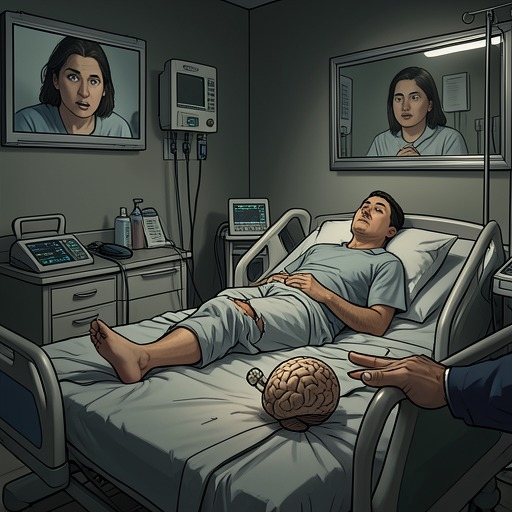
Dissociative state
REDissociation is a recurring psychological state in Tabitha Moore’s return to 1998, a defensive withdrawal that helps her survive experiences she cannot yet integrate. It appears not as simple calm but as a rupture between what happens to her and what she can feel, say, or understand: emotion gathers to an unbearable intensity, then collapses into distance, blankness, or detached observation. The state therefore exposes both the cost of her second life and the limits of treating future knowledge as protection.
Definition and Psychological Context
Tabitha’s dissociation is rooted in the collision of an adult consciousness with a thirteen-year-old identity. She remembers a first life extending more than forty years, yet must inhabit the social and bodily conditions of 1998, including school, hormones, dating expectations, family authority, and the unresolved dangers surrounding Aunt Lisa. The mismatch repeatedly produces identity problems and a tendency to dissociate from experience before it can become an ordinary teenage attachment or desire. Even a minor encounter with Bobby becomes difficult to process because it awakens feelings associated with adolescence while the rest of Tabitha’s mind remains occupied by trauma, responsibility, and knowledge of what may happen.
Her response to Bobby shows how dissociation can interrupt both pleasure and self-recognition. She is surprised by the giddiness produced by speaking with a boy, then immediately attempts to explain it away through hormones, social expectations, and comparisons to a young Heath Ledger. She cannot simply enjoy the encounter or simply reject it. Instead, she analyzes the feeling from outside herself, questioning whether attraction might arise from Bobby’s superficial resemblance to her father and wondering why his social background does not repel her in the way Aunt Lisa’s does. The experience becomes an object of scrutiny rather than a straightforward emotion, demonstrating how psychological distance protects Tabitha while also preventing her from inhabiting the present naturally.
Dissociation Under Immediate Pressure
The state becomes more severe during the family crisis involving Lisa and her sons. After the confrontation, Tabitha cries with Joshua while the voices of Aunt Lisa and her parents continue rising outside the bedroom. Her anger and hatred overwhelm every other feeling, and she is too strained and distressed to lift him. When the bedroom door is eventually opened from the other side with a screwdriver after forty minutes, she watches the knob turn with detached interest. The detail is significant: an intensely invasive domestic conflict is rendered through the passive observation of an object and an action, as though Tabitha were witnessing someone else’s crisis rather than living through her own.
The physical aftermath confirms that this detachment is not recovery. Her eyes are swollen, her throat raw, and her entire body aches; she and Joshua have both exhausted themselves through crying. Yet once the heated emotions recede, Tabitha’s mind becomes cold, bitter, and hateful. Dissociation here follows emotional overload rather than replacing it from the beginning. The feelings are first experienced at full force, then emptied out, leaving a residue of hostility without the energy or clarity needed to act on it. Her apparent stillness therefore conceals the accumulated effects of grief, rage, helplessness, and familial betrayal.
The Sudden Blankness of Recognition
The most starkly visible instance occurs when Alan Moore tells Tabitha that, once she is grown, she will understand Lisa’s discipline of her children. The statement fails because it invokes adulthood as a future explanation for violence that Tabitha already recognizes as unacceptable. At the words about understanding when grown, every emotion in her eyes seems to go out at once. The transition is not gradual composure or rational persuasion; it is an abrupt extinguishing witnessed by Mrs. MacIntire, who understands that Tabitha is no longer emotionally present in the ordinary sense.
Sandra MacIntire’s reaction makes dissociation a relationally visible condition rather than a private interior label. She is chilled by the sudden change and decides that Tabitha must be removed from the family environment. Tabitha then announces, in a flat voice, that she is leaving and asks permission to stay with the MacIntires for however long necessary. Her declaration is practical and decisive, but its flatness shows that the decision emerges after emotional shutdown. When she tells her father that she will be where she needs to be when he calls and apologizes, she establishes a boundary without pleading, crying, or arguing. Leaving becomes both an act of self-protection and the external consequence of an inner withdrawal.
Emptiness After the Crisis
At the Williams residence, safety does not immediately restore Tabitha’s emotional life. She can smile faintly at Hannah’s familiar joke about covering her ears when her father may swear, and she recognizes that the food is exceptionally good, but these ordinary comforts do not penetrate the emptiness. She feels uncomfortably full while also completely empty, a bodily contradiction that gives the state material form. The absence is not described as the hollow ache of depression and not quite as numbness; it is the aftermath of having spent all her tears and exhausted her anger.
Tabitha imagines this exhaustion as waiting for another emotional payment after overdrawing her account. The image conveys a temporary but uncertain suspension: she has dealt with and processed as much as she can, yet expects another awful revelation or some eventual resolution. Events have struck her too quickly to be fitted into the framework of her earlier knowledge or plans, and she cannot immediately adapt to the place where those events have left her. She therefore sits among people who are talking easily and listens with detached interest, hesitant to draw attention back toward herself. The Williams family’s carefully managed conversation offers social inclusion without demanding disclosure, allowing her to remain present while psychologically withdrawn.
Narrative Significance
Dissociation gives form to the novel’s larger problem of living twice without possessing a stable self. Tabitha’s future memory might appear to promise control, but knowledge instead accelerates her exposure to pain: she recognizes patterns that others dismiss, carries responsibilities inappropriate to her age, and repeatedly confronts people who interpret her insight as childish imagination. Her adult mind can identify abuse, manipulation, and family denial, but it cannot automatically supply the emotional resources required to endure them in a thirteen-year-old body.
The state also complicates any simple division between strength and weakness. Tabitha’s blankness enables her to stop arguing, leave the Moore home, and accept protection from Sandra MacIntire. At the same time, it interrupts ordinary pleasure, makes social contact difficult, and leaves her unable to know what should happen after a crisis has ended. Through this pattern, dissociation becomes both a survival mechanism and a warning: emotional shutdown can create the distance necessary to escape immediate harm, but genuine recovery will require more than physical removal. It will require a setting in which Tabitha’s conflicting identities, memories, loyalties, and feelings can eventually coexist rather than alternating between overwhelming intensity and nothingness.