Present day, after the events
The Dream of Manderley
The second Mrs de Winter dreams of returning to Manderley, now a ruined and overgrown estate. She finds the iron gate locked and the lodge uninhabited, but passes through like a spirit. The drive is choked with grass and moss, and the woods have encroached upon it. She comes upon the house, grey stone shining in the moonlight, but the garden has obeyed the jungle law, with nettles everywhere. She imagines the house alive, with light from the windows and the library door half open, but a cloud passes and the illusion vanishes. The house is a sepulchre, and she resolves to think of Manderley only in its happier moments, knowing it is no longer theirs.
Present day, after the events
Exile and Memory
The second Mrs de Winter reflects on the present, living abroad with Maxim. They have found a kind of peace, but the past is still close. Maxim sometimes looks lost and puzzled, and she knows he remembers. She has learned to avoid topics that hurt him, like wood pigeons, which recall Manderley. She reads English news and sports to him, and they live by routine. She thinks of Mrs Danvers and Jack Favell, and of the expression on Mrs Danvers' face that gave her first feeling of unrest. She remembers her own younger self, shy and gauche, trailing after Mrs Van Hopper in Monte Carlo.
Early in the story, at the Hotel Cote d'Azur in Monte Carlo
Meeting Maxim de Winter
Mrs Van Hopper spots Maxim de Winter in the restaurant and insists on introducing herself. She sends the narrator to fetch a letter from her nephew as a pretext. The narrator returns to find Maxim already sitting with Mrs Van Hopper. He is polite but distant, and when Mrs Van Hopper presses him about Manderley, he makes a dry joke about Ethelred the Unready. He then turns to the narrator, asking her opinion of Monte Carlo, and she feels his eyes on her, puzzled and reflective. Mrs Van Hopper's chatter continues, and Maxim eventually escapes when a page-boy announces a dressmaker. He leaves with a sardonic remark about the family motto, 'He travels the fastest who travels alone.'
Later the same day
Maxim's Apology Note
After the encounter, the narrator receives a note from Maxim apologizing for his rudeness. The note is unsigned but her name is spelled correctly. She is surprised and pleased, and puts the note away. She had been sketching a mediaeval profile, but after reading the note, the drawing no longer pleases her.
The next morning
Mrs Van Hopper's Illness
Mrs Van Hopper wakes with a sore throat and a high temperature. The doctor diagnoses influenza and orders her to stay in bed, suggesting a trained nurse. The narrator is relieved to have a break from her duties. She goes down to lunch early, hoping to avoid Maxim, but finds him alone in the restaurant.
The same day, during Mrs Van Hopper's illness
Lunch with Maxim
The narrator knocks over a vase of anemones at her table, and Maxim comes to help. He insists she have lunch with him, and she reluctantly agrees. They talk easily, and she tells him about her father and her life. He says she has taken him out of his despondency. He offers to drive her to Monaco to sketch, and she accepts. The lunch lasts an hour and a half, and she feels a bond forming between them.
The same afternoon
The Drive to the Precipice
Maxim drives the narrator to the hills above Monte Carlo. He drives dangerously fast, and she feels a thrill. They stop at a precipice, and he becomes silent and detached, lost in his own thoughts. She fears he might be mad. He then apologizes and turns the car around. He tells her he had been there years ago with his wife, and that she has blotted out the past for him. He asks her to call him Maxim.
Later that evening
The Book of Poems
Back at the hotel, the narrator sits alone in the lounge and reads the book of poems Maxim lent her. It opens to a much-frequented page, 'The Hound of Heaven'. She then sees the dedication: 'Max - from Rebecca. 17 May'. The handwriting is bold and slanting. She shuts the book, disturbed. She remembers Mrs Van Hopper's words about Rebecca's drowning in the bay near Manderley.
The following weeks
Daily Drives with Maxim
The narrator spends her mornings driving with Maxim while Mrs Van Hopper is ill. She feels a feverish excitement, like a schoolboy with a passion for a prefect. She treasures every moment, wishing she could bottle the memory. He teases her, and she wishes she were older and more sophisticated. She tells him she knows nothing about him except that he lived at Manderley and lost his wife. He becomes silent, and she fears she has ruined their friendship.
During one of the drives
Maxim's Declaration
After the narrator's mention of his wife, Maxim stops the car and tells her that all memories are bitter and he wants to forget the past. He says she has blotted out the past for him more effectively than the bright lights of Monte Carlo. He asks her to come with him because he wants her company. She is moved, and he kisses her hand. He then pulls her beside him and kisses the top of her head, telling her to call him Maxim.
A few weeks later
Mrs Van Hopper's Departure Plan
Mrs Van Hopper announces they are sailing to New York. The narrator is devastated, realizing she will never see Maxim again. She imagines a furtive farewell and a life of dullness in America. She locks herself in the bathroom and cries. She then decides to go to Maxim's room to say goodbye.
The morning of departure
Maxim's Proposal
The narrator goes to Maxim's room and tells him they are leaving. He is shaving and asks her to wait. He then takes her to the terrace for breakfast and proposes to her, saying she can choose between America and Manderley. She is stunned and accepts. He tells her they will marry in a few days and go to Venice for a honeymoon. She is overwhelmed with joy and imagines her life as Mrs de Winter.
Immediately after the proposal
Breaking the News to Mrs Van Hopper
Maxim goes to tell Mrs Van Hopper about the engagement. The narrator waits in her room, feeling nervous. She burns the page from the book of poems with Rebecca's inscription, symbolically destroying the past. Maxim returns and says Mrs Van Hopper is recovering from the shock. The narrator then goes to speak to Mrs Van Hopper, who is cynical and warns her that Maxim is only marrying her because he can't bear to live alone at Manderley.
Early May, after the honeymoon
Arrival at Manderley
The narrator and Maxim arrive at Manderley. The drive is long and winding through dark woods, and she is nervous. They are greeted by a full staff assembled by Mrs Danvers. The narrator feels like a victim on a block. Mrs Danvers shakes her hand with a cold, lifeless grip and makes a stiff speech of welcome. The narrator drops her gloves in confusion. Maxim makes a short speech and then takes her to the library for tea.
The same afternoon
First Encounter with Mrs Danvers
After tea, Mrs Danvers shows the narrator to her new rooms in the east wing. She is cold and critical, implying the rooms are inferior to those in the west wing. She mentions that the west wing was where the first Mrs de Winter lived, and that the large bedroom there looked down to the sea. The narrator feels uncomfortable and intimidated. Mrs Danvers leaves when Maxim arrives, and he tells the narrator not to worry about her.
The first morning at Manderley
The Morning-Room Discovery
The narrator explores the house and finds the morning-room, which is filled with rhododendrons and furnished in exquisite taste. She realizes it was Rebecca's room. She sits at the desk and sees the docketed pigeon-holes in Rebecca's handwriting. She opens a drawer and finds a guest book and notepaper. She feels like an intruder. The house telephone rings, and she answers, mistakenly saying Mrs de Winter is dead. It is Mrs Danvers, who is clearly aware of her faux pas.
A few days after arrival
Lunch with Beatrice and Giles
Beatrice and Giles Lacy come to lunch. Beatrice is direct and outspoken, and the narrator feels awkward. Beatrice comments on Maxim's health and the narrator's appearance. Frank Crawley, the agent, is also there. The conversation is strained at times, especially when the narrator asks about bathing in the bay, which leads to an awkward silence. After lunch, Beatrice tells the narrator she is very different from Rebecca.
The same afternoon
Walk to the Happy Valley
After the guests leave, Maxim takes the narrator for a walk. They go through the Happy Valley, a beautiful, secluded spot with azaleas and rhododendrons. The narrator is enchanted. They come to a cove with white shingle, and Maxim throws stones for Jasper. The narrator then follows Jasper over the rocks to another cove, where she finds a cottage and a man named Ben. She goes into the cottage to find string for Jasper, and is disturbed by its damp, neglected state.
The same afternoon, after the walk
The First Quarrel
Maxim is angry that the narrator went to the other cove and the cottage. They argue on the way back, and Maxim reveals that he never goes near the place because of his memories. He says they should never have come back to Manderley. The narrator is hurt and confused. Later, in the library, she finds a handkerchief in the pocket of the mackintosh she wore, monogrammed with an R. It smells of azaleas, the same scent as in the Happy Valley.
The following weeks
The Shadow of Rebecca
The narrator becomes increasingly aware of Rebecca's presence in the house. She feels like a guest, not the mistress. She finds Rebecca's handwriting everywhere, and the servants refer to her preferences. She is haunted by the comparison to Rebecca, which she hears from visitors. She begins to dread social calls and feels inadequate. She confides in Frank Crawley, who tells her to forget the past and that she has qualities of kindness and sincerity.
A few weeks later
The Broken Cupid
The narrator accidentally breaks a valuable china cupid in the morning-room. She hides the pieces in a drawer. Mrs Danvers accuses Robert, the footman, of stealing it. The narrator confesses to Maxim, who is annoyed. Mrs Danvers is called in, and the narrator admits to breaking it. Mrs Danvers is cold and implies the narrator is careless. The incident deepens the narrator's sense of inadequacy.
End of June
Maxim's London Trip
Maxim goes to London for a public dinner. The narrator is left alone and feels a sense of freedom. She goes for a walk to the cove and finds Ben in the cottage, hiding. He is frightened and gives her a shell, saying she has 'angel's eyes' and is not like the other one. He implies that Rebecca threatened him. The narrator is disturbed and runs back to the house. She sees a car hidden in the drive and a man in the west wing with Mrs Danvers.
The same afternoon
Encounter with Jack Favell
The narrator finds Jack Favell in the morning-room. He is familiar and offensive, calling Maxim 'Max' and asking about the bride. He says he came to see Mrs Danvers. The narrator is uncomfortable. Mrs Danvers appears and introduces him. Favell asks the narrator not to tell Maxim about his visit. After he leaves, the narrator suspects Mrs Danvers of dishonesty and decides to explore the west wing.
The same afternoon
Exploring Rebecca's Room
The narrator goes to the west wing and enters Rebecca's bedroom. It is fully furnished, as if waiting for her return. She sees the brushes, the dressing-gown, the slippers, and the nightdress case. She touches them, feeling a growing horror. Mrs Danvers appears and shows her everything, describing Rebecca's life and death in intimate detail. She tells the narrator that Maxim is still in hell and that Rebecca's spirit still watches them. The narrator is terrified and runs back to her room.
The next day
Visit to Maxim's Grandmother
Beatrice takes the narrator to visit Maxim's grandmother. The old lady is nearly blind and confused. She mistakes the narrator for someone else and asks for Rebecca, saying she is fond of her. The narrator is deeply hurt. Beatrice is embarrassed and apologetic. The incident reinforces the narrator's feeling that she can never replace Rebecca.
A Sunday afternoon
The Fancy Dress Ball Proposed
Lady Crowan suggests reviving the Manderley fancy dress ball. Maxim is reluctant, but the narrator agrees, thinking it would be fun. Frank Crawley is put in charge of arrangements. The narrator decides to keep her costume a secret. She later gets the idea from Mrs Danvers to copy a portrait in the gallery, the one of Caroline de Winter.
The following weeks
Preparations for the Ball
The house is prepared for the ball. The narrator orders a costume from London, copying the portrait of Caroline de Winter. She keeps it a secret from Maxim and Frank. Beatrice and Giles arrive for the night. The narrator feels excited and important. She goes upstairs to dress, helped by Clarice.
The evening of the ball
The Costume Disaster
The narrator comes to the head of the stairs in her costume, which is an exact copy of what Rebecca wore at the last ball. The guests below are stunned. Maxim is ashen with anger and tells her to go and change. She realizes Mrs Danvers deliberately misled her. She runs back to her room, humiliated. Beatrice tries to comfort her, but the narrator refuses to go down again. She eventually changes into a blue dress and joins the party, but the evening is a torment.
The next morning
The Morning After the Ball
The narrator wakes late to find Maxim did not come to bed. She feels their marriage is a failure. She receives a note from Beatrice, who has left. She telephones Frank, who is evasive. She then confronts Mrs Danvers in Rebecca's room. Mrs Danvers is crying and reveals her hatred for Maxim and her devotion to Rebecca. She tells the narrator that Maxim never loved her and that she should leave Manderley. She tries to persuade the narrator to jump from the window.
The same morning
The Stranded Ship
The narrator is about to jump when rockets are fired from a stranded ship in the bay. Mrs Danvers releases her. Maxim is on the terrace, organizing help. The narrator goes down to the cliffs to watch. The diver goes down to inspect the ship. Later, Captain Searle arrives at Manderley with news: the diver found Rebecca's boat, and in the cabin, a body.
Later that day
Maxim's Confession
Captain Searle leaves, and Maxim tells the narrator the truth: he killed Rebecca. He shot her in the cottage after she told him she was pregnant with another man's child and would pass it off as his heir. He then sank her body in the boat. The narrator is shocked but accepts the truth. She realizes Maxim never loved Rebecca, and they are united in their secret.
The following Tuesday
The Inquest
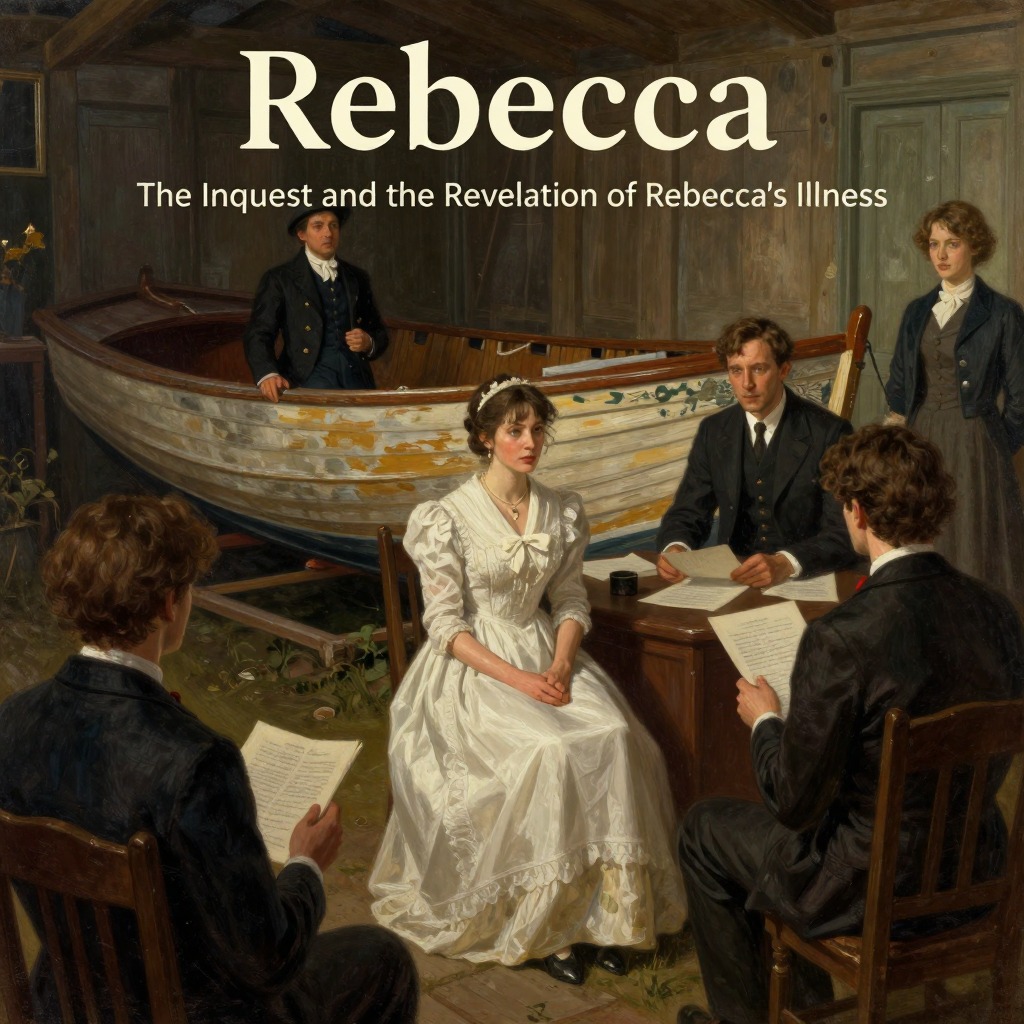
The inquest is held in Lanyon. The narrator faints during the proceedings. The boat-builder, James Tabb, testifies that the boat was deliberately scuttled. The Coroner questions Maxim, who remains calm. The jury returns a verdict of suicide. The narrator is relieved, but the ordeal is not over.
The evening of the inquest
Favell's Blackmail Attempt
Jack Favell comes to Manderley and tries to blackmail Maxim, threatening to reveal the truth. He produces a note from Rebecca asking him to meet her. Maxim calls Colonel Julyan, who comes to the house. Favell claims Rebecca was murdered, but his witness, Ben, refuses to corroborate his story. Mrs Danvers is called and denies that Rebecca loved Favell. The name 'Baker' is found in Rebecca's diary, leading to a doctor's appointment.
The next day
The Trip to Doctor Baker
Maxim, the narrator, Colonel Julyan, and Favell drive to Barnet to see Doctor Baker. Baker reveals that Rebecca was terminally ill with cancer and would have died in a few months. She had known this when she saw him. The news provides a motive for suicide, and Favell's case collapses. Colonel Julyan warns Favell to stay away from Kerrith.
The same evening
The Return Journey
After the meeting with Baker, Maxim and the narrator have dinner in a Soho restaurant. Maxim telephones Frank, who tells him Mrs Danvers has disappeared. They decide to drive back to Manderley that night. The narrator sleeps in the back of the car. She has troubled dreams about Rebecca and Mrs Danvers.
Early morning, as they approach Manderley
The Fire at Manderley
As they near Manderley, the narrator sees a red glow in the sky. Maxim realizes it is Manderley burning. He drives faster. The sky is shot with crimson, and the ashes blow towards them with the salt wind from the sea. The novel ends with this image of destruction.