Rebecca de Winter
RebeccaRebecca de Winter is the beautiful, charismatic, and deeply manipulative first wife of Maxim de Winter, whose death by drowning in the bay near Manderley is initially believed to be an accident. The novel reveals that she was a cruel and promiscuous woman who tormented Maxim with her affairs and her psychological games, and that he killed her in a fit of rage after she taunted him with a false pregnancy. Her presence, preserved by the housekeeper Mrs Danvers and by the narrator's own insecurities, haunts Manderley long after her death, and the discovery of her sunken boat forces the truth into the open.
Identity and Appearance
Rebecca was tall, slim, and strikingly beautiful, with a cloud of dark hair, a very white skin, and a figure that was the envy of other women. She had a gift for being attractive to people—men, women, children, and dogs alike—and she used this charm ruthlessly. Her cousin Jack Favell described her as having "the courage and spirit of a boy," and Mrs Danvers, who had cared for her since childhood, worshipped her as a kind of goddess. The narrator, who never meets her, pieces together her image from the objects she left behind: the long, slanting handwriting that stabs the white page, the scent of white azaleas that clings to her handkerchief, and the bold, confident way she signed her name, "Rebecca," with a tall, sloping R that dwarfed the other letters.
Life and Marriage to Maxim
Rebecca married Maxim de Winter under a false pretense of love and respectability. Within five days of the wedding, she revealed her true nature to him, telling him things he would never repeat to a living soul. She made a cynical bargain: she would run Manderley, make it the most famous show-place in the country, and play the part of the perfect wife, while Maxim would keep up the facade of a happy marriage and never expose her. She kept her side of the bargain with brilliant success, transforming the house and gardens, entertaining lavishly, and winning the adoration of the local community. But she also lived a secret life of debauchery, taking lovers—including Favell, Frank Crawley (whom she harassed), and Giles Lacy—and using the cottage on the beach for her assignations. She laughed at her husband behind his back, mimicked the servants, and treated the whole charade as a game.
The Murder and Its Aftermath
On the night of her death, Rebecca returned unexpectedly from London and went to the cottage. Maxim followed her, intending to confront her about her affair with Favell. Instead, she taunted him with a new cruelty: she told him she was pregnant, and that the child would be born at Manderley, bearing his name, and that he could never prove it was not his. She laughed at him, and in a blind rage he shot her through the heart. He then carried her body to her boat, the "Je Reviens," took it out into the bay, opened the seacocks, and drove spikes through the planking to sink it. The boat sank too close to shore, and for over a year it lay undiscovered on the seabed, with Rebecca's body still inside the cabin.
The Revelation of Her Illness
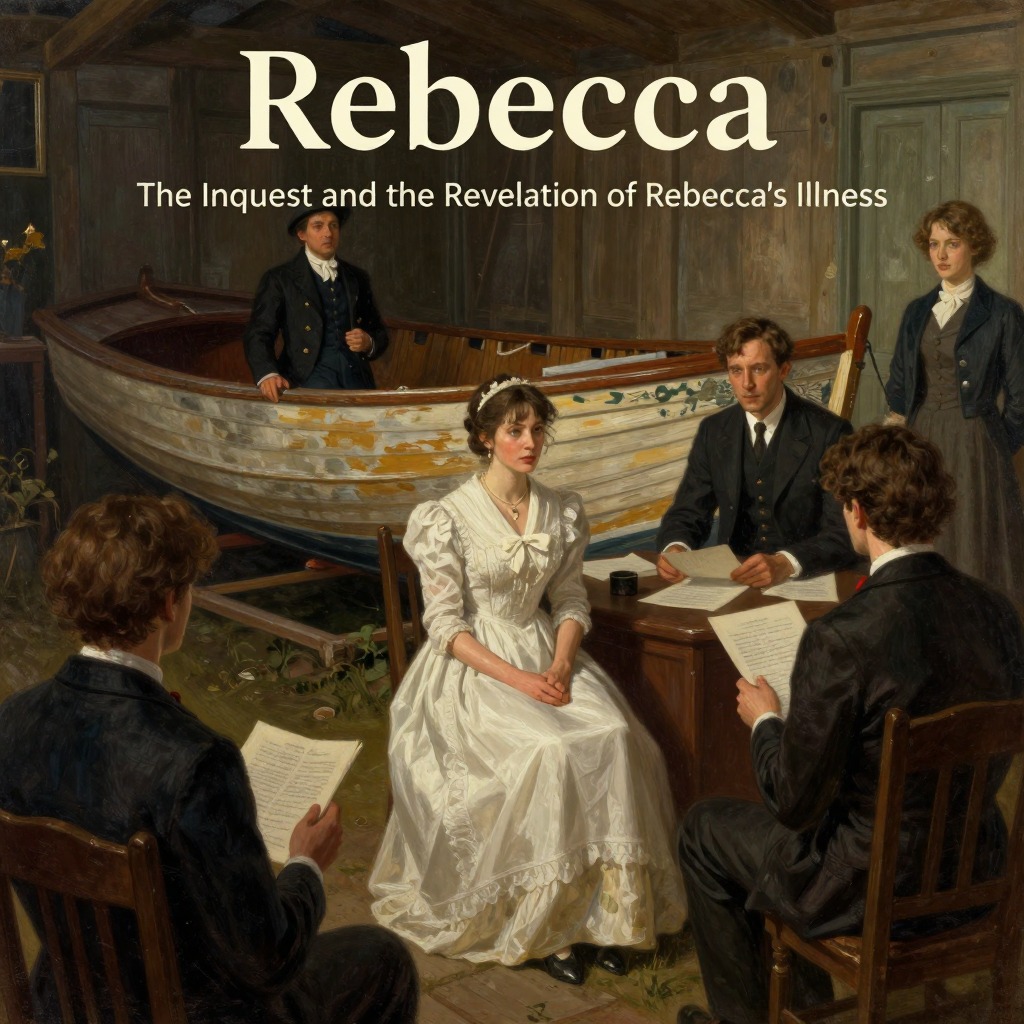
At the inquest, the boat-builder James Tabb testified that the boat had been deliberately scuttled, not capsized by accident. This led to a search for a motive, which was finally supplied by Doctor Baker, a London specialist. Rebecca had visited him on the day she died, using the false name "Mrs Danvers," and he had told her that she was suffering from a deep-rooted, inoperable cancer that would kill her within months. She had known she was dying, and she had deliberately provoked Maxim into killing her, making her death look like a murder so that he would be destroyed along with her. The verdict at the inquest was suicide, but the truth was more complex: Rebecca had engineered her own death as a final, triumphant act of revenge.
Thematic Significance
Rebecca functions as the novel's central absence and its most powerful presence. She is the "shadow" that falls between Maxim and his second wife, the standard against which the narrator measures herself and finds herself wanting. She represents a kind of untamed, amoral vitality that the conventional world cannot contain, and her death—whether by murder or by suicide—is the logical outcome of a life lived without restraint. The novel ultimately suggests that Rebecca's power was not in her beauty or her charm, but in her refusal to be defined by anyone else's rules. She chose her own death, on her own terms, and she nearly succeeded in destroying Maxim along with her. Only the discovery of her illness, which provided a motive for suicide, saved him from the gallows.
Upon its 1938 publication, Rebecca received mixed initial reviews; The Times dismissed it as "nothing in this is beyond the novelette," and V.S. Pritchett predicted it would be quickly forgotten. Yet the novel proved enduringly popular, winning the U.S. National Book Award for favorite novel of 1938 as voted by the American Booksellers Association. In subsequent decades, critical reassessment has been more favorable, with Ceri Radford and Chris Harvey of The Independent describing it as a "marvellously gothic tale" rich in atmospheric and psychological horror. The novel has remained continuously in print since 1938, with Avon estimating monthly paperback sales of over 4,000 copies in the U.S. as late as 1993. It placed 14th in the 2003 BBC survey The Big Read, was voted the UK's favorite book of the past 225 years in a 2017 WHSmith poll, and was included on the BBC's 2019 list of the 100 most inspiring novels. Du Maurier's own intention—to explore the power dynamics between a dominant man and a subordinate woman—was often overlooked by early critics.