Kousminski
ResurrectionKousminski is the principal landed estate inherited by Dmitri Ivanovitch Nekhludoff from his mother, a large property in the black-earth district that provides the bulk of his income. It is the first place where Nekhludoff, after his moral awakening at Maslova's trial, attempts to put his convictions about the injustice of private landholding into practice, an effort that leaves him with a troubling sense of incompleteness and shame.
Identity and Background
Kousminski is a large, fertile estate in the black-earth region, inherited by Nekhludoff from his mother, who had received ten thousand acres of land as her dowry. Nekhludoff had lived there in his childhood and youth, and had visited it twice as an adult, once with a German steward to verify accounts at his mother's request. The estate is managed by a German steward, a stout, muscular, self-assured man who speaks Russian well and whom the local peasants regard as ostentatious and corrupt, believing he has enriched himself by buying an estate of his own. The steward's arguments for maintaining the existing system—that the peasants would spoil the land and that selling the implements would bring a loss—are the first obstacle Nekhludoff encounters when he decides to change the way the land is farmed.
Nekhludoff's Land Reform Attempt
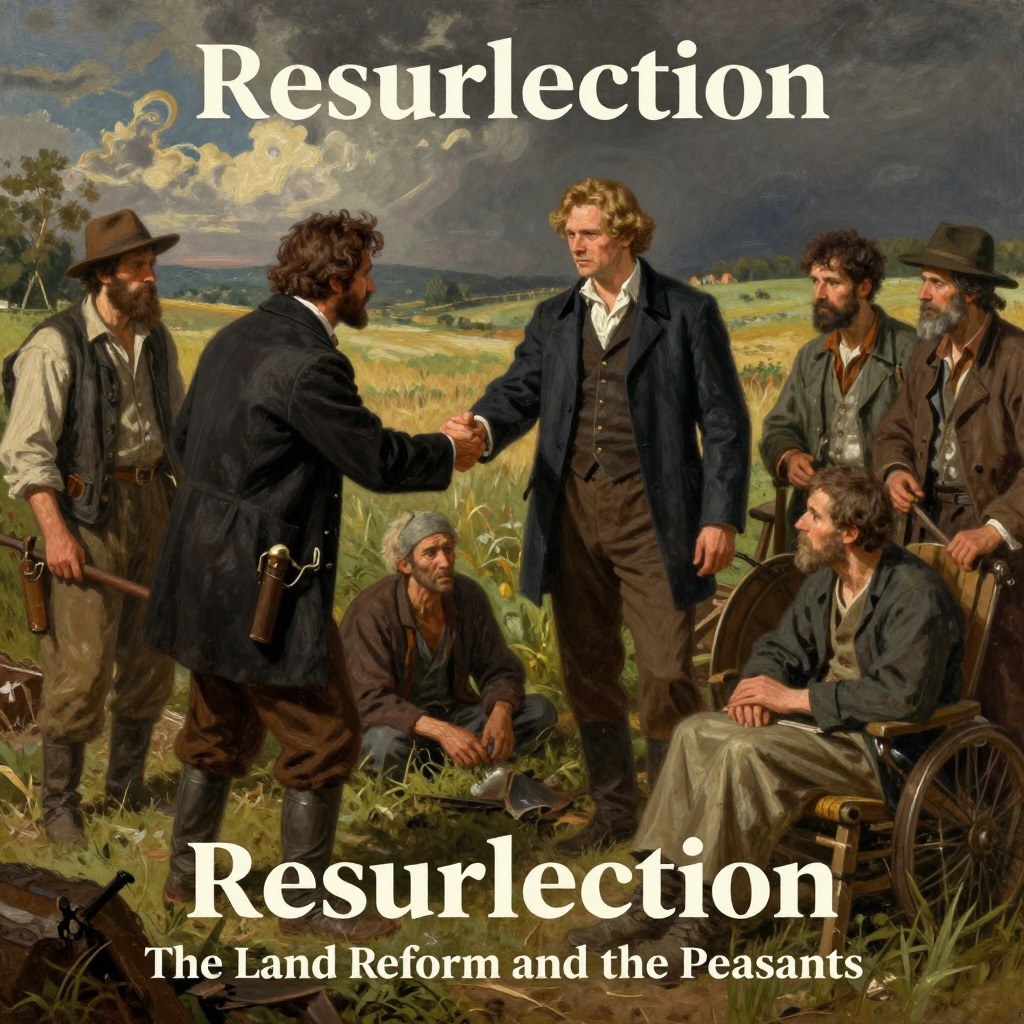
After his spiritual awakening, Nekhludoff resolves to stop farming the land himself and instead to lease it to the peasants at a low rent, so that they can cultivate it without dependence on a landlord. He sees this as a step toward a less brutal form of serfdom, though not a full solution. When he arrives at Kousminski, he examines the office books and learns that two-thirds of the best cultivated land is tilled by hired laborers using improved machinery, while the remaining third is worked by peasants who are paid only five roubles per desiatin for ploughing, harrowing, sowing, reaping, and delivering the grain—work that would cost at least ten roubles if done by wage labor. The peasants also pay for meadows, wood, and potato-stalks through labor at inflated rates, and nearly all are in debt to the estate office. The land beyond the cultivated fields, which the peasants rent, costs them four times the value it would yield if invested at five percent. Nekhludoff calls a meeting of the peasants from the three neighboring villages that lie within his estate and offers to lease them all the land at a price far below the market rate. The peasants, however, do not accept the offer with the gratitude he expected; instead, they bargain, and a dispute arises among themselves about whether to exclude the weak and those unlikely to pay. The agreement is finally signed, but the peasants leave shaking their heads in a dissatisfied and disappointed manner, and Nekhludoff feels ashamed and dissatisfied with himself, sensing that he has not done what they truly expected.
Thematic Significance
Kousminski is the site where Nekhludoff first confronts the practical difficulty of translating his moral principles into action. The estate represents the comfortable, luxurious life he has led—the income from it has supported his idle, depraved existence—and his attempt to reform it is a direct challenge to the system of private landholding that he now considers unjust. Yet the peasants' suspicion and disappointment reveal that his gesture, though costly to himself, is not perceived as a genuine act of justice but as another trick by the landlord. The experience at Kousminski prepares him for the more radical step he takes later at Panovo, where he decides to give the land to the peasants outright and to acknowledge the rent as their communal property. The estate thus marks the beginning of Nekhludoff's long, difficult journey toward living according to his conscience, a journey that will lead him to Siberia and to a new understanding of the fundamental law of human life.