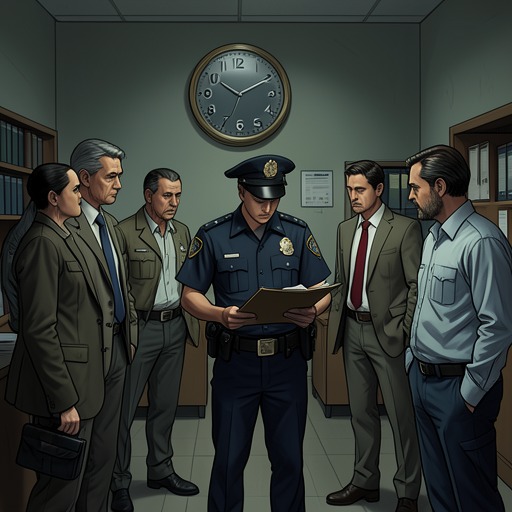
Miami Beach Police Department
RetributionThe Miami Beach Police Department is a local law-enforcement agency whose officers become central to the investigation of the Cupid murders after rookie Victor Chavez stops William Rupert Bantling’s Jaguar. The stop leads to the discovery of a murder victim, but the circumstances that follow place the department under scrutiny: its officers must cooperate across jurisdictions and protect evidence while facing the possibility that an unlawful stop will undermine the prosecution. The department’s role thus shifts from ordinary patrol work to a test of institutional procedure, interagency authority, and individual accountability.
Task Force Role and Structure
The Miami Beach Police Department is one of four municipal and county police departments named as a full-time contributor to the Cupid task force. Twelve officers and detectives from five agencies are assigned to the investigation. At the request of Governor Bush, the Florida Department of Law Enforcement provides a conference room at its Miami Regional Operations Center as headquarters, along with a criminal analyst, office equipment, and part-time clerical support. The task force’s shared arrangement reflects the scope of a case that crosses local jurisdictions: no single department owns the investigation, and the work depends on coordination among participating agencies.
That structure does not erase the local department’s responsibilities. Miami Beach officers are involved in the traffic stop that brings Bantling into custody, in the initial handling of the scene, and in the search of his residence. Their actions become part of a larger investigation involving the task force and other law-enforcement bodies, but the legality of their own conduct remains a decisive issue. The department’s place within a multi-agency operation is therefore both practical and consequential: it provides personnel at crucial stages while making the reliability of those officers’ accounts essential to the case.
Chavez’s Stop and the Discovery in the Jaguar
At about 8:15 p.m., Chavez sees a black Jaguar traveling south on Washington Avenue toward the MacArthur Causeway. The account he first gives the task force is that the car is speeding and has a broken taillight. He stops it, identifies the driver as William Rupert Bantling, and asks to search the trunk after suspecting an odor coming from the vehicle. Bantling refuses consent. Chavez calls for backup and a K-9 unit; the dog alerts at the trunk, which officers open. Inside they find a dead woman whose chest has been cut open and whose heart is missing. The discovery rapidly draws officers from different jurisdictions and turns a traffic stop into the entry point for a major murder investigation.
The scene requires immediate cooperation as well as restraint. Manny Alvarez reports that he has kept others from touching the body, although officials have looked at it, and that crime-scene personnel have photographed it. The handling of the evidence matters because the investigation depends on establishing what officers encountered and preserving it for later examination. The discovery makes Bantling a murder suspect, but it does not settle whether the officers lawfully stopped and searched his car. That distinction becomes the department’s central procedural vulnerability.
Officers at Bantling’s Residence
Miami Beach officers also take part in securing Bantling’s home on LaGorce Avenue after he becomes a prime suspect. A young uniformed department officer stands guard at the front door while crime-scene technicians examine the residence and media crews watch from across the street. The search is extensive: investigators collect samples from household surfaces and furnishings, photograph rooms, and bag items from areas including the foyer and the laundry. The department’s guard is a visible part of the security surrounding a search in which even ordinary household material is treated as possible evidence.
The guard’s position becomes important when federal agents arrive seeking access. He initially refuses to let them inside and asks them for identification, prompting the agents to make a scene on the lawn. Dominick Falconetti later sees the agents outside while the crime-scene work continues. He returns across the lawn and quietly praises the young officer’s conduct. The exchange presents access control not as a theatrical contest but as a practical boundary: the officer is responsible for the scene, and the presence of a federal agency does not automatically displace that responsibility. The scene also shows the pressures placed on a junior officer, whose decisions are being observed by superiors, investigators, and the news media.
The Stop Under Scrutiny
The legality of the stop becomes an issue when the defense moves to suppress the stop and the search that followed. Under Florida law as explained in the account, an anonymous tip alone cannot justify a vehicle stop unless its detail and independent corroboration provide an adequate basis; a traffic or mechanical violation observed by an officer can independently support a stop. Evidence obtained through an unlawful stop and search may be excluded. The distinction makes the precise sequence of Chavez’s observations and decisions critical, rather than incidental paperwork.
Chavez later tells C.J. Townsend that Sergeant Lou Ribero arrived after the trunk was opened. Chavez says he explained what had happened and that Ribero feared the case would be dismissed. According to Chavez, Ribero then said they needed another reason for the stop, one that was not the tip. In the account subsequently prepared for the case, the justification expands to include a more detailed description of the Jaguar’s route, a higher estimate of its speed, an illegal lane change, Bantling’s apparent nervousness, a substance on the bumper that looked like blood, and a suspected odor of marijuana. The difference between the initial account and this fuller narrative raises the possibility that the department’s officers were constructing a lawful basis after the fact to preserve the prosecution.
That conflict follows the department into court. Because Lourdes Rubio’s motion is the defense’s motion, the defense bears the burden of proving that the stop was improper, and Chavez is called as a witness because he observed it. The hearing puts the credibility of the officer’s account—not just the discovery in the trunk—at issue. For the department, the stakes are institutional as well as case-specific: if a stop is unlawfully conducted or its justification is falsified, the ensuing evidence may be excluded, and public confidence in the investigation may be damaged.
Institutional Significance
The Miami Beach Police Department is neither the sole investigative authority nor a background presence. Its officers participate in the task force, secure key locations, and supply the observations on which the prosecution’s account of the Jaguar stop depends. The narrative places two different forms of police work side by side: the young officer who holds the boundary at Bantling’s home, and the account of a stop whose justification appears to have been altered after the discovery in the trunk. The contrast does not resolve responsibility for every decision, but it makes the department’s conduct inseparable from the question of whether the murder case can be pursued lawfully.
That tension is the department’s defining function in the case. The task force’s collective effort gives investigators the means to respond across jurisdictional lines; the contested stop shows how one agency’s actions can threaten the work of all of them. Procedure is not separate from the search for justice. It determines which evidence can be used, whose testimony can be trusted, and whether the prosecution’s pursuit of Bantling can withstand scrutiny.