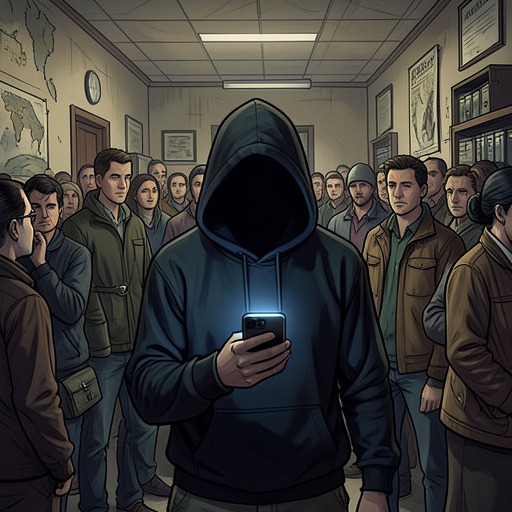
Rubber clown mask
RetributionThe Rubber clown mask is a recurring disguise in the assaults that C.J. Townsend connects to William Rupert Bantling. First appearing in reports from separate cities, it becomes a visible thread through a series of cases that had not been linked. Yet the mask is not, by itself, what identifies the attacker: C.J. finds certainty in the intimate knowledge he possessed about his victims. The object therefore marks both the pattern she uncovers and the limits of what pattern alone can prove.
Appearance and Use
The reports describe a latex or rubber clown face, sometimes with shaggy red polyester hair and eyebrows and a large red smile. In the assaults C.J. investigates, the masked intruder enters a first-floor apartment in the middle of the night while the resident is asleep. The disguise conceals his face as he takes control of the encounter; in the victims’ accounts, the attacker also uses a jagged knife to subdue and frighten them. The mask is part of a repeated method, but the reports also record variations: in some cases the assailant wears a latex alien mask instead.
The disguise appears in a particular kind of setting rather than only in one city or one isolated incident. The victims are asleep in ground-floor homes when a stranger comes in through a window. Across the accounts C.J. assembles, the mask changes between clown and alien forms while the circumstances of entry and the use of disguise remain strikingly similar. The object is thus a recurring feature of the attacker’s approach, not a complete description of every assault.
Early Reports Across California
C.J.’s search of newspaper archives brings the clown mask into view through three reports from California. In January 1991, a student at the University of California at Los Angeles awoke at 3:00 a.m. to a stranger in a rubber clown face. The attack lasted several hours, and the man escaped through a first-floor window without being identified. In July 1993, a bartender in Hollywood was attacked in her apartment after returning from work; the assailant wore a latex clown mask and was not caught. In December of that year, a student in Santa Barbara was assaulted by a man who had entered through a window at night and wore a rubber clown mask. No suspect was identified in that case either.
Initially, these incidents existed as separate reports, spread over years and jurisdictions. C.J. recognized the shared elements—ground-floor apartments, nighttime entry, unidentified intruders, and clown disguises—and concluded that the same rapist was responsible. A fourth case, in San Luis Obispo, resembled the others but involved an alien mask. That difference complicates a simple mask-based match, while the common circumstances suggested to her that the disguise could vary without changing the broader method.
From Similarity to Identification
C.J. broadened her search beyond California and found reports of comparable assaults in Chicago in September 1989 and San Diego in early 1990. One attacker wore an alien mask; another wore a clown mask. She compared the victims’ locations with addresses associated with Bantling in his AutoTrack record and found that he had lived within ten miles of the victims in Chicago and San Diego. The proximity supported her emerging hypothesis, but did not, on its own, establish who had committed the crimes.
She then obtained police reports from six departments. Their accounts described the same general pattern of entry and disguise: a stranger in a latex clown or alien mask entering a first-floor apartment at night. C.J. also found that physical evidence had not tied the cases together; the reports listed no usable trace that identified the assailant. The mask could help investigators recognize resemblance among the incidents, but it could not supply the missing identification by itself.
What persuaded C.J. was the attacker’s knowledge of details about each woman that were personal and private: preferences, routines, relationships, and other specifics. The mask concealed his face, but those details exposed a repeated intimacy between the assailant and his targets. C.J. concluded that Bantling was responsible, while recognizing that the old cases might not be prosecutable: she found that the Chicago assault had passed Illinois’s ten-year limitation period, and worried that the other cases faced similar legal obstacles.
International Scope and Significance
After C.J. contacted Investigator Christine Frederick at INTERPOL, Frederick reported similar wanted notices from Rio de Janeiro, Caracas, and Buenos Aires, as well as four assaults in the Philippines between 1991 and 1994. The reports described a white male using masks, including clown, alien, monster, and other latex faces. Frederick cautioned that these notices had not yet been confirmed with the relevant police agencies or consulates. C.J. nevertheless read them as consistent with the pattern she had uncovered; she believed the possible victims extended well beyond the American cases.
The Rubber clown mask carries two distinct meanings in the investigation. It is a practical disguise repeatedly named in victims’ reports, and it is a clue that allows C.J. to bring neglected cases into relation. But the mask also demonstrates the limits of resemblance: an alien face appears in related reports, the disguise itself changes, and the historical cases lack physical evidence linking them to one another. The investigation advances when C.J. combines the mask and the recurring circumstances with geographic and personal details, rather than treating the object as proof on its own.