The Wall
RetributionThe Wall is the Cupid task force’s large evidence board, built to hold the identities, disappearance histories, and case photographs of eleven young women. Its expansion turns a modest conference-room corkboard into the investigation’s central visual record: a place where the victims remain individually recognizable even as the task force searches for a pattern connecting their cases.
Creation and Physical Arrangement
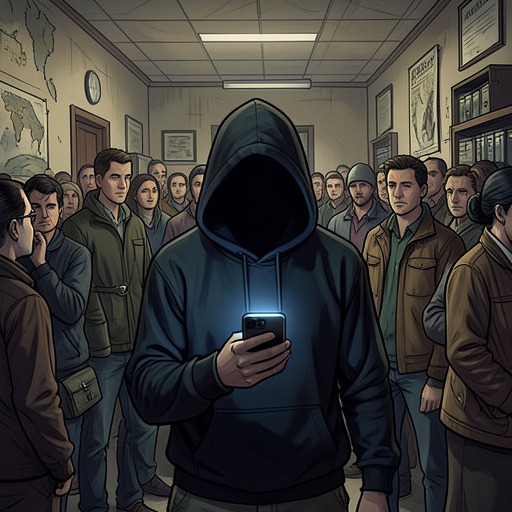
The Wall stood in a former conference room at the Florida Department of Law Enforcement’s Miami Regional Operations Center, which had been made available as task-force headquarters. When Special Agent Dominick Falconetti joined the investigation after eight months, six women had disappeared, three bodies had been found, and the task force had no leads. His first practical change was to get a larger corkboard. As the case files and photographs accumulated, the board grew to occupy almost the length of the room.
Its prominence came at the expense of the room’s former display. Law-enforcement plaques, awards, photographs, and trophies were taken down and stacked on top of bookcases to make room for The Wall and the investigation’s working materials. Green report folders, boxes, computers, and a file cabinet crowded the space. The board was therefore not a memorial installed apart from police work: it was embedded in the ordinary, burdensome machinery of the inquiry, among reports, interviews, and records that investigators had to sort through.
A Record of Lives and Disappearances
Families of the eleven missing women were asked to provide recent photographs for identification. They sometimes supplied three, five, or as many as ten. Rather than asking a family to choose one image as the definitive portrait of a whole life, investigators selected the most detailed photograph for the board and filed the other pictures. The portraits were arranged in the chronological order of the women’s disappearances, not the later dates on which their bodies were found. That decision made the sequence of vanishings—not the sequence of discoveries—the board’s organizing timeline.
Beneath the portraits, the board placed five crime-scene and autopsy photographs for each of the nine women whose bodies had been recovered. Hot-pink thumbtacks secured the pictures, and white index cards, each five by seven inches, separated the images of a woman in life from the records of her death. The cards identified each victim by name, age, and brief physical description, then listed where and when she disappeared, where and when her body was found, and the coroner’s estimated date and time of death. With the cards in place, the photographs could be linked to the correct person; without them, investigators found that matching the postmortem images to the portraits was virtually impossible.
The arrangement insisted on a difference between a person and a case record, even as it displayed both together. Family-provided portraits carried details of individual lives: some were from school or graduation, while six of the women had professional head shots. Against those images, the board assembled official dates, locations, and forensic photographs. Forensic identification was not always straightforward in Miami’s heat and humidity; in some cases, dental records were the only means of identifying a body. The index cards thus served not merely as labels but as essential links between evidence and identity.
Expansion and Investigative Use
The board changed as the case changed. At one stage, Dominick used hot-pink tacks to add five photographs beneath the card for Marilyn Siban, nineteen, whose disappearance from Club Liquid had gone unreported for two days because her friends thought she might have left with someone she knew. Her family had supplied a photograph taken for a used-car dealer in the Keys two days before she vanished. The placement of her case among the others made a particular missing-person timeline part of the shared record, rather than leaving it in a separate file.
Two additional portraits at the far end represented Morgan Weber, twenty-one, last seen at The Clevelander on Miami Beach, and Anna Prado, twenty-four, last seen at Level nightclub. Their cards were still incomplete: both women were missing and presumed dead. The unfinished entries made the board a record of uncertainty as well as a catalogue of recovered evidence. It could show what investigators knew, but it could not resolve a disappearance simply by displaying it.
Investigators also used the portraits as a reference when examining possible evidence and leads. While reviewing seized videotapes, Dominick asked whether any of the women from The Wall appeared in the material; none had been identified in the first three videos viewed, although more than a hundred remained to be examined. Later, Dominick and Manny Alvarez revisited clubs where women on the board had last been seen and showed staff a color lineup that included William Rupert Bantling. Several workers recognized Bantling as a frequent customer, often accompanied by a different young blonde woman, but none could place him with a particular victim on the right night. The board helped define the comparison investigators were making; it did not supply the missing corroboration.
Meaning and Limits
The Wall’s organization gave the task force a way to look across separate cases without reducing the women to a single undifferentiated list. Beside it, aerial photographs of South Beach and Miami-Dade County displayed red pins for disappearance locations and blue pins for other sites around Miami. Those maps were distinct from the victim photographs, but together the displays placed faces, dates, and geography within the same investigative room. Dominick repeatedly studied The Wall while trying to find a connection not yet visible in the accumulated evidence.
The board also embodied the cost of making private lives available to an investigation. The files stored nearby included victims’ financial records, diaries, date books, letters, photo albums, and emails. Their most personal belongings and thoughts had become part of Florida’s public record. The Wall did not contain all those materials, but it stood at the center of a room organized around their collection and examination. Its force lies in that double function: it keeps each victim’s name and image present, while showing how police procedure turns lives into evidence. It makes the cases visible; it cannot, by itself, explain why the women were targeted or identify the person responsible.