Karl Alexander Gymnasium
ReunionThe Karl Alexander Gymnasium, Stuttgart’s celebrated grammar school, is the setting of Hans Schwarz’s first meeting with Konradin von Hohenfels and of the school’s transformation from a sheltered humanist institution into a place where antisemitism isolates Hans. Years later, the school’s destruction and a memorial appeal bring that transformation into focus: the institution remains part of his history, but he can no longer feel that he belongs to the community it represents.
Foundation and Setting
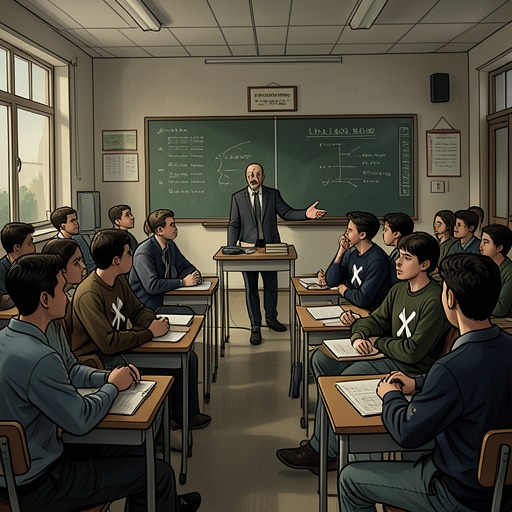
The school was founded in 1521, the year Martin Luther stood before Charles V, Holy Roman Emperor and king of Spain. Hans remembers it as Württemberg’s most famous grammar school, a distinction that locates it within a long educational and civic tradition. His account gives the building a more immediate identity through its classrooms: heavy benches and tables, grey walls, and winter clothing gathered in the room. These details make the school not simply a name on a map but the everyday setting in which a decisive friendship begins.
Hans first sees Konradin in February 1932, at three o’clock in the afternoon, two days after his sixteenth birthday. The grey winter day and the classroom’s familiar arrangement frame an encounter that acquires its significance in retrospect. Hans remembers the moment with unusual precision, while many of the schoolmates in the room later die in distant theatres of war. From the start, then, the school is both a place of youthful life and a setting through which the older narrator measures the losses that followed.
The remembered classroom also contains an account of the boys’ conduct toward Herr Zimmermann, their tired and gentle teacher. They despise his poverty and appearance and sometimes treat him with cruelty. Hans’s recollection acknowledges this behavior as a familiar form of bullying by healthy boys toward someone vulnerable. The school’s traditions and learning do not prevent its pupils from reproducing contempt in their ordinary relations; that contrast complicates any simple picture of the institution as a refuge from the world outside.
Humanist Tradition and War Memory
For much of Hans’s school life, the Karl Alexander Gymnasium appears insulated from contemporary politics and technology. When he returns after spending the summer holidays in Switzerland with his parents, he recognizes that this separation is ending. Until then, he had understood the school as a temple of the humanities, where Homer and Horace, Euripides and Virgil carried more authority than inventors or temporary rulers. The classical curriculum provided its own language for interpreting history and civic duty.
The school had already lost more than a hundred boys in the First World War. Within its established outlook, their deaths were understood through ancient examples: the Spartans at Thermopylae and the Romans at Cannae. Falling for one’s country could therefore be treated as a continuation of an honored tradition. This framework makes the later history of the school especially charged. The classical ideal had given loss a familiar meaning, but the wars that followed would bring destruction on a scale that reached beyond the school’s walls and its inherited comparisons.
Antisemitism and Hans’s Isolation
The change in the school’s atmosphere becomes visible in a classroom discussion Hans hears through a closed door. The words he can make out concern Jews; when he enters, the discussion stops. Several boys look at him, and two remain conspicuously confrontational: Bollacher grins, while Schulz holds his nose and stares. Hans considers whether he could fight Schulz, but decides that doing so would not undo the poison already spreading through the school. His choice marks a change in what the setting permits: an ordinary school dispute has become part of a wider hostility directed at him as a Jew.
Konradin is present in the classroom, apparently occupied with his work and not acknowledging what is happening. Later, after the others have left, Hans waits in the hope that Konradin will also be there to help or console him. He finds the street empty. Hans then avoids Konradin, believing that his absence from the friendship will spare his friend embarrassment and that Konradin may be grateful for the decision. At school, hardly anyone speaks to Hans; even a former classmate who used to challenge him to demonstrate his strength stops doing so. The institution that had witnessed the beginning of the friendship becomes the setting of Hans’s growing solitude.
That isolation forms part of the circumstances behind his parents’ decision to send him to America. His father tells him that school has evidently not been easy and that university in Germany would be harder. The family hopes the separation will be temporary, but the departure takes Hans away from the school and the country with which he had identified. In his later account, the school’s political change is not an abstract development: it is registered in the classroom’s changed behavior and in the friendships Hans can no longer rely on.
Destruction and Retrospective Return
More than a decade later, Hans asks a man from Württemberg what became of Stuttgart. The answer is that three-quarters of the city was destroyed. When Hans asks specifically about the Karl Alexander Gymnasium, he is told that it is rubble. Palais Hohenfels has also been reduced to rubble. The school’s physical disappearance joins the loss of the earlier social world: the buildings that held the friendship and its rupture no longer stand, but their absence cannot erase Hans’s memories of them.
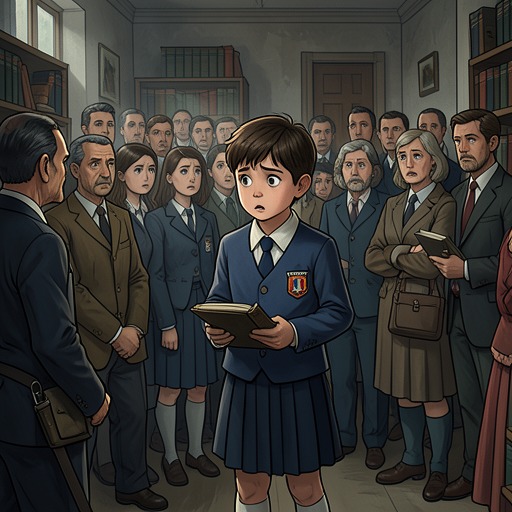
A later appeal from the Karl Alexander Gymnasium asks Hans to contribute to a war memorial for pupils killed in the Second World War. It arrives with a small book of names. Hans’s first impulse is to discard the request, since he feels he has severed himself from the school and its community. He has cut seventeen years out of his life, as he puts it in his recollection, and resents being asked to contribute to deaths he considers unrelated to him. Yet he reads the appeal and learns that four hundred boys were killed or missing. Going through the alphabetical list, he avoids the letter H. The gesture registers his unresolved proximity to the school: he rejects its claim on him, but the names still bring the past close enough to require a response.
The Karl Alexander Gymnasium thus carries several histories at once: an old humanist education, a remembered culture of cruelty, the arrival of antisemitic hostility, and the wartime deaths and destruction that later reshape Hans’s relation to home. Its ruins do not provide a clean ending. The memorial list reopens what exile had seemed to cut off, leaving Hans both connected to the school’s history and resistant to being counted again among its people.