Palais Hohenfels
ReunionPalais Hohenfels is the family home that Hans Schwarz approaches repeatedly before he is invited inside by Konradin von Hohenfels. Its gate makes their social distance physical: Hans can accompany Konradin to the entrance, but for a time he must remain outside. The palace therefore becomes more than a setting for their friendship. It is the place where Hans’s longing for inclusion gathers, and where the contrast between an imagined world of inherited grandeur and the ruin left by war eventually comes into view.
The Gate and the Boundary
At the end of visits, Hans and Konradin stop at the iron grille of Palais Hohenfels. Two griffons above it carry the family armorial shield. Konradin says goodbye, opens the heavy gate, and walks along a path bordered by oleanders toward the portico and main entrance. The door opens for him, then closes behind him; Hans remains on the other side. The repeated routine gives an ordinary parting the shape of a separation. Hans can see the way in, but cannot yet follow his friend across the threshold.
The gate and griffons acquire force through Hans’s attention to them. He imagines the figures as hostile guardians and experiences the house as a stronghold. His wait outside is not merely a pause before the next meeting: each time, the building seems to confirm that a part of Konradin’s life is closed to him. The grandeur of the entrance magnifies a private uncertainty into a visible boundary between the boys’ circumstances.
An Imagined Interior
Because no invitation comes for days and weeks, the unseen rooms become increasingly important to Hans. He cannot understand why Konradin, whom he regards as considerate and careful not to hurt him, has not asked him in. Too proud to ask directly, Hans grows worried and suspicious, and his desire to enter the house intensifies. The palace’s importance thus arises partly from what remains unknown: its closed doors invite Hans to fill the blank with his own hopes.
His imagination furnishes the interior with objects associated with a grand and distant past: banners, crusader swords, suits of armour, and lamps said to have come from Isfahan and Tehran, as well as brocades from Samarkand and Byzantium. These are Hans’s imagined treasures, not things he has seen. Their variety shows how the inaccessible building becomes a screen for his expectations. The actual obstacle is a missing invitation, but in his mind it takes on the scale of a fortified world whose possessions and history are withheld from him.
The Invitation and the House Within
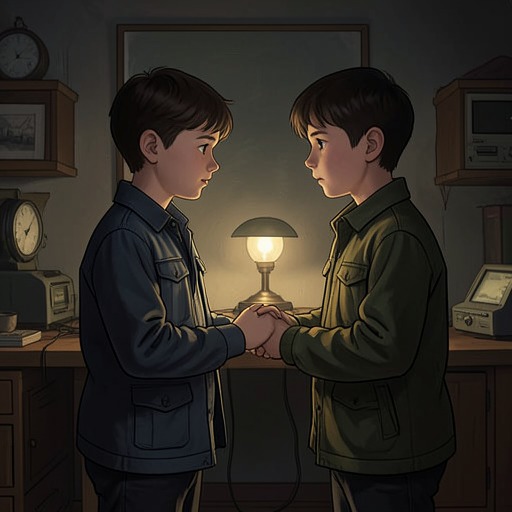
One day, as Hans is about to leave, Konradin turns back and invites him in, saying that he has not seen his room. The gates that have marked so many departures open at last. The change is abrupt enough to unsettle Hans: the invitation fulfils a long-held wish before he has prepared himself for meeting Konradin’s parents. He worries about his unpolished shoes and possibly dirty collar, and follows his friend in a state of nervousness. Crossing the threshold resolves the immediate exclusion, but also exposes Hans to the social world he had been imagining.
The entry hall is large and its walls display hunting trophies, including antlers, a European bison’s head, and an elephant’s tusks. A servant comes to announce that coffee has been served and addresses Konradin as a count. Konradin leads Hans up a dark oak staircase. On the first floor Hans glimpses closed doors, oak-panelled walls, hunting pictures, a portrait of the late king, and a castle view. They continue to the second floor, past pictures depicting Luther before Charles V, the Crusaders entering Jerusalem, and Barbarossa asleep in the Kyffhäuser mountain. The sequence of rooms makes the palace’s inherited status legible through its furnishings and images; it also replaces Hans’s imagined inventory with particular things he can actually see.
An open door offers a brief glimpse into a woman’s bedroom, where a dressing table holds scent bottles and tortoiseshell brushes inlaid with silver. Among photographs in silver frames, Hans notices one that resembles Adolf Hitler. The resemblance shocks him, though he immediately thinks he must be mistaken: he cannot reconcile such a photograph with his idea of a Hohenfels household. The moment is a small but unsettling interruption in his first tour. The palace is no longer only the romantic stronghold of his imagination; one detail has introduced an association he does not know how to interpret.
Ruin and Retrospective Meaning
Years later, when Hans asks what became of Palais Hohenfels, the answer is that it is rubble. The concise reply overturns the permanence suggested by the heavy gate, family shield, historic pictures, and accumulated objects. What had seemed to Hans like a sealed inheritance, almost too substantial to approach, has not survived intact. The contrast is especially sharp because the childhood house once appeared to him to hold the key to his friendship and to a world beyond his own.
Hans laughs after hearing that both the Karl Alexander Gymnasium and Palais Hohenfels have been reduced to rubble. The exchange supplies no explanation for his laughter, and it should not be reduced to a single stated emotion. Its place at the end of the palace’s story nevertheless makes the contrast plain: the building that once concentrated his longing to enter has vanished. In retrospect, its threshold marks both the beginning of access to Konradin’s private world and the distance between the boys’ remembered life and the destroyed city to which that world belonged.