Stuttgart
ReunionStuttgart is the setting of Hans Schwarz’s school years and of his first meeting with Konradin von Hohenfels, but it also becomes a measure of what history destroys. Hans recalls the city as a prosperous, self-assured place shaped by its landscape and cultural life; years later, from exile, he learns that most of it has been destroyed and that his school is rubble. The contrast gives Stuttgart a double presence: the lived city of memory and the damaged city encountered through a brief report.
Setting and Civic Character
Hans’s parents live in a modest local-stone villa in the Höhenlage, an elevated neighborhood of prosperous and wealthy residents. The house stands in a small garden planted with cherry and apple trees. Stuttgart itself occupies a narrow valley surrounded by hills and vineyards; level streets are scarce, and many roads climb away from the Königstrasse, the city’s main street. From the heights, the view takes in villas, the old and new Schloss, the Stiftskirche, the Opera, museums, and former royal parks. The Neckar River winds through a landscape of cliffs, castles, poplars, vineyards, and old towns.
The account presents Stuttgart not simply as scenery but as a place with a strong sense of its own distinction. Its residents’ local pride is reflected in streets named for writers, philosophers, and other figures associated with Württemberg. Hans describes a city of fewer than half a million people whose opera, theatre, museums, collections, and public life could, in his judgment, compare favorably with those of much larger European cities. Though no longer a royal capital, Stuttgart remains surrounded by prosperous towns, castles, and landmarks, with the Black Forest and Lake Constance within the wider region.
That civic life has a sensory and social dimension in Hans’s recollection. Summer evenings bring people to hillside restaurants with broad terraces, where they eat substantial meals, drink Neckar or Rhine wine, and look out toward the forests and river. At night, the hillsides are marked by thousands of lights, while voices, singing, and laughter carry through the warm air. The scene conveys comfort and abundance, but also a settled communal confidence: the city’s inhabitants appear at home in a landscape and culture they regard as exceptional.
The City as a Place of Memory
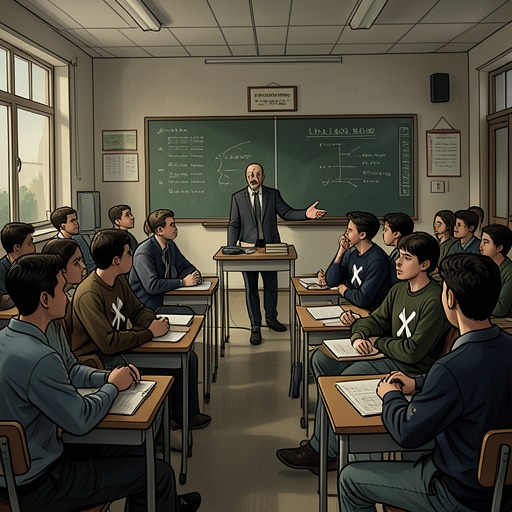
Stuttgart is where Hans first sees Konradin, on a grey winter afternoon in February 1932, two days after his sixteenth birthday. The meeting takes place at the Karl Alexander Gymnasium, which Hans identifies as Württemberg’s most famous grammar school and dates to 1521. The remembered classroom is sharply specific: heavy benches and tables, damp winter coats, melted snow, and pale marks on the walls where portraits of Kaiser Wilhelm and the King of Württemberg had hung before the revolution. Even the room’s details preserve layers of the city’s past, making the school a place where political change remains visible in ordinary surroundings.
Hans’s memory of the school is not only architectural. He remembers the boys seated before him, some of whom would later die on the Russian steppes or in the sands of Alamein, and Herr Zimmermann, their tired, gentle teacher. The recollection links Stuttgart’s prewar schoolroom to the distant battlefields on which many of its pupils would perish. The classroom is therefore both a precise setting for a formative encounter and a point from which the narrator looks back on lives cut short by war.
A Changed Atmosphere
In Hans’s account, the school’s social climate changes as antisemitic ideas gain force. Before that shift, he had encountered ordinary friction among boys but says he had not faced religious or racial intolerance there. After a teacher’s visit alters the atmosphere, Hans hears a heated discussion through the closed classroom door; the repeated subject of the argument is Jews. When he enters, the conversation stops, and several boys stare at him as if seeing him anew. Bollacher grins at him, while Schulz holds his nose and stares provocatively.
Hans considers whether he could knock Schulz down, but decides that doing so would not address what has already spread through the school. He goes to his place and pretends to examine his homework, as Konradin also appears to ignore what is happening. Stuttgart’s school thus becomes more than the backdrop to Hans’s friendship: it is where a formerly ordinary school environment is overtaken by an open racial hostility that changes how classmates look at him and how he understands his place among them.
Destruction and the Afterlife of Place
Years later, Hans encounters Stuttgart through a conversation with a man from Württemberg. He asks what has happened to the city and learns that three-quarters of it has been destroyed. He then asks specifically about the Karl Alexander Gymnasium. The answer is a single word: rubble. The exchange gives the city’s destruction a personal scale. The loss is not only of streets and buildings but of the schoolroom that held the memory of Hans’s first encounter with Konradin and the beginning of a relationship that remained central to his life.
The report is brief, but its brevity sharpens the difference between the remembered city and its later condition. Earlier, Stuttgart appears through an expansive inventory of hills, landmarks, food, public culture, and evening life. In the postwar exchange, the city is reduced to a fraction and the school to debris. The contrast does not erase the earlier setting; rather, it leaves its particulars intact as things that can no longer be assumed to exist.
Stuttgart also remains entangled with Hans’s exile. He says that speaking German to Germans is an effort he pretends to make, although he can still speak the language, and that reminders of Germany reopen wounds that have not healed. His question about Stuttgart therefore joins geographic loss to personal estrangement. The city endures in detailed recollection, while the ruined school and Hans’s protective distance from German speech mark how far memory is from return.