Nazism
ReunionNazism is the political force that turns the apparent security of Hans Schwarz’s German-Jewish life into a fragile illusion. In the account, its advance is measured not only by public unrest but by changes within a classroom, by a friend’s political conversion, and by the choices a family makes under pressure. The decisive contradiction is that Hans and his parents regard Germany as home, while the movement’s antisemitism increasingly treats Jewish belonging as incompatible with German identity.
An initially distant political storm
At first, political upheaval seems remote from the boys’ lives in Stuttgart. Reports of clashes between Nazis and Communists come from Berlin, while the city appears quiet and reasonable. There are warning signs: swastikas appear on walls, a Jewish citizen is molested, and Communists are beaten. Yet daily routines continue in the restaurants, opera, and cafés; the weather is hot, the vineyards bear grapes, and families discuss summer travel. The contrast makes the threat legible through its coexistence with ordinary life. Politics seems to belong to adults and distant places, while Hans and Konradin von Hohenfels occupy themselves with friendship and questions about how to live.
That sense of separation is not simply ignorance of events. It rests on a settled faith that the political storm is temporary and that German society will recover its usual character. Hans’s father sees the Nazis as a passing illness rather than a permanent transformation. His confidence reflects a deep attachment to German culture and civic life, and helps explain why the family initially stays rather than anticipating the scale of what is coming.
Belonging under pressure
Hans’s understanding of home is rooted in family history and everyday identity. The Schwarzes have lived in Stuttgart for at least two hundred years, and Hans thinks of himself first as Swabian, then German, and then Jewish. His parents do not deny their Jewish ancestry, but religious observance occupies a limited place in their lives: his mother attends synagogue on Yom Kippur, while his father avoids smoking and travel that day out of consideration for others rather than religious conviction.
His father’s argument with a Zionist makes the depth of his German identification explicit. He rejects the idea that Jews should claim Palestine after two thousand years and insists that his own home is Germany. Even when confronted with the rise of Adolf Hitler, he trusts the country associated with Goethe, Schiller, Kant, and Beethoven to resist the movement. He invokes the twelve thousand Jews who died for Germany, and takes pride in being an assimilated German Jew. In his view, Jewish participation in German culture can enrich it; it does not make Jews foreigners to it.
That confidence has visible supports. Hans’s father is a respected doctor, honored by eminent townspeople and publicly celebrated by Gentile neighbors. His Iron Cross, First Class, and officer’s sword stand as reminders of his service in the First World War. He believes such a record, and the esteem of his fellow citizens, should secure his place in the country. The story’s later events reveal how little protection these signs of belonging offer when political identity is recast as racial exclusion.
Ideology enters the school
As the political atmosphere worsens, its messages become harder to keep outside the school. Blood-red posters denounce Versailles and Jews; swastikas and Communist symbols cover walls, and processions of unemployed people march through town. Inside the school, historical teaching initially remains focused on earlier periods, so the boys have little formal instruction about contemporary events. Their sheltered education cannot keep contemporary politics at the door.
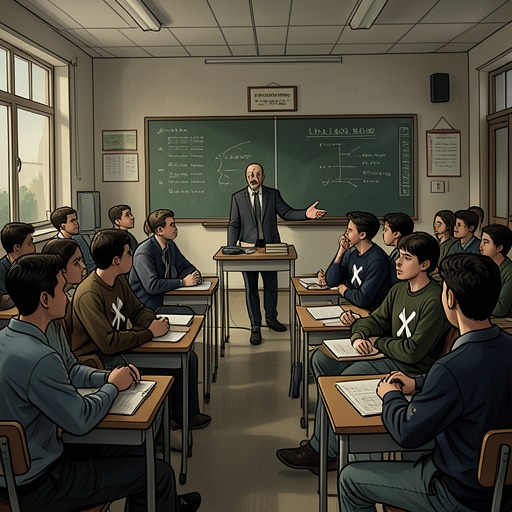
A new history master, Herr Pompetzki, changes the atmosphere by presenting history as a struggle against unnamed “dark powers” that supposedly undermine national heritage and morality. Though he avoids naming the group he means, the students understand the antisemitic implication. Some reject his account by pointing to civilizations and cultures it ignores; others accept parts of it. The lesson gives a conspiratorial political explanation authority within the classroom, even as the argument exposes its omissions.
Soon Hans hears boys repeatedly discussing Jews behind a closed classroom door. When he enters, the conversation stops. Bollacher grins at him, while Schulz stares provocatively and holds his nose. Hans considers whether he could fight Schulz but decides that doing so would not undo the poison already affecting the school. His restraint marks a change in the social world around him: hostility that had not previously been directed at him is now organized around his Jewish identity.
When Bollacher tells Hans to go back to Palestine, Pompetzki refuses to recognize the remark as an insult and presents it as friendly advice. He tells the boys that their problems will soon be solved, aligning the classroom’s authority with the exclusionary politics already gathering outside it. Hans waits after school, still hoping Konradin will offer help or comfort, but finds the street empty. He then avoids his friend, believing that being seen together would embarrass Konradin. Isolation spreads beyond the confrontation itself: classmates and teachers withdraw, and even a boy who had challenged him physically now wears a small silver swastika.
Political choice and its consequences
Konradin’s letter before Hans’s departure reveals that the political rupture has entered their friendship, too. He says that he believes in Adolf Hitler and presents him as Germany’s hope against materialism and Bolshevism. After meeting Hitler in Munich with his mother, Konradin describes being impressed by his conviction and intensity. He acknowledges that the Germany he imagines will have no place for Hans for a time, but expects that Hans might return later and assumes his parents can remain safely in the country.
The letter makes clear how far apart the two boys’ expectations have become. Hans’s father believes the crisis will pass and chooses to stay in his homeland; Konradin accepts a new political order while imagining that it can distinguish between Jewish people it considers acceptable and undesirable. His confidence in that distinction sits uneasily beside Hans’s experience of being told to leave. What the letter promises as temporary exclusion is already determining Hans’s future.
In December, Hans’s parents decide to send him to relatives in New York, where he can continue his education. They tell him they intend to stay in Germany, which they still regard as their Fatherland and home. Hans leaves school at Christmas and departs for the United States on his birthday, January 19. The separation is thus both a family decision made to protect him and an early consequence of a country in which his identity has become a liability.
Retrospective meaning
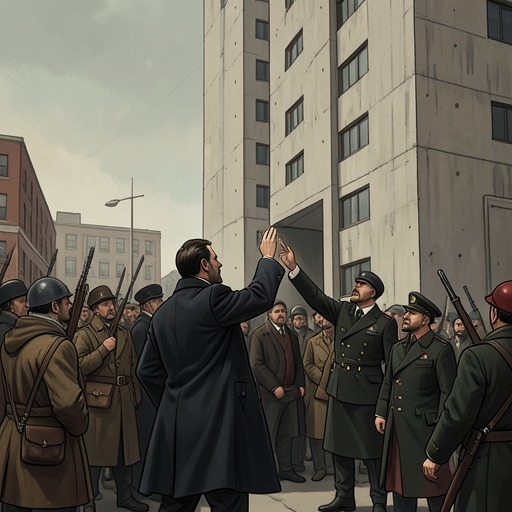
The later account overturns the assurances voiced when the danger first appeared. Hans’s parents do not end up in a concentration camp, but they die by suicide after the regime’s public campaign against Jews reaches his father’s medical practice. A Nazi is posted outside the surgery with an antisemitic notice. Hans’s father responds by standing beside him in his officer’s uniform and decorations, including the Iron Cross, First Class. A crowd gathers; its hostility is directed at the Nazi, who leaves and is not replaced. A few days later, Hans’s father turns on the gas while his wife is asleep, and both die.
The incident briefly recalls the public respect his father once enjoyed, but it cannot restore the safety that respect was supposed to guarantee. His resistance is a solitary assertion of dignity, and its immediate public effect does not reverse the family’s larger predicament. From America, Hans tries to forget Germany: after his parents’ deaths he avoids meeting Germans and stops opening German books, even Hölderlin. The movement’s consequence therefore extends beyond expulsion and death to a break with the language and culture Hans had once understood as his own.
Nazism’s narrative force lies in this gradual reversal. At first it appears to be a distant disturbance beside vineyards, holidays, and friendship; then it speaks through posters, historical instruction, schoolyard contempt, and the assumptions in a friend’s letter. The story sets that political transformation against the Schwarzes’ long-standing belief that they belong in Germany. Their faith is not presented as a lack of attachment but as its deepest expression. The catastrophe comes when political power turns that attachment into no guarantee at all.