The Problem of Evil and Crisis of Faith
ReunionThe Problem of Evil and Crisis of Faith is the rupture in Hans Schwarz’s inherited confidence that a benevolent God governs the world. The deaths of three children in a neighboring house fire make suffering intimate rather than statistical, and force Hans and Konradin von Hohenfels to confront whether any religious explanation can reconcile catastrophe with divine goodness and power. Their argument ends without agreement, but it changes the questions that organize Hans’s thought: from whether life has a providential meaning to how a person should spend a life that may have none.
Religious Background and Childhood Belief
Before the fire, Hans’s religious outlook was open-ended but not anguished. His father left him free to believe as he wished. Though his father accepted that the historical Jesus had been a wise Jewish teacher, he rejected the idea of Jesus as the Son of God and found it repellent that an omnipotent divine Father would allow his son to suffer. Hans understood his father’s position as agnostic rather than atheist; his father likely would not have objected to his becoming Christian or Buddhist, though he would have opposed a monastic life as irrational and wasteful.
Hans’s mother embodied a different kind of religious looseness. She went to synagogue on Yom Kippur, sang a Christmas carol, donated to Jewish aid for children in Poland, and also gave money to Christians seeking converts among Jews. She had taught Hans simple prayers as a child, but neither parent appeared to depend on religion. In that household, he grew up among Jews and Christians without being pressed toward a single creed. He neither believed deeply nor seriously doubted that a benevolent intelligence presided over the world, which he imagined as a special home for humanity and for Jews and Gentiles alike.
The Fire and the Particularity of Loss
The event that shattered this quiet assumption was a fire at the wooden home of the Schwarz family’s neighbors, Mr and Mrs Bauer. Their three children were four, seven, and twelve. Hans had not known them well, but he remembered seeing them play with their parents in the garden. One image endured: their father pushing a little girl higher on a swing, her white dress and reddish hair moving among the apple-tree leaves.
The parents were out one night and the maid had gone on an errand when the house caught fire. The flames spread so quickly that the children died before the fire engines could arrive. Hans did not witness the blaze or hear the screams; the next day he saw its aftermath: blackened walls, burnt dolls, and the swing’s charred ropes hanging from a shriveled tree. Those remnants made the loss immediate. He had already read about mass deaths in floods, volcanic eruptions, and war, but such figures remained abstractions. These were children he had seen, and the question of what they or their parents had done to deserve their fate became impossible to set aside.
The Dispute over God and Evil
Hans drew a stark conclusion: either no God existed, or a powerful God was monstrous and a powerless one futile. He abandoned belief in a benevolent master-mind. The argument was not abstract for him; it was anchored in the burning children, whose suffering he believed no doctrine could excuse.
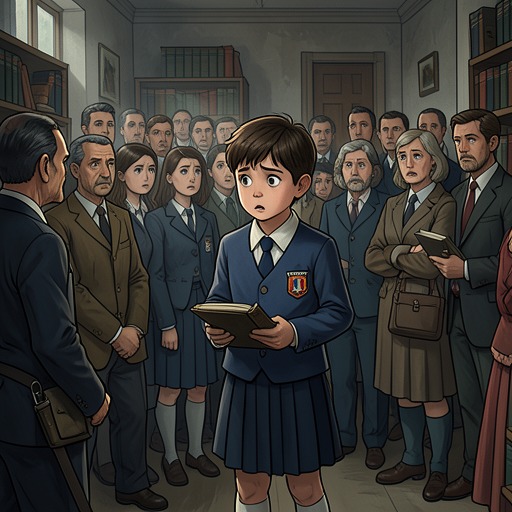
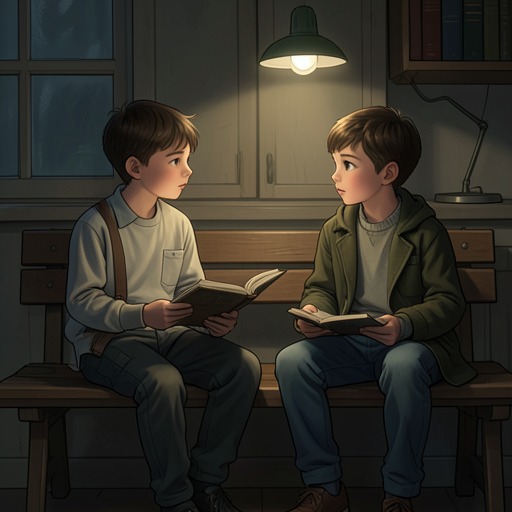
He argued passionately with Konradin, who had been raised in a strict Protestant faith. Konradin agreed that the fire was terrible and admitted he could not explain it, but maintained that an answer might exist beyond the understanding of two schoolboys. He appealed to the accumulated thought of priests, bishops, and saints, and urged humility before their greater wisdom. Hans rejected that appeal, insisting that inherited authority could not make the children’s deaths acceptable. His challenge to Konradin was grounded in the victims’ imagined suffering and in his refusal to treat a powerless or pitiless deity as an adequate answer to disease, famine, and war.
Konradin consulted his pastor and returned reassured. He reported that Hans’s objections had been dismissed as the immature outpouring of an untrained schoolboy and that the pastor had answered the questions satisfactorily. Yet Konradin could not make that answer clear to Hans. He spoke of evil as necessary for people to appreciate good, as ugliness was necessary to perceive beauty. The explanation offered a relation between opposites, but did not explain why the children had to suffer. Their discussions reached a deadlock: Konradin retained trust in a possible religious answer, while Hans judged the proposed explanation insufficient to meet the particular fact of the fire.
Cosmic Scale and a Changed Question
At the same time, Hans was reading about light-years, nebulae, galaxies, and stars vastly larger than the sun. The astronomical scale made Earth seem like one pebble among countless others and human beings like particles of dust. Rather than softening the shock of the fire, this vision reinforced his doubt that a deity could take an interest in human suffering across so many celestial bodies. The catastrophe and the new cosmic perspective worked together: one made evil painfully concrete, the other made humanity seem cosmically small.
That combination first brought complete despair, then intense curiosity. Hans’s central problem shifted from what life was to what one should do with a life that seemed valueless yet somehow uniquely valuable: whether to live for oneself or for humanity, and how to make the best of a bad situation. He and Konradin returned to these questions almost daily as they walked the streets of Stuttgart and looked toward Betelgeuse and Aldebaran. The stars’ immense distance sharpened rather than settled the debate. The crisis therefore produces no recovered faith or final theodicy; it leaves Hans with a demanding practical question about how to live without relying on a benevolent cosmic guarantee.