German-Jewish Assimilation and Heimat
ReunionGerman-Jewish assimilation and Heimat describe the tension between belonging to Germany as home and being identified as Jewish in a society increasingly shaped by antisemitism. Through the Schwarz family, the narrative presents patriotism not as a pose but as an intimate conviction, built from generations in Stuttgart, everyday cultural attachments, and faith in Germany’s civic and moral traditions. The crisis comes when those ties, which Hans Schwarz’s father believes should secure their place, fail to protect his son from exclusion.
A Home Made Familiar
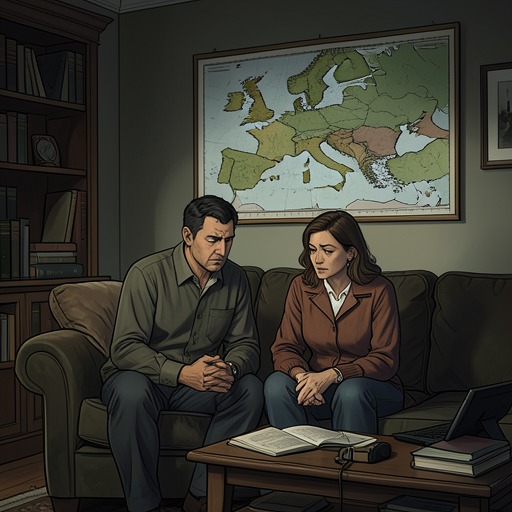
Hans Schwarz remembers his family’s home as a world that seemed secure and permanent. The Schwarzes had lived in Stuttgart for at least two hundred years, although the absence of records left their earlier origins uncertain. He could not trace the family to the remote German past associated with Barbarossa, nor establish whether its ancestors had come from eastern Europe or the Iberian Peninsula. At the time, such questions seemed beside the point: Stuttgart was home, and the family’s belonging felt as though it had neither beginning nor end.
That attachment did not require Hans Schwarz to deny Jewish descent. Instead, his childhood understanding ordered identity by locality and nation first: the family was Swabian, then German, and then Jewish. Jewish observance played a limited role in the household. His mother attended synagogue once a year on Yom Kippur, while his father refrained from smoking and travelling that day out of consideration for other people’s feelings, rather than religious belief. The distinction matters: assimilation here is not the erasure of ancestry, but the conviction that ancestry need not outweigh a settled German identity.
For Hans Schwarz’s father, that conviction was reinforced by the family’s place in Stuttgart and by his own public standing. He was a respected doctor among Jews and Gentiles. On his forty-fifth birthday, a delegation led by the mayor visited him; a newspaper printed his portrait, and Gentile residents serenaded him. His Iron Cross, First Class, hung above his bed beside his officer’s sword and a picture of the Goethe-Haus in Weimar. These signs of recognition and national culture formed a private assurance that the family belonged within Germany, not at its margins.
Assimilation and Its Limits
A dispute with a Zionist brought the father’s understanding of belonging into explicit political focus. He rejected the claim that Jews should reclaim Palestine after two thousand years, comparing it to Italy claiming Germany on the grounds of the Roman occupation. He feared that such a claim would lead to prolonged conflict with the Arab world and insisted that his own connection was to Stuttgart, not Jerusalem. His objection was not presented as a rejection of Jewish ancestry; it arose from his belief that Germany was already his country.
When challenged over the rise of Adolf Hitler, the father remained confident that German society would recover once economic conditions improved. He invoked the nation’s cultural inheritance and the memory of twelve thousand Jews who had died for Germany. Describing himself as an assimilant, he wanted Jews to be identified with Germany. Yet his position was not simply a demand that Jewish difference disappear: he also believed that Jews who did not wholly integrate could enrich German culture. Assimilation, in his account, combined national identification with a continuing, if limited, distinctiveness.
The father’s confidence rested partly on a sense that history and civic esteem would outweigh political agitation. He had served in the First World War and regarded himself as ready to defend Germany again. Nazism appeared to him a temporary sickness in an otherwise healthy country, something that could be overcome rather than a transformation of the society to which he belonged. His military service, professional reputation, and the public honors he had received made his confidence understandable within the family’s experience, even as they could not guarantee safety.
The Boundary of Belonging
The limits of this ideal are exposed in Hans Schwarz’s friendship with Konradin von Hohenfels. Konradin von Hohenfels explained that his mother, from a formerly royal Polish family, hated Jews and regarded them as socially beneath her. She saw her son’s friendship with Hans Schwarz as a stain on the Hohenfels family’s standing and believed Hans Schwarz had undermined his religious faith. Konradin von Hohenfels insisted that his own avoidance of introducing Hans Schwarz to his parents did not mean he was ashamed of his friend; rather, he had struggled to preserve time with him against his mother’s hostility. Their friendship crossed a boundary that the family’s social world continued to enforce.
The same boundary becomes public at school. After a teacher’s theories had altered the atmosphere, Hans Schwarz heard a heated classroom discussion in which references to Jews recurred. When he entered, some boys stopped speaking, while others stared at him and displayed contempt. Later, when Bollacher told him to go back to Palestine, the teacher treated the remark as friendly advice rather than an insult, then redirected the class to its history lesson. The exchange shows how exclusion could pass from open hostility into the language of ordinary instruction: Hans Schwarz’s own sense of himself as a German did not control how others classified him.
Exile and the Recasting of Heimat
At the beginning of December, Hans Schwarz’s father told him that his parents had decided to send him to America for the time being. Relatives in New York would look after him and help him continue his education. His father believed that the political storm would pass and that Germans would soon come to their senses. He and Hans Schwarz’s mother intended to stay, maintaining that Germany was their Fatherland and home. The decision therefore divided the family’s immediate futures without dissolving the parents’ attachment to the country.
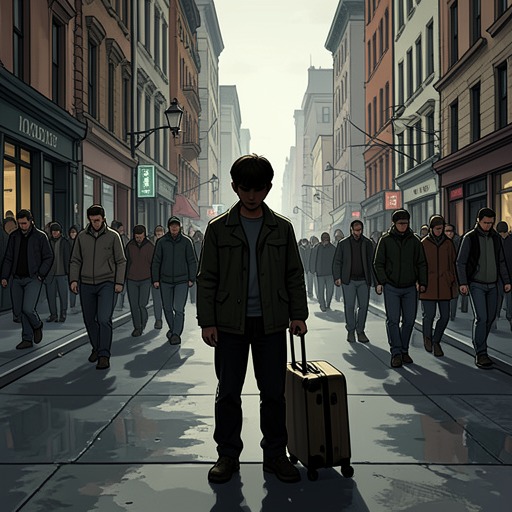
Hans Schwarz left school at Christmas and departed for America on January 19, his birthday. Two days earlier, he had received a letter from Konradin von Hohenfels that made their different readings of Germany unmistakable. Konradin von Hohenfels believed in Adolf Hitler, whom he considered capable of restoring Germany, and imagined that Hans Schwarz might eventually return when the country again had room for people like him. He also assured Hans Schwarz that his parents would remain safe and could live and die in peace. Those assurances echoed the father’s confidence that belonging and security would endure, but they came from someone who had accepted a political order that excluded Hans Schwarz for being Jewish.
The contrast gives Heimat its painful force in the narrative. For the Schwarz family, Germany is neither an abstract political claim nor a place they have casually chosen: it is the home formed by family history, civic participation, cultural memory, and habitual life in Stuttgart. Yet national attachment cannot compel society to recognize that belonging. Hans Schwarz’s departure turns the gap between self-identification and imposed exclusion into a lived separation, while his parents’ decision to remain preserves, for a time, their belief that Germany is still their home.