A bargain for the firstborn child
RumplestiltskinA bargain for the firstborn child is the story’s decisive escalation from exchanges of personal property to a claim on the queen’s future family. The miller’s daughter accepts it when she has nothing left to give the dwarf for spinning the king’s final heap of straw into gold; after she becomes queen and gives birth, the promise returns as a threat to her baby. Her appeal wins three days to discover the dwarf’s name, and naming him releases the child from the bargain.
From payment to promise
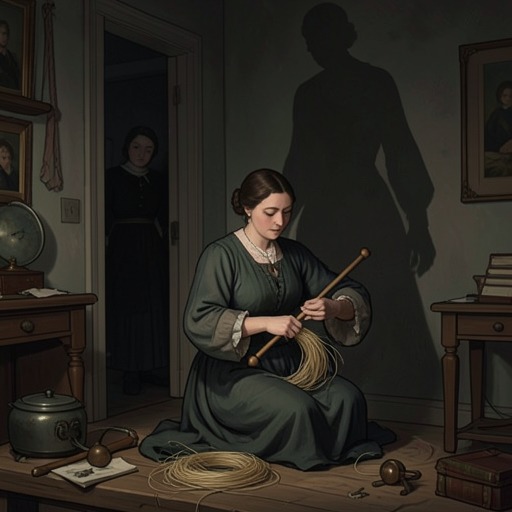
The bargain emerges from a sequence in which the miller’s daughter is repeatedly compelled to meet the king’s demands. Her father has boasted that she can spin gold from straw, and the king, driven by his love of money, confines her in a chamber with a spinning wheel and a heap of straw. She cannot perform the impossible task herself. When the dwarf offers to do the work in exchange for her necklace, she accepts; when the king demands another heap, she gives the ring from her finger. These earlier payments establish a pattern of urgent exchanges, but both are objects she possesses and can hand over at once.
The third demand changes the terms. The king takes her to a still larger heap and says that if she spins it that night, she will become his queen. The dwarf asks what she will pay for his help, and she answers that she has nothing left. He then names a different price: the first little child she may have when she is queen. The promise is for a future person, not a possession available in the chamber, and it is made under pressure: the king’s task must be completed overnight, while the daughter knows no other way to secure the gold.
She agrees despite thinking that the child may never come. That thought does not make the promise harmless; it marks the distance between the immediate crisis and its possible consequence. The dwarf spins the straw, the king finds the gold in the morning, and, having obtained what he wanted, keeps his word and marries her. The bargain thus helps bring about her elevation to queenship even as it places a claim on a child she does not yet have.
The claim comes due
When the queen gives birth to her first child, she is glad and has forgotten both the dwarf and her promise. The bargain has not vanished with the passage of time: one day the dwarf comes into her room while she is sitting with the baby and reminds her of it. The intimate setting makes the earlier, seemingly remote price immediate. The child is now present, and the exchange threatens to separate mother and baby.
The queen offers the dwarf all the wealth of the kingdom if he will let her off, but he refuses. The contrast with the original bargain is stark: wealth had been the measure of the king’s desire, and the queen now offers all of it in an attempt to recover what she had promised. It cannot buy an escape. Her tears, rather than her offer of riches, soften the dwarf; he grants her three days’ grace, on the condition that she tell him his name. If she succeeds within that period, she may keep the child.
The reprieve changes the bargain’s immediate terms without erasing its stakes. The dwarf still holds the child as the price originally agreed upon, but the queen is given a precise countercondition and a limited time to meet it. Her task is no longer to produce gold: she must find information that will let her defeat the claim.
A name as the countercondition
The queen stays awake through the night, thinking of unusual names, and sends messengers across the land to seek more. On the first day, she tries names including Timothy, Ichabod, Benjamin, and Jeremiah; the dwarf rejects each. On the second, she turns to comic names such as Bandy-Legs, Hunchback, and Crook-Shanks, but these also fail. The repeated refusals make clear that a list of familiar or amusing possibilities will not satisfy the condition.
On the third day, a messenger returns after travelling for two days. He reports seeing a hut among the forest trees on a high hill, near the place where the fox and hare bid each other good night. By a fire outside the hut, he saw a dwarf dancing on one leg and singing that Rumpelstiltskin was his name. The decisive information comes not from the queen’s guesses but from the messenger’s account of a scene far from the court: the figure who has demanded the child has disclosed his name while alone at the fire.
Armed with that report, the queen makes the naming challenge public. She sits on her throne and calls her court together to enjoy the encounter; the nurse stands beside her holding the baby, apparently ready for the child to be surrendered. The dwarf arrives chuckling at the prospect of taking the baby home to his hut in the woods and asks the queen to name him. She first offers John and Tom, then Jemmy, before slyly saying Rumpelstiltskin. His startled protest that a witch must have told her confirms that she has found the name that fulfills the condition.
Release and significance
The bargain ends not with payment but with the queen’s successful answer. In a rage, the dwarf drives his right foot so deeply into the floor that he must use both hands to pull it out. He then makes his way off. The nurse laughs, the baby crows, and the court jeers at the dwarf for all the trouble he has taken for nothing. The child remains with the queen, and the threat that began with a promise made over a heap of straw is defeated through the name-giving condition attached to the reprieve.
The exchange’s progression gives the bargain its force: a necklace, then a ring, then a first child. The king’s repeated demands create the circumstances in which the daughter makes each deal, while the dwarf’s assistance converts an impossible royal task into a series of increasingly costly obligations. Yet the final contest also reverses the imbalance. The queen cannot undo the original promise by offering the kingdom’s wealth, but she can satisfy the later condition through knowledge gathered by her messengers. The bargain makes a future child the price of present survival and advancement; its resolution shows that the claim can be escaped only by meeting the dwarf on the terms of the name challenge.