The power of true names
RumplestiltskinThe power of true names is the tale’s decisive countermeasure to a supernatural bargain: when the queen learns and speaks the little man’s actual name, she keeps her child and he departs. Names first appear as a seemingly endless set of guesses; their importance changes when one proves to be more than a label, becoming the knowledge that lets the queen escape an obligation she had accepted under duress.
From Bargain to Naming
The name challenge arises from a chain of coercive demands. The king summons the miller’s daughter after hearing her father boast that she can spin gold from straw. He locks her in a chamber with a heap of straw and a spinning-wheel, demanding gold by morning on pain of death. The little man performs the impossible task in exchange first for her necklace and then, when the king sets a larger task, for her ring. For the third heap, the daughter has nothing left to give; the little man instead asks for the first child she will have as queen. She agrees because she sees no other way to finish the work, and the king marries her after finding the gold.
The bargain is not forgotten merely because its cost is deferred. At the birth of her first child, the queen is glad and has forgotten what she promised. The little man comes into her room as she sits with the baby and reminds her of the agreement. Faced with losing her child, she offers him all the wealth of the kingdom, but he refuses. Her tears soften him enough to grant three days’ grace: if she can tell him his name within that time, she may keep the baby. The name becomes the sole condition that can reverse the bargain’s otherwise overwhelming claim.
The Search and Its Failures
The queen’s response turns the condition into a task of gathering information. She lies awake thinking of every odd name she has heard and sends messengers throughout the land to find others. When the little man comes the next day, she tests names she remembers, including Timothy, Ichabod, Benjamin, and Jeremiah. He rejects each one with the same answer. The search is not successful simply because she can produce many names: an abundance of guesses cannot substitute for the one fact she needs.
On the second day, the queen tries another set, this time comical names such as Bandy-legs, Hunchback, and Crook-shanks. The little gentleman again denies every suggestion. The repeated failure makes the distinction clear: a plausible, unusual, or mocking name has no power by itself. The answer must be his name, not merely a name that sounds strange enough to fit him.
The decisive information comes not from the queen’s own recollection but from a messenger’s report. After travelling for two days without hearing another name, the messenger describes climbing a high hill among the forest trees, where a little hut stood. By a fire in front of it, a funny little dwarf danced on one leg and sang about the feast he would make, the brewing and baking to come, and a stranger who would arrive the next day. In the song, he disclosed that Rumpelstiltskin was his name. The hidden name is therefore obtained through an overheard self-revelation, not discovered by guessing at the queen’s bedside.
The Name Spoken and the Claim Broken
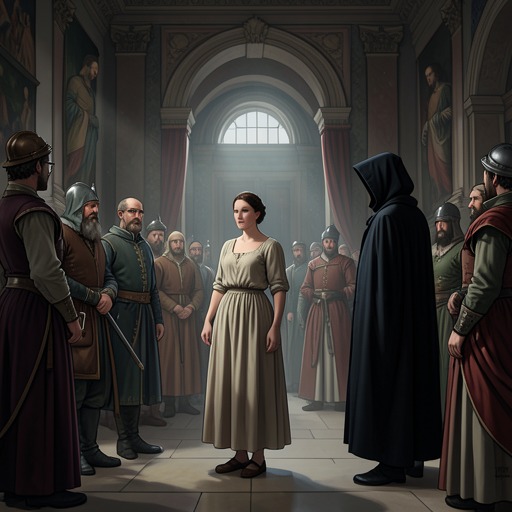
When the queen hears the report, she jumps for joy. She waits for the little man’s next visit seated on her throne, with her court gathered to witness the encounter and the nurse beside her holding the baby, apparently ready to surrender it. The scene places the threatened child in full view: the name contest is not an abstract riddle but the last chance to prevent the little man from taking the queen’s firstborn.
The little man chuckles at the thought of taking the child home to his hut in the woods and asks the queen to tell him his name. She first offers John, then Tom, and then Jemmy; each is rejected. Only then does she slyly say Rumpelstiltskin. His answer—“Some witch told you that!—some witch told you that!”—shows that she has struck upon the concealed fact he believed she would not know. He drives his right foot so deeply into the floor in his rage that he must seize it with both hands to pull it out.
His departure completes the reversal. He makes the best of his way off, while the nurse laughs, the baby crows, and the court jeers at him for having taken so much trouble for nothing. The court’s farewell repeats his name and turns the once-hidden knowledge into public mockery. The immediate consequence is concrete: the child remains with the queen, and the little man leaves without fulfilling his claim.
Meaning and Limits of the Name
The name’s force is established through the plot’s contrast between what the queen initially possesses and what she must learn. Her necklace and ring can buy the first two acts of spinning, but she has no possession left to exchange for the third. She consents to the child bargain only because the king’s demands have left her without an alternative; later, even the wealth of the kingdom cannot persuade the little man to release her. The name condition changes the terms: instead of offering more payment, she must identify the person who holds the claim.
The tale presents the name as effective knowledge, but does not explain a general magical law by which names control their bearers. Its force is shown in this particular contest: the little man sets a deadline, the queen secures information, and speaking the right name defeats his expectation that she will fail. The story thus makes naming both a practical means of recognition and the turning point between threatened loss and rescue. Yet it also gives the little man a distinct reaction rather than presenting the name as a spell mechanically cast: he protests that someone must have told her, rages, struggles to pull his foot from the floor, and departs. The success depends on knowing and voicing what he disclosed in secret, and the ending converts that private disclosure into the court’s shared knowledge.